

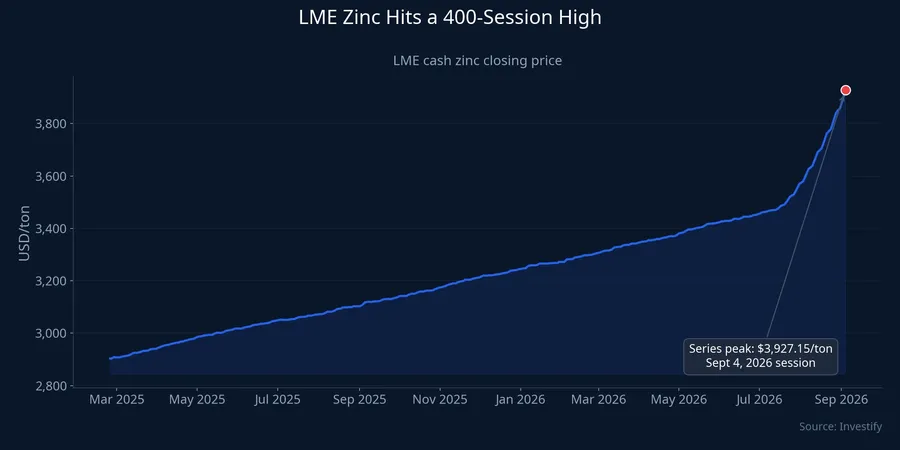
In the latest session, spot zinc on the London Metal Exchange closed at $3,927.15/ton, the highest level since May 2022. That's up 25.5% from $3,130.10/ton at the start of this year, and up 38.3% from $2,839.60/ton on the same day last year.
The instinctive read is a supply crisis. But the zinc industry's own balance sheet tells a different story. The International Lead and Zinc Study Group (ILZSG) forecast back in April 2026 that the refined zinc market would run a deficit of roughly 19,000 tons this year against total demand of about 14 million tons: a gap of less than 0.14%.Mining.com That's the definition of a balanced market, not a market running short.
So the world isn't short of zinc. What's in short supply is zinc sitting in the right place: the warehouses that set the reference price for the rest of the world.
The Metal Moved. It Didn't Disappear.
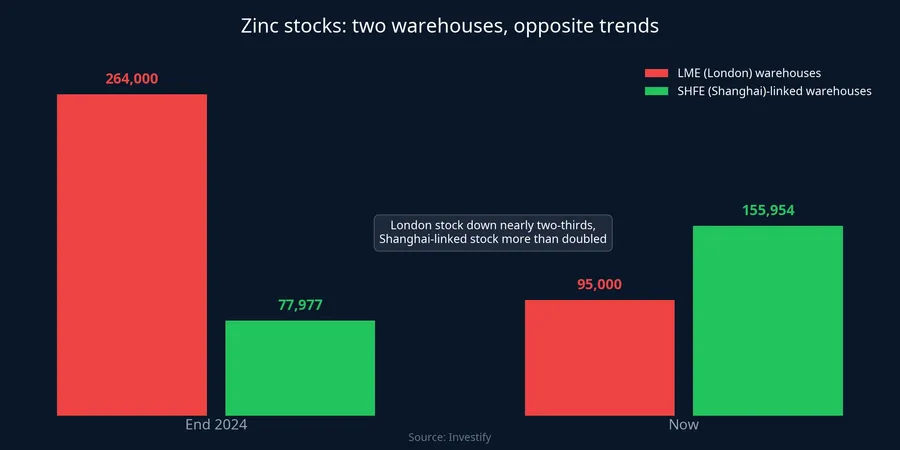
Registered zinc stock in the LME warehouse system now sits at roughly 100,525 tons, and nearly a third of that is cancelled warrants: metal already earmarked for load-out rather than available to trade.Mining Weekly That's down roughly 62% from the 264,000 tons recorded at the end of 2024, pushing usable inventory to a multi-year low.
Over the same stretch, stock in warehouses linked to the Shanghai Futures Exchange (SHFE) reached 155,954 tons as of August 21, 2026, more than double year-earlier levels.Fastmarkets In other words, the zinc that global statistics count as ample still exists. It's just sitting in the East rather than in the Western warehouses that LME futures contracts use for delivery.
The market has reacted exactly as it would to a genuine spot shortage. The premium of cash zinc over the three-month contract — what buyers pay to secure metal right now — briefly topped $230/ton in late August before easing to roughly $139/ton in the first week of September.Mining Weekly That cooling wasn't random: as the SHFE/LME price ratio widened enough to make it worthwhile, Chinese zinc started flowing back toward Western warehouses.Fastmarkets
This isn't the only possible explanation. Global refined zinc output fell 2.6% year-on-year in the first half, as large mines like Antamina in Peru and Red Dog in Alaska worked through lower-grade ore.Mining Weekly Smelter and mine cutbacks genuinely contributed. But if a global supply shortfall were the main driver, inventories at both exchanges would be falling together. Instead one is drained and the other is swelling, which means most of this rally is about where the metal is standing, not how much of it exists.
Which Cost Line Does Zinc Actually Hit for Vietnamese Steel Coaters
Zinc is the anti-corrosion coating applied over base steel, and nothing else substitutes for it in galvanized steel products. Rising zinc prices therefore flow straight into the cost of goods sold at Hoa Sen (HSG) and Nam Kim (NKG). The more useful question is how large that cost line actually is relative to everything else.
According to FPTS, hot-rolled coil (HRC) accounts for more than 68% of Hoa Sen's production cost.VnBusiness Zinc sits in the remainder, alongside electricity, gas, aluminum alloy and labor. Neither company discloses zinc's exact share of cost of goods sold, so any specific figure here is an estimate, not a reported number.
What stands out is that these two cost lines are moving in opposite directions. Just as zinc was hitting its peak, Formosa Ha Tinh cut HRC prices for September 2026 delivery by roughly $8/ton, following Hoa Phat's lead, bringing SAE1006 HRC to about $522/ton delivered in Ho Chi Minh City.DNSE Per ton, zinc now costs roughly 7.5 times as much as base steel. But the coating is only a thin film on the surface, while the steel substrate accounts for nearly all of the material's weight. The net effect: the cost line that's getting cheaper is the one that dominates cost of goods sold.
Where the Two Companies Stand
Both companies' latest quarters were better than the average of the six quarters before them. Hoa Sen, in the third quarter of its 2025-2026 fiscal year, posted net revenue of VND 9,993 billion, gross profit of VND 1,526 billion, and after-tax profit of VND 382 billion, up 39% year-on-year.MekongASEAN That works out to a gross margin of about 15.3%, and after nine months the company had already exceeded its full fiscal-year profit target.
Nam Kim, in the second quarter of 2026, reported net revenue of VND 4,150 billion, gross profit of over VND 437 billion, and after-tax profit attributable to parent shareholders of over VND 104 billion, with gross margin improving to roughly 11%, nearly 4 percentage points higher than the same period last year.Vietstock
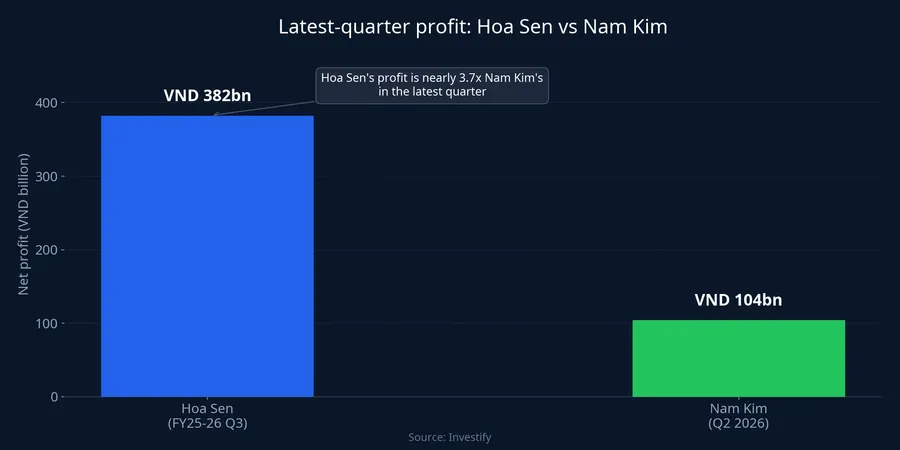
These results need to be read against their timing. Both quarters closed before zinc climbed to its August-September peak. The margin improvement came from higher selling prices and cheaper HRC stockpiled earlier, which means that cushion will thin out as the old inventory gets used up. That's why zinc's peak isn't necessarily bad news for this quarter. It's just not a reason for comfort next quarter, either.
The Bigger Variable Isn't on the Metals Board
The real pressure on Vietnamese galvanized steel exporters in the second half of this year comes from trade barriers, not input costs.
In the US, Vietnamese galvanized steel currently faces anti-dumping duties of up to 162.96%, which drove Q1 2026 galvanized steel exports down 39.8% year-on-year.Dân Việt In Europe, starting July 1, 2026, the annual duty-free quota was cut 47% to 18.3 million tons, while the out-of-quota tariff rose to 50%.VietnamBiz
The most recent development is Australia. The Anti-Dumping Commission opened an investigation into galvanized steel imports from Vietnam on April 30, 2026, following a petition from BlueScope that named Hoa Sen and Nam Kim directly, alleging an initial dumping margin of up to 56.21%.Vietstock Hoa Sen has pushed back, stating that the 56.21% figure was put forward by the petitioner and is not a preliminary or final determination by the investigating authority.CafeF The investigation report is due to be submitted to the responsible minister before October 2, 2026.
A Watch-List for Investors
For anyone holding or tracking HSG and NKG, zinc's record high deserves to be ranked correctly. It's a small cost line getting more expensive, while the largest cost line, HRC, is getting cheaper. Both companies have just shown they can pass part of their costs through to selling prices over the last two quarters.
Three signals will actually decide HSG's and NKG's margins in the quarters ahead, and none of them come from the London exchange. The first is the outcome of Australia's investigation in early October, since Australia is one of the few export doors still open after the US shut and the EU tightened its quota. The second is how quickly the cheap HRC stockpile gets used up: the same buffer that has propped up gross margin for the past two quarters and will keep thinning. The third is whether domestic galvanized steel prices can hold their upward pace as both companies redirect more volume to the home market to offset narrowing export channels.
If LME zinc inventory keeps being replenished from Chinese supply, as the early-September signals suggest, the spot premium will narrow further and cost pressure on galvanizing will ease without any change in global supply and demand. That's the line between a warehouse-location squeeze and a genuine shortage. For HSG and NKG, it isn't the variable that should worry investors most in the quarter ahead.