

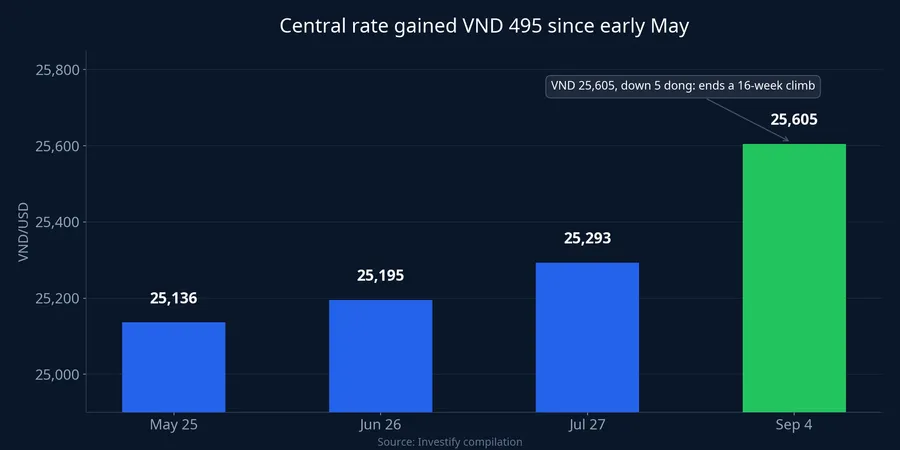
On the morning of September 5, the State Bank of Vietnam (SBV) set the week-closing central reference rate at VND 25,605 per dollar, down 5 dong from the prior week.Nguoi Quan Sat A tiny move on its own, but enough to snap a 16-week winning streak that ran from early May, the longest stretch of consecutive gains for the central rate since the start of 2026.
The big picture here is not a weaker global dollar; last week's data points the other way. The real reversal happened in the domestic money market: VND overnight interbank rates jumped above USD rates for the first time in weeks, and that is the mechanism that actually pulled the exchange rate down.
Four months, one small step at a time
The climb started in late May. On May 25, the central rate stood at VND 25,136, up just 2 dong from the previous session, a move small enough that nobody noticed.Thi Truong Tai Chinh Tien Te Those small steps repeated steadily for four months: by late June the rate hit VND 25,195Thoi Bao Ngan Hang, and by July 27 it reached VND 25,293, the same day commercial banks' USD selling rates broke above VND 26,500, pressing right up against the SBV's regulatory ceiling of VND 26,523.FiLi
That near-zero gap between banks' quoted rate and the regulatory ceiling in late July marked the peak of the pressure. By September 4, Vietcombank's selling rate had eased to VND 26,255, down 5 dong for the week, while BIDV quoted VND 26,285, down 10 dong.Thoi Bao Tai Chinh Viet Nam The same-session reference ceiling had climbed to VND 26,835, meaning the buffer between banks' actual selling price and the regulatory cap had widened from a few dozen dong in late July to nearly VND 600.Thoi Bao Tai Chinh Viet Nam
The four-month pressure was homegrown
This rally never came from a stronger dollar abroad. Per Vietstock's analysis, all three of Vietnam's traditional net FX-supply sources weakened or flipped negative in the first half of 2026: the goods trade balance ran a USD 16.65 billion deficit, versus a USD 7.95 billion surplus in the same period of 2025; remittances into Ho Chi Minh City over six months came to USD 4.04 billion, down 22.8%; and net tourism surplus was just USD 0.95 billion, as spending by outbound Vietnamese travelers offset nearly all inbound tourism revenue.FiLi
At the same time, room to intervene using FX reserves has narrowed considerably. As of its June 18, 2026 disclosure, the SBV put state foreign-exchange reserves at approximately USD 87.6 billion, well below the USD 111.8 billion peak from January 2022.CafeF Measured against average first-half import turnover, that reserve level covers only around 1.85 months of imports, short of the IMF's recommended three-month benchmark, which makes broad FX selling an expensive tool the SBV would rather avoid if there's another option.
The free market turned two months earlier
The trend here is easy to miss if you only watch the number posted each morning: the central rate doesn't lead the market, it follows it. Free-market dollar rates had already fallen for nine straight weeks through late August, settling around VND 25,860-25,890, even as the SBV's official quote kept climbing week after week.Thoi Bao Tai Chinh Viet Nam In the first week of September, the decline continued: free-market dollars slipped another 80 dong, to VND 25,770-25,810.Thoi Bao Tai Chinh Viet Nam In other words, the appetite to hoard foreign currency among households and businesses had already been fading since early July, and last week's 5-dong drop in the central rate was simply the official number catching up with what the free market had been doing for nearly two months.
The interest-rate spread just flipped
The most direct mechanism behind this week's move played out in the interbank market. On August 28, the average VND overnight rate fell to 1.2% per year after the SBV injected a net VND 36,262 billion, while the equivalent USD overnight rate held at 3.65%.Nguoi Quan Sat Holding dollars overnight at that point paid roughly 2.45 percentage points more than holding dong.
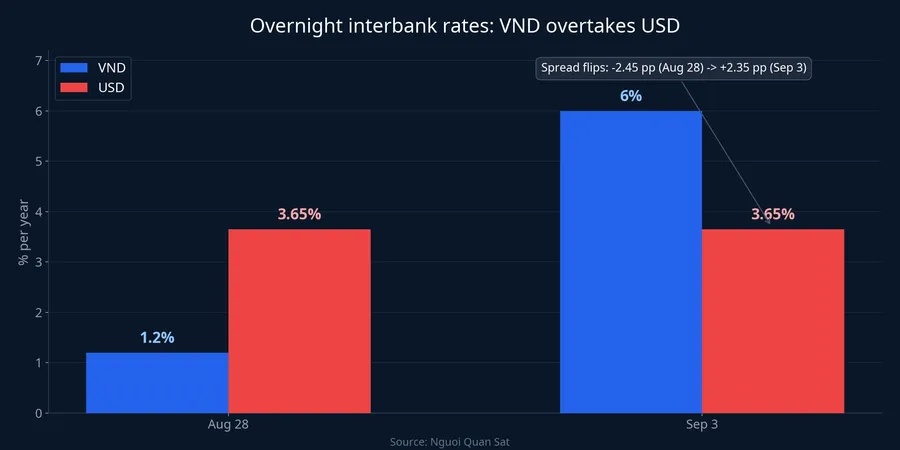
By September 3, that relationship had completely flipped: average VND interbank rates were trading at 6% overnight, 6.35% for one week, and 6.5% for one month, while USD rates stayed almost flat at 3.65%.Nguoi Quan Sat Holding dong overnight was now paying about 2.35 percentage points more than holding dollars. That same session, the SBV auctioned and fully allotted VND 5,625 billion of 7-day paper at 4.5% per year, pushing outstanding volume on its repo channel to VND 248,031 billion. That is exactly the tool Vietstock describes as the cheapest FX defense still available when reserves are a hard constraint: widen the rate spread in the dong's favor instead of selling foreign currency.
Three explanations, and which one carries the most weight
Last week's move has at least three plausible explanations, and they aren't mutually exclusive.
The first, a weaker global dollar, is the weakest fit for the data. The DXY closed at 99.17 on August 28 and at 98.97 on September 4, down just 0.2% for the week (DB: DXY), and after the stronger-than-expected August US jobs report landed on the evening of September 4, the index bounced back to 99.16, essentially unchanged over the week.Thoi Bao Tai Chinh Viet Nam
The second is shifting Fed policy expectations. Fed Governor Christopher Waller signaled he leans toward holding rates steady at the September meeting if inflation keeps cooling, pulling the market-implied probability of a rate hike from 68% on September 1 down to around 50%.CNBC This factor is real, but its effect on VND is indirect, and it was largely diluted by the weekend jobs report.
The third, a reversal in the domestic interest-rate spread combined with FX supply and demand that had already softened, best fits the data: all three price points, the central rate, banks' quoted rate, and the free-market rate, moved down together, in the exact week VND rates jumped above USD rates.
One caveat worth flagging so as not to over-read this: the September 2 holiday drove a spike in cash demand, and the jump in overnight rates from 1.2% to 6% was partly seasonal. The positive spread over USD will only really matter if it holds once holiday-related liquidity effects fade, and that isn't something we can confirm yet.
What this means for individual investors
For savers, the fact that VND rates are being held elevated is a technical byproduct of defending the exchange rate through the interest-rate spread rather than through reserves. As long as FX pressure hasn't disappeared, the base case is that short- and medium-term deposit rates stay anchored at elevated levels.
For bond portfolios, short duration suffers less valuation damage when the yield curve shifts higher; the 10-year government bond yield closed at 4.45% on September 3.Nguoi Quan Sat For importers and stocks carrying foreign-currency debt, one flat week for the exchange rate isn't enough to change a full quarter's cost picture, but it does halt a four-month margin squeeze. For gold, a cooler conversion rate removes one of the domestic price drivers, though the premium over world prices is still mainly set by local supply and demand.
Two signals to watch next week
The nearest catalyst is the US August inflation report, due September 11, since Waller himself tied the September decision to that exact number. If inflation runs hotter than expected, Fed rate-hike expectations could snap back and pressure on the exchange rate could return quickly.
The second signal is closer to home and gets far less attention: whether VND overnight rates can hold above USD's 3.65% once holiday-driven liquidity effects fade. If they fall back to the 1-2% range seen in late August, the cheapest defense the exchange rate has would disappear, and the 16-week streak that just ended could turn out to be just a pause within a longer uptrend. If they stay anchored above 4% after the holiday, last week will have genuinely earned the label of a turning point.