


On Thursday afternoon, September 3, Vietnam's Ministry of Industry and Trade and Ministry of Finance announced the first fuel pricing cycle after the National Day holiday. E5 RON92 gasoline rose to VND 22,486/liter, up VND 723.LuatVietnam Diesel, meanwhile, fell VND 341 to VND 27,743/liter.MekongASEAN
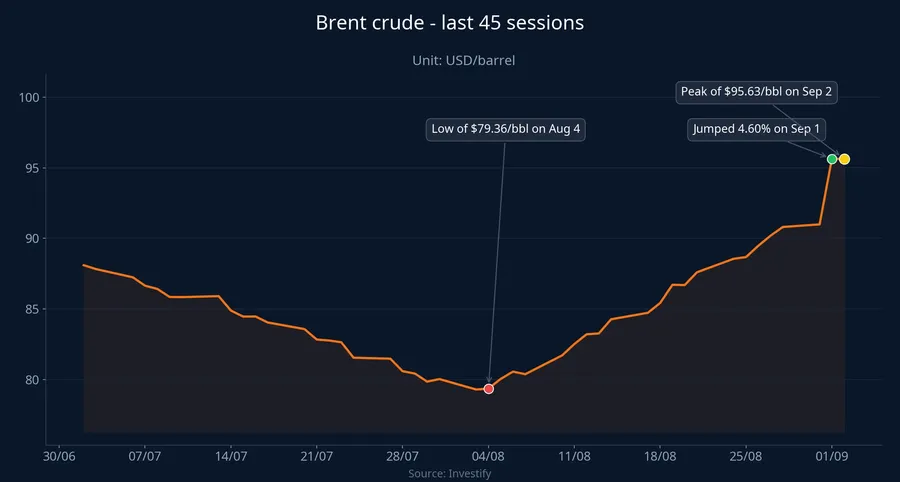
That same week, Brent crude closed at $95.63/barrel on September 2, its highest level since the US-Iran conflict around the Strait of Hormuz flared up. Global oil prices peaked while Vietnam's retail diesel price fell. That is not a data error. It is simply how Vietnam's fuel-pricing mechanism works: there is a built-in lag, and that lag is about to close.
Retail prices run one cycle behind
Under Decree 80/2023, Vietnam's retail fuel prices are adjusted every 7 days, on Thursdays. The base price for each cycle is calculated from the average finished-product price on the Singapore market over the entire prior cycle, not the price on the most recent trading session. That single mechanical detail is what many first-time investors miss when they see gasoline and diesel move in opposite directions on the same announcement day.
The September 3 cycle reflects the price window from August 27 to September 2. Within that window, Brent was still trading near $88/barrel on August 28 and only spiked in the final three sessions. The weekly average for diesel specifically still came in below the prior week, which was enough to pull the retail price down by VND 341 even as global prices were hitting a peak.
The next pricing cycle falls on Thursday, September 10, and its input window runs from September 3 to September 9, meaning the entire $94-95/barrel peak sits inside it. In other words, last week's spike hasn't reached the pump yet. It will next cycle, almost certainly, because the input data is already locked in.

The retaliation chain at Hormuz
On the night of August 30, the US struck two Iranian Revolutionary Guard missile launchers on Larak Island after detecting that Tehran was preparing to fire torpedo-carrying missiles into the strait.CNBC Iran retaliated with ballistic missiles against two US bases in Jordan, and on September 1 an oil tanker took three hits while transiting the southern shipping lane near Oman's coast.CNBC On September 2, Iran launched a wave of missile and drone strikes against US military facilities in Kuwait, Jordan, Bahrain, and the Kurdistan region of Iraq.CafeF It was the first direct exchange between the two sides in over a month, pushing the conflict into its seventh month.
Oil prices tracked every milestone closely. On September 1, Brent jumped 4.60% to $94.65/barrel, its strongest session in more than a month. For the week, Brent surged 7.43% from $88.10/barrel on August 28. Against the $79.36/barrel low on August 4, current levels are now 19.3% higher.
One detail that's gotten little coverage domestically: shipping traffic through Hormuz had already been sitting near multi-week lows before this latest escalation even began, averaging just about 13 transits per day over the 5 days through August 12, a roughly 90% drop from the 130 daily transits recorded before the conflict erupted back on February 28.FireAnt On August 24 alone, just 2 cargo ships passed through, with most vessels rerouting via Oman and switching off their tracking transponders.FireAnt That means the market had already priced in a scenario of prolonged disruption; it has not yet priced in a full closure of the strait.
Two paths for next week
Oil and capital flows next week will follow one of two branches, and the two are not symmetrical in timing.
The first branch is further escalation. The specific trigger would be a strike aimed directly at Gulf energy infrastructure, or a fresh full-blockade declaration from Tehran. Neither has appeared in the current window. If either happens, an unpriced risk premium gets added on top, and Brent could push past the $100/barrel mark it briefly touched on July 23, pulling both the September 10 and September 17 cycles higher. Diesel would face the most pressure, having already climbed 30.6% from VND 21,860/liter on July 1 to VND 28,540/liter on August 20 before retreating to current levels.
The second branch is a cooling-off. The trigger here is a week passing with no new retaliatory strikes, alongside Hormuz shipping traffic ticking up from its lows. In that case, the geopolitical risk premium gets unwound, and Brent slides back toward the $88-90/barrel range. The key point is that the September 10 cycle rises under both scenarios, since its input data is already locked in. The cooling-off branch only takes effect from September 17 onward, one full pricing cycle behind the military de-escalation itself, mirroring how global oil prices ran one cycle ahead of Vietnam's domestic mechanism in the cycle just passed.
A variable that has nothing to do with Tehran
There is a third trigger that sits entirely inside Vietnam, has a fixed date, and does not depend on military developments at all. Under Resolution 34/2026/NQ-CP, the zero-dong environmental protection tax, VAT exemption, and preferential import tax on fuel are only in effect through the end of September 30, 2026.LuatVietnam
That tax break makes up a meaningful share of the base price. If the policy isn't extended again, October retail prices will rise without crude needing to move a single cent. Even if the Hormuz cooling-off scenario plays out, consumers and transport companies may not see pump prices fall in the fourth quarter.
The inflation backdrop makes this variable weigh even heavier. August CPI rose 0.47% month-on-month and 4.89% year-on-year, reversing two straight months of decline.Báo Chính phủ The transport group climbed 4.09% and contributed 0.41 percentage points, the largest single contribution that month, with diesel up 22.15% and gasoline up 9.53%. Over the first 8 months, average CPI reached 4.45%, just 0.05 percentage points shy of the full-year control target.Thời báo Tài chính Việt Nam
Stocks got ahead of the pump price
Market reaction over the past week shows that most of the oil story was already priced into stocks back in August, not waiting for the September 3 pricing cycle. Capital moved ahead of the official announcement, typical for commodity-sensitive names.
Oilfield services stocks are the clearest theoretical beneficiaries of sustained high oil prices, since exploration and production budgets get approved more easily. PVS closed the September 4 session at VND 38,700/share, up more than 12% over one month, the best performer in the group tracked here, while PVD at VND 19,200/share rose in tandem but hasn't reversed its weak longer-term trend.
Distribution and refining stocks transmit the effect differently. PLX benefits short-term as retail prices rise against inventory bought at lower cost, yet the stock has still dropped a sharp 4% over the last 5 sessions to VND 36,000/share, a sign of profit-taking once the news went official. BSR at VND 26,750/share instead depends on the crack spread between finished-product and crude input prices, not on the absolute oil price.
On the other side, shipping and aviation names are absorbing cost pressure: GMD closed at VND 77,400/share and HAH at VND 47,200/share, both falling in the very sessions oil rose the most, while HVN (VND 22,500/share) and VJC (VND 124,500/share) traded flat, partly because both carriers can pass costs through via fuel surcharges.
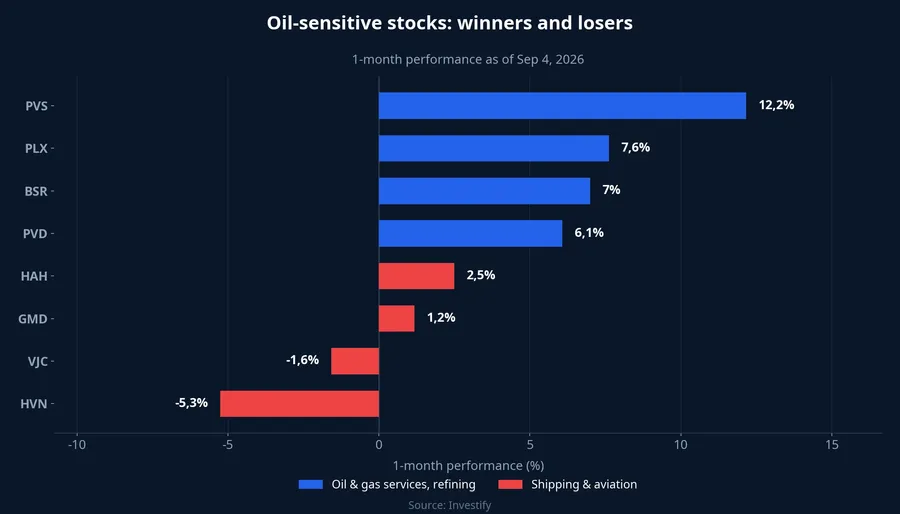
It's worth being clear that individual stock moves this period aren't driven by oil alone. The mid-September FTSE index rebalancing, company-specific stories, and overall market conditions could all play a role. What the data supports most strongly is a divergence by position in the value chain: upstream names have held momentum better than fuel-consuming names, though separating exactly how much of that move is oil-driven versus FTSE-driven isn't something the current data can cleanly disentangle.
Three dates to watch next week
For individual investors, next week's watch list narrows down to three dates rather than chasing every headline out of the conflict. Thursday, September 10 is a pricing cycle whose input data is already locked in and almost certain to rise, so the direction itself is no longer new information. What's worth reading is the magnitude of the increase, since that's the clearest gauge of how tight regional product prices really are. Military developments during the week will determine the September 17 cycle: one quiet week with no new retaliatory strikes would be enough to flip the base-price trend downward. September 30 is the tax-policy deadline, and it's the only one of these three variables the market can forecast on a calendar rather than waiting on war news.
Taken together, a cooling scenario starting from the September 17 cycle currently looks more probable than a break above $100/barrel, since most of the geopolitical risk premium was already discounted into prices back in August, and Hormuz traffic data suggests the market has adapted to prolonged disruption rather than bracing for a fresh shock. The one thing that would flip this view is a new strike on Gulf energy infrastructure — and that is the single most important signal to watch over the next seven days.