


Vietnamese people today live nearly 9 years longer than their parents did, with average life expectancy rising from 65.5 in 1993 to 74.7 in 2025.Vietstock That sounds like good news, but those extra 9 years don't fall into the working years. They fall squarely into retirement, the stretch of life that has to be funded by money saved beforehand. Put simply: the longer people live, the heavier the financial burden of old age becomes.
Two pieces of news surfaced in the same week, unrelated to each other but revealing when placed side by side. On September 4, the Manulife Asia Care 2026 survey found that 89% of Vietnamese respondents prioritize financial independence in old age, 57% don't want to become a burden on their families, and only 21% still expect financial support from their children.Vietstock That same day, Deputy Prime Minister Phạm Thị Thanh Trà signed Decision 124, setting March 2027 as the date the pension and wage reform proposal will be submitted to the 14th Party Central Committee.Tuoi Tre
On one side, the public appears ready to take responsibility for its own retirement. On the other, the policy machinery is still at the drafting stage, still six months away from reaching the country's top decision-making body. That leaves a practical question for anyone still working: what do you live on in the meantime?
The money needed and the money received have not met
The Manulife survey, conducted among 1,000 Vietnamese adults, found that people expect to need an average of 10 years of care and 13 years of financial support in old age.Tinnhanhchungkhoan For those over 60 specifically, the need for financial support stretches to 15 years, with an estimated cost of living around VND 11.8 million a month.
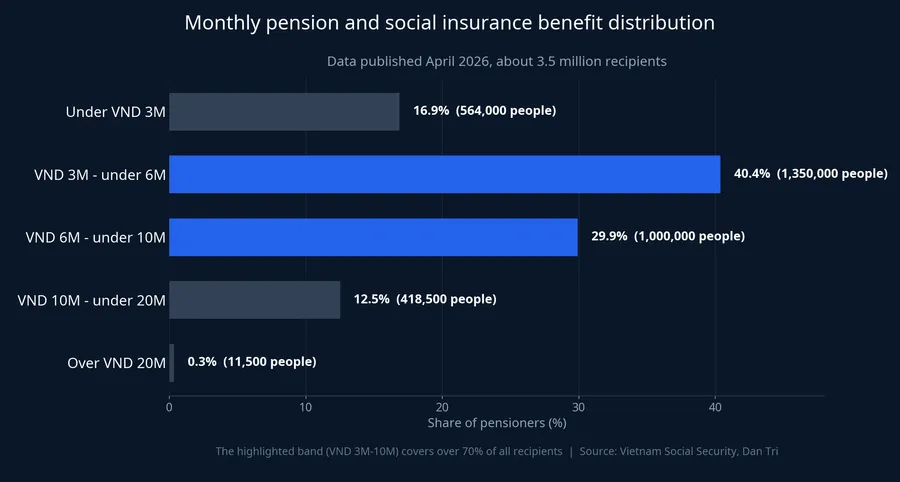
Set that figure next to what pensioners actually receive, and the gap becomes clear. Per data from Vietnam Social Security published in April 2026, of about 3.5 million people currently receiving monthly pensions or allowances, nearly 564,000 receive under VND 3 million, about 1.35 million receive VND 3 to under 6 million, and over 1 million receive VND 6 to under 10 million.Dan Tri The VND 3-10 million band alone accounts for over 70% of all recipients, while just over 11,500 people receive more than VND 20 million.
To be fair, pensions aren't the only source of income for older people. Many also have savings, rental property, or help from their children. But the fact that only 21% still expect financial support from their children suggests that traditional safety net is thinning, and the VND 11.8 million figure comes from people's own estimates, not an externally imposed benchmark.
Why the payout ratio is hard to max out
Under the 2024 Social Insurance Law, effective from July 1, 2025, the payout ratio still ranges from 45% to 75% of the average monthly salary on which social insurance was paid. Female workers reach 45% after 15 years of contributions, male workers after 20 years, with each additional year adding 2%. To hit the 75% ceiling, women need 30 years and men need 35 years of continuous contributions, a bar that is hard to clear in a labor market where informal employment still makes up a large share.
Here's a point often overlooked: the ratio applies to the average monthly salary reported for social insurance, which is typically lower than actual take-home pay, not total income. So the final payout gets shrunk twice: once through the percentage, and again through a denominator that was already low to begin with.

Pensions and social insurance allowances did rise 8% starting July 1, 2026 under Decree 162/2026, alongside the base salary increase from VND 2.34 million to VND 2.53 million a month. That's only a routine annual adjustment, not reform. The new pay scale and the redesign of retirement policy belong to the proposal still being drafted.
The reform timeline just got locked in
Decision 124, signed by Deputy Prime Minister Phạm Thị Thanh Trà in her role as Head of the Central Steering Committee for Wage, Social Insurance and Preferential Treatment Policy Reform, lays out a plan for researching and drafting the proposal. Under that plan, from August to October 2026 the Ministry of Home Affairs and Steering Committee members will build and finalize the draft proposal. In January 2027 the draft resolution will be completed. In February 2027 the proposal goes to the Politburo and Secretariat. In March 2027 it goes to the 14th Party Central Committee.
It's worth reading this timeline correctly so expectations don't run ahead of reality: this is a plan to research and draft a proposal, not an issued resolution. From the March 2027 submission to an actual resolution, then to laws and decrees that turn it into real payouts, there are still many steps ahead. For someone who is 40 today, that gap is just a few years within a working life of more than two decades left, but they are years worth not sitting out.
More than half the workforce sits outside the system
As of the end of May 2026, total participation in mandatory and voluntary social insurance reached about 21.99 million people, of which 19.41 million were in the mandatory scheme. The labor force aged 15 and above in the first half of 2026 stood at 53.7 million. Put those two numbers together and coverage comes out to roughly 41%, meaning close to six in ten Vietnamese workers are not in the social insurance system at all.
That figure lines up closely with the 61.9% informal employment rate in the first half of 2026. For that group, the pension story hasn't even started: with no contribution years recorded, there's no payout ratio to calculate.
What people are doing to close the gap themselves
The Manulife survey found 81% of respondents plan to rely on personal savings for retirement, 48% on insurance, and 43% on investment products. In terms of concrete actions, 51% are increasing their savings deposits, 45% are buying health insurance, and 26% are putting money into mutual funds, yet only 27% have shifted toward cash-flow-generating channels even though 53% say financial independence in old age is their goal. Put simply, the gap between intention and action lies mainly in where the money actually goes.

As of September 4, 2026, the 12-month deposit rate at major banks sits around 5.9-6.1% a year, a nearly risk-free rate suited to money needed within the next few years. But over a longer horizon, the picture looks very different. Among 38 active equity mutual funds, only 9 have a full 10-year track record, and all 9 posted positive returns, with a median annualized growth of 10.1%, ranging from 6.1% at the low end to 12.6% at the high end. Bond mutual funds are steadier but lower, ranging 7.1-8.6% a year over 10 years, with no fund posting a loss at the 3- to 5-year mark.
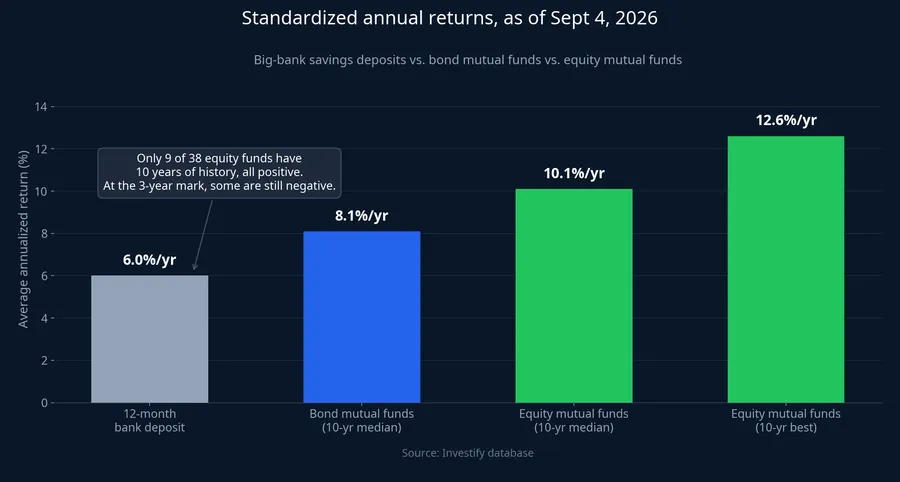
The price of higher returns is volatility. At the 3-year mark, the median equity fund returned 8.2% a year, but the weakest fund was still down 1.0%; at 5 years, the median was 6.2% with the weakest fund down 1.7%. Equity funds' advantage only shows up reliably from the 10-year mark onward, and the condition for capturing it is not pulling money out right when the market is falling.
A 13-year horizon and the power of compounding
For someone with 20 working years left, followed by 13 to 15 years living off savings, the difference between 6% and 10% annual returns is not trivial. On the same monthly contribution over 20 years, a 10% annual return produces a meaningfully larger ending balance than 6%, and that gap widens over time rather than narrowing.

A common allocation framework for retirement goals is to split money by the time horizon it will be needed, not to pour everything into a single channel. The emergency fund and money needed within 3 to 5 years should sit in savings deposits or bond mutual funds, where the risk of capital loss is low. Money that won't be touched for at least 10 years is the portion that fits equity mutual funds, because that's the horizon where the data shows a fairly stable probability of positive returns. Choosing a fund with a long enough track record to measure performance across a full cycle is the basic first filter, since currently only 9 of 38 equity funds have the full 10 years of data to reference.
It's also worth acknowledging other explanations for this gap between intention and action. Part of it comes from current financial pressure: 72% of people aged 35-44 are currently supporting family members financially, and 74% of that group say the pressure affects their ability to build long-term independence. Part of it comes from a preference for cash and a general discomfort with volatility. Both are real, and neither changes the math down the road.
What to watch
March 2027 is when the substance of the reform first becomes visible, not when policy actually changes. Before that, the thing worth watching most closely is the draft proposal the Ministry of Home Affairs is expected to complete in October 2026, since that's where the specific options on payout ratios, required contribution years, and how the average salary base is calculated will appear first.
For people still working, though, their own part of the equation doesn't need to wait for any of these milestones. The Ministry of Health has proposed guiding people to start preparing for old age from age 40. The number of years left before retirement is the single most important variable in the compounding equation, and it's also the one variable that can't be bought back later, no matter how much money you have.