

In early September 2026, Sacom Crypto Asset Exchange JSC (SCEX) completed a jump in charter capital from VND 360 billion to VND 5,000 billion, nearly a 14-fold increase in just a few months.CafeF The figure was immediately set against the VND 10,000 billion minimum required under Vietnam's crypto exchange pilot program, producing the familiar reading: SCEX is only halfway there.
That reading is correct, but incomplete. A close look at Article 8 of Resolution 05/2025/NQ-CP shows the hardest part isn't raising another VND 5,000 billion, it's whose name goes on that capital. The rule requires most of it to belong to institutions, and not just any institutions, but ones from specific sectors, with profits and clean audited financials. That's not a problem you solve by simply raising money faster.
The capital trajectory: VND 6.8 billion to 5,000 billion in 11 months
SCEX traces back to Loc Phat Vietnam Crypto Asset Exchange JSC (LPEX), founded on September 30, 2025 in Hanoi with charter capital of VND 6.8 billion, contributed by three individuals: Duong Van Quyet (40%), Nguyen Thi Bich Ngoc (30%), and Vu Phat Dat (30%).Nguoi Quan Sat
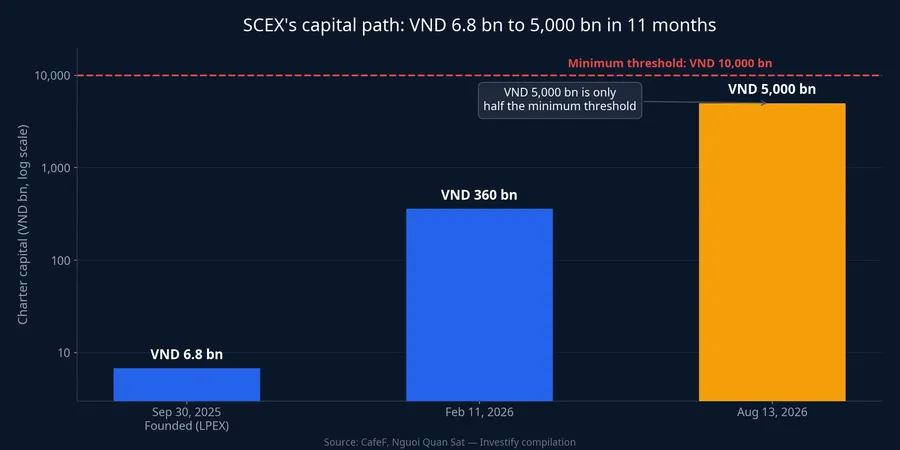
From there, capital climbed in two steep jumps. On February 11, 2026, the company raised capital to VND 360 billion, roughly 53 times higher just over four months after founding.Nguoi Quan Sat On April 28, 2026, LPEX was renamed SCEX.CafeF By August 2026 came the second jump, to VND 5,000 billion, more than 735 times the founding capital.
Capital wasn't the only thing moving. In June 2026, SCEX overhauled its leadership: Nguyen Duy Khoa became Chairman of the Board, Nguyen Xuan Thai (born 2003, son of Nguyen Duc Thuy) became Vice Chairman, and Nguyen Minh Huong became CEO effective June 1, 2026.CafeF Nguyen Duc Thuy, widely known as "bau Thuy," is currently Standing Vice Chairman of Sacombank following the bank's shareholder meeting on April 22, 2026.VnExpress
What's still unclear is who actually funded the increase. Reports describe the new capital as domestic private money with no foreign component, but no source has yet published SCEX's shareholder list after the two capital raises, or the method of issuance. That's the single most important information gap in this story, and it's also what determines whether the company is closer to, or further from, a license than the headline number suggests.
Article 8 is about more than VND 10,000 billion
Resolution 05/2025/NQ-CP, issued September 9, 2025, opened a five-year pilot for the crypto asset market, capped at five licensed operators.Chinh Phu The most-cited condition is a minimum of VND 10,000 billion in paid-in charter capital, but the same article also sets a series of requirements about exactly who that capital belongs to, and this part gets far less attention.
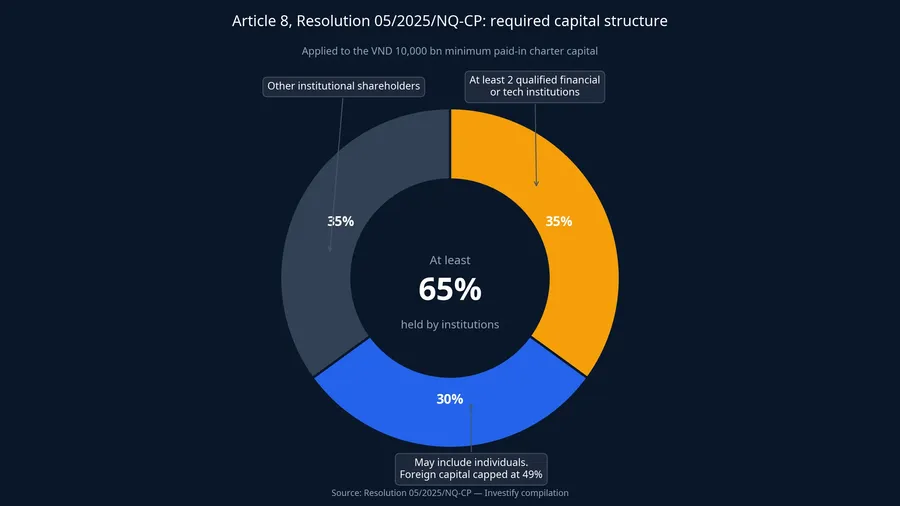
At least 65% of charter capital must come from institutional shareholders. Of that, more than 35% must come from at least two institutions in banking, securities, fund management, insurance, or technology, each having posted profits for two consecutive years before the licensing application, with financial statements carrying an unqualified audit opinion for both years. Total foreign ownership cannot exceed 49%.
Applied to the VND 10,000 billion floor, the requirement becomes very concrete: at least VND 6,500 billion must be held by institutions, and more than VND 3,500 billion of that must come from at least two qualified financial or tech institutions. Individual money, no matter how much, can only fill the remaining share below 35%. A company that started with three individual shareholders can't treat the rest of this road as simply a fundraising problem.
CAEX solved it a different way
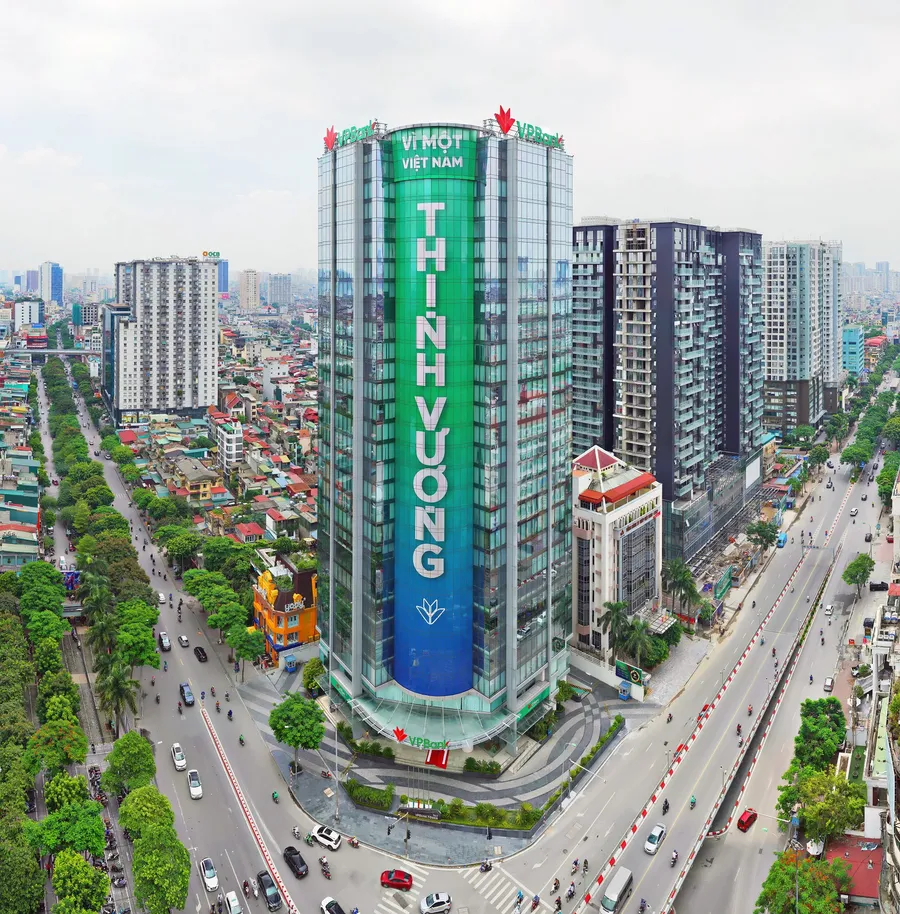
Among the five valid applications the Ministry of Finance is currently reviewing, SCEX, VIXEX, CAEX, TCEX, and Vietnam Digital Assets JSC, CAEX offers the clearest point of comparison.VietnamFinance Vietnam Prosperity Crypto Asset Exchange JSC, part of the VPBank ecosystem, raised its charter capital from VND 25 billion to the full VND 10,000 billion, with VND 8,940 billion in domestic capital and VND 1,060 billion (10.6%) in foreign capital from two investors, OKX Ventures and HashKey Capital.
CAEX's approach solved both layers of the condition at once: hitting the VND 10,000 billion mark, and sourcing that capital from financial institutions rather than individuals, with foreign ownership kept under the 49% cap. SCEX took the opposite sequence: build out operating capability and brand first, sort out the institutional shareholder structure later.
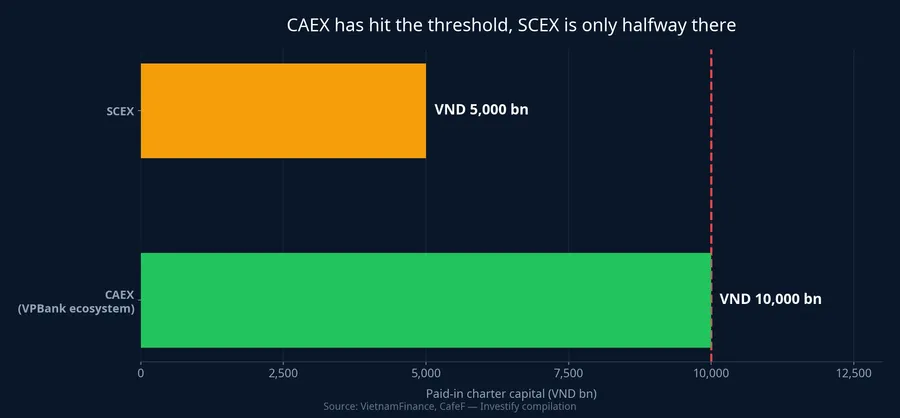
To be fair to SCEX, the VND 5,000 billion mark isn't necessarily where it stops. Charter capital could still rise further before the second round of review, and SCEX has said it is pursuing its license with backing from LPBank, LPBank Securities (LPBS), and Sacombank. Nguyen Xuan Thai is both Vice Chairman of SCEX and a board member and major shareholder at LPBS; the two firms signed a strategic cooperation agreement in May 2026. But strategic cooperation isn't the same as capital contribution. Until there's a specific disclosure on ownership percentages, Article 8's hardest condition remains open.
The pool of qualified institutions is shrinking
What makes the math harder is the supply of partners. Through 2026, a string of major securities firms pulled back from this race: SSI Digital Technology JSC's application failed to clear the review round in mid-March 2026, HSC's leadership said it's still too early to participate, and Vietcap shelved its own digital asset exchange plan back in August 2025, citing capital requirements too large against an unclear profit model.Dan Tri
The firms that just walked away are exactly the type of shareholder Article 8 describes: securities firms with years of profits and clean audited financials. With them on the sidelines, the pool of institutions both qualified and willing to put a few thousand billion dong into a market that hasn't operated a single day gets smaller. The remaining candidates are competing not just on how fast they raise capital, but on who they can recruit to co-sign it.
What individual investors need to know right now
Demand for this market is real. The SCEX Simulator, a mock-trading platform launched in July 2026, logged more than 41,000 accounts and nearly 142,000 orders in its first week.CafeF But that's simulated trading, not real money, and it's not a license.
As of early September 2026, no crypto asset exchange has been officially licensed in Vietnam. The Ministry of Finance has said it hopes to grant licenses and launch the market in the third quarter of 2026, meaning this month, but all five applications are still being finalized for a second review round covering capital, infrastructure, and information security.TheLEADER
Into that gap, a penalty framework has already taken effect ahead of the market's opening. Decree 284/2026/ND-CP, issued July 16, 2026 and effective from September 1, 2026, sets maximum fines of VND 200 million for organizations and VND 100 million for individuals; providing crypto asset services without a license carries a fine of up to VND 200 million.LuatVietnam
Put the two together and there's a practical rule for this September: any pitch claiming a crypto asset exchange is already licensed in Vietnam contradicts the public record, because the list of licensed operators is still empty. The first review round SCEX and TCEX announced completing back in May 2026 was an application screening step, not a license.
What to watch
For SCEX specifically, the next charter capital figure isn't the most important data point. The decisive one is a disclosure on ownership structure: whether at least two financial or tech institutions hold more than 35% of capital, and whether those institutions meet the two-year profit condition with a clean audit opinion. Until that disclosure appears, there's no basis to say SCEX is closer to or further from a license than the VND 5,000 billion figure alone suggests.
For the market as a whole, the milestone to watch is the outcome of the Ministry of Finance's second review round and the first list of up to five licenses. Until that list appears, every crypto trading channel accessible to individual investors in Vietnam sits outside the pilot framework, and the legal risk of participating belongs to the participant.