
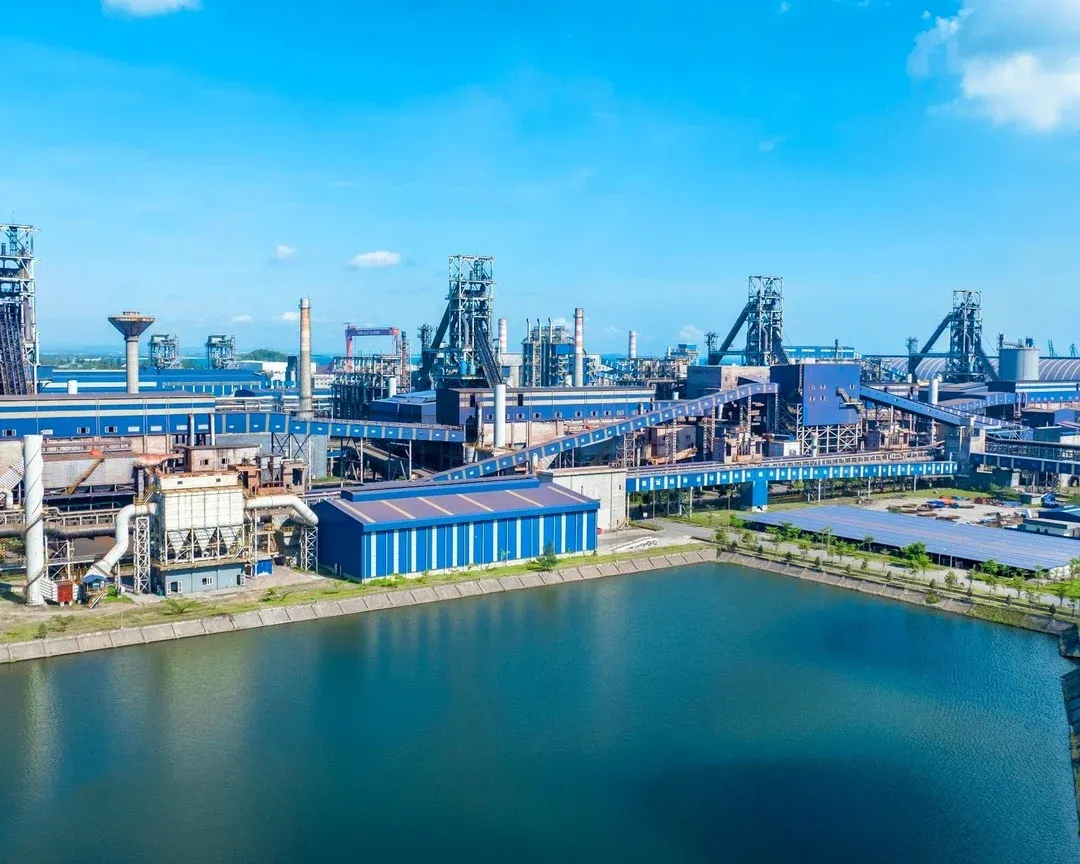

In August 2026, Hoa Phat's Dung Quat steel complex hit 1 million tons of molten iron output for the month, up roughly 2% from July and nearly 65% year-on-year.CafeF Marking the moment, Hoa Phat announced the entire complex is now formally running in sync, at a designed capacity of 12 million tons of steel per year on total investment above USD 7 billion.Nguoi Quan Sat
But this is not the first month all six blast furnaces ran together. Per the company's own release, August 2026 marks a full year since all six furnaces began operating in sync, following the last Dung Quat 2 furnace coming online in September 2025. What's new in August is that output for the first time matched designed capacity, not a decision to fire up another furnace. That rules out the easiest read: that Hoa Phat simply timed the global steel price recovery to open the taps. Capacity has existed for a year, so the real question is why a company would squeeze every last ton of throughput out of that equipment before knowing how long the price cycle will last.
A cost line that does not shrink with output
The answer sits in the cost structure of a large capital project. In Q2 2026, Hoa Phat booked VND 2,851 billion in depreciation and VND 1,520 billion in interest expense, together roughly VND 4,371 billion for the quarter, equivalent to nearly 8% of net revenue for the same period (VND 55,158.9 billion). Both lines are essentially insensitive to output: equipment depreciates on schedule whether a furnace runs fast or slow, and banks charge interest on outstanding debt regardless of how many tons the plant sells. The only way to ease that burden per ton of output is to spread it over a larger denominator.
Group-wide crude steel output in Q2 2026 came to more than 3.6 million tons, up 48% year-on-year. Divide VND 4,371 billion by 3.6 million tons and each ton carries roughly VND 1.21 million in depreciation and interest. If output fell back to 2.9 million tons, that same cost bill would load roughly VND 1.51 million onto each ton. The company did nothing wrong and selling prices haven't moved, yet unit cost would automatically climb by about a quarter.
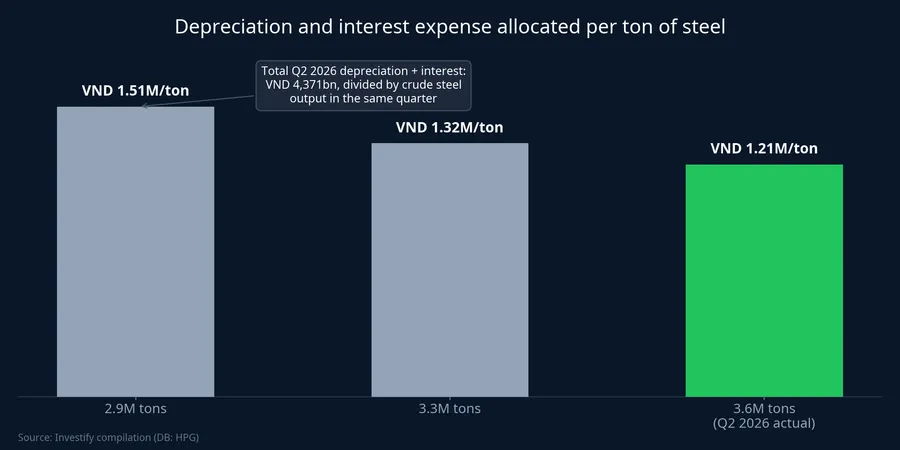
That's why running at full capacity isn't a cyclical bet on prices, it's the condition for the cost math on a USD 7 billion complex to hold together. Steel prices decide how much profit comes out the other end, not whether the furnaces run at all.
The widest sales-input spread in six quarters
Hoa Phat's stroke of luck is that the larger denominator arrived just as the numerator widened too. Average HRC prices in Q3 2026 stood at USD 1,193.9 per ton, up 42.4% year-on-year, while average iron ore prices were just USD 96.9 per ton, down 4.2%. The gap between selling price and the main input has widened from roughly USD 707 per ton in Q1 2025 to roughly USD 1,097 per ton in Q3 2026, the widest spread in at least six quarters.
Gross margin has tracked that same path: from a base of 12.7% in Q4 2024, up to 18.4% in Q2 2025, down to 13.9% in Q4 2025 as ore prices outran selling prices, then recovering to 15.8% in Q1 2026 and a peak of 19.0% in Q2 2026. Absolute gross profit rose from VND 4,364.9 billion to VND 10,487.8 billion over the six quarters.
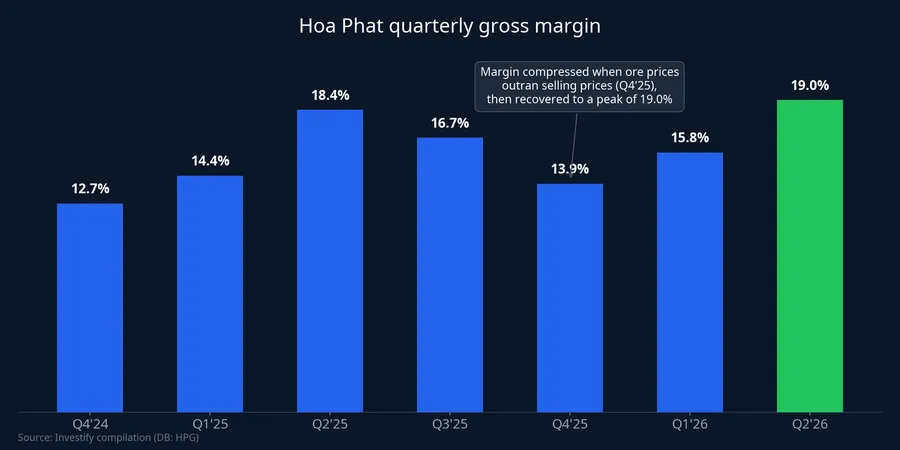
It matters to name where this improvement actually comes from: it's driven by rising selling prices, not falling input costs. Iron ore has traded in a narrow USD 96-107 per ton band for six straight quarters. A business earning on price will lose earnings just as fast when price reverses.
What's actually accelerating isn't iron ore
Look only at iron ore, and Hoa Phat's input cost picture looks comfortable. Look at coking coal instead, and it's a different story.
Global coking coal prices reached USD 274.00 per ton on September 3, 2026, up from USD 226.50 in mid-July, a roughly 21% jump in six weeks. In just the second half of August, prices climbed 17.6% in two weeks, while HRC prices over the same window rose only about 4%. Coking coal is the mandatory fuel and reducing agent for blast-furnace technology, exactly the technology all six Dung Quat furnaces use. When coking coal moves five times faster than selling prices, the spread the iron ore chart implies gets eaten away in practice. These are two different inputs rising for two different reasons, so the input-cost picture can't be captured by an iron ore chart alone.
There's one more layer at the shipping stage. The Baltic Dry bulk freight index climbed from 2,791 points on August 20 to 3,488 points on September 3, up roughly 25%. Hoa Phat imports nearly all of its iron ore and coking coal by sea, so higher freight is a real cost, even as higher freight also makes imported steel more expensive and shields domestic prices in the other direction. On the domestic side, D10 rebar has held flat at VND 14,210 per kg for weeks: the current price rally is flowing into the HRC line, not the construction-steel line.
A protective layer on the output side
On the upside, Hoa Phat's output is better shielded than at any point before. On April 2, 2026, the Ministry of Industry and Trade issued Decision 612/QD-BCT, imposing a provisional anti-circumvention duty of 27.83% on wide-width HRC imports from China, effective April 17, 2026.VietnamBiz Hoa Phat is the only Vietnamese producer that makes HRC, so the barrier pushes demand toward domestic supply. HRC sales volume in Q2 2026 reached 1.9 million tons, up 64% year-on-year and 31% quarter-on-quarter, lifting Hoa Phat's HRC market share to 63.7% from 62.3% in Q1. Roughly 80% of HRC sold is consumed domestically, with the rest exported to around 20 countries.
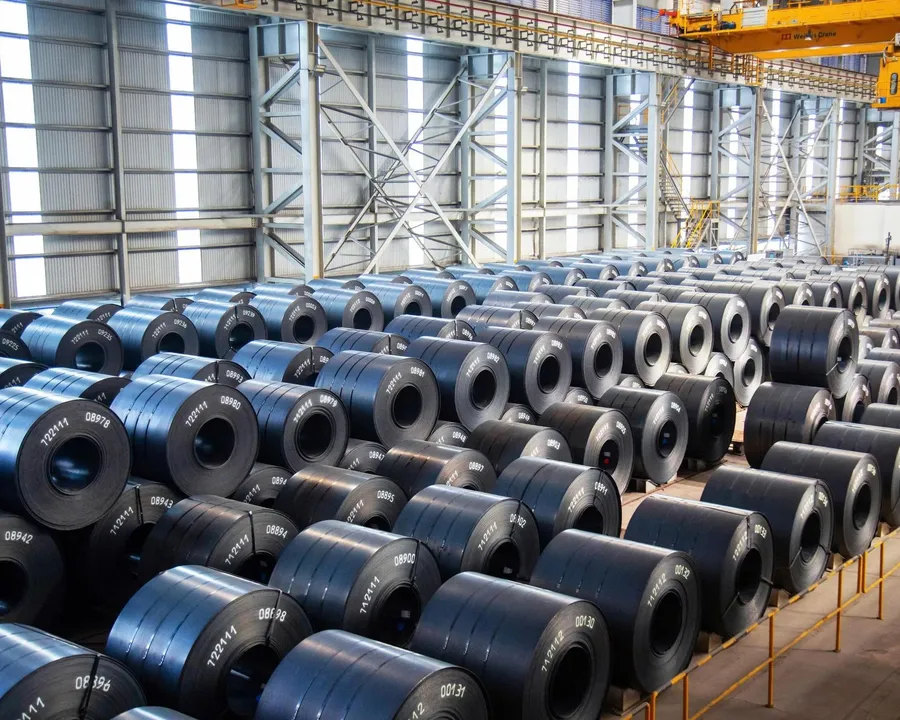
This structure is both a strength and something to watch. The company is less exposed to trade-defense risk abroad, but in exchange, domestic construction and manufacturing demand almost single-handedly determines its output.
Operating leverage cuts both ways
The risk in this cost structure sits exactly where its strength does: spreading fixed costs over large volume amplifies profit when prices rise, and amplifies losses by the same amount when prices fall. Interest expense has already climbed from VND 627 billion in Q1 2025 to VND 1,520 billion in Q2 2026. The interest coverage ratio in Q2 2026 stood at 4.7x, down from 8.0x in Q1 2026. The balance sheet remains under control: total borrowings of VND 98,530 billion, a debt-to-equity ratio of 0.97x, net debt-to-EBITDA down from 13.0x in Q1 2025 to 7.7x, and equity climbing steadily to VND 141,516 billion. This isn't a stretched balance sheet, but it is one that needs steady cash flow to run smoothly.
Why did the August milestone arrive now rather than earlier or later? The weakest explanation is that the company timed the price cycle, since capacity has been ready since September 2025 and a blast furnace can't be switched on and off with weekly prices. The stronger explanation is a technical learning curve: Hoa Phat says the output milestone came from adjusting the furnace's central gas flow, redesigning the charging pattern, optimizing ore batch weight, and the oxygen enrichment ratio, improvements that accumulate over operating time rather than a single month's decision. The data supports this reading: the 65% year-on-year jump is mostly a base effect from August 2025 still missing the last furnace, while output rose just 2% versus July 2026. The pull from domestic HRC demand after the April 2026 tariff barrier explains why the output sold, but not why furnace efficiency improved.
From here, price is the last variable
For investors holding or watching HPG, the biggest shift after the August milestone is that the source of growth has changed in kind. Over the past six quarters, profit grew on two legs at once: expanding volume as Dung Quat 2 came online, and rising selling prices. With output now matching designed capacity, the first leg is nearly out of room until a new project comes along. From Q4 2026 onward, incremental profit growth can mainly come from selling prices and from input consumption per ton.
The indicator worth watching is no longer monthly output, but the spread between HRC prices and combined iron ore plus coking coal costs. Across the last six quarters, every compression in gross margin has coincided with a narrowing of that spread, and vice versa. Coking coal's 21% jump over the past six weeks is the first signal that the spread may not keep widening the way it has all year, though it isn't yet enough to reverse the margin trend if HRC prices hold their gains.
HPG shares closed at VND 21,700 on September 4, 2026, with a market capitalization of roughly VND 166.6 trillion. Q3 2026 results, expected in October, will be the first quarter to fully reflect both the capacity ceiling and the coking coal price spike, the report that answers what the August output milestone couldn't: for the same volume of steel, how much profit the company actually keeps.