
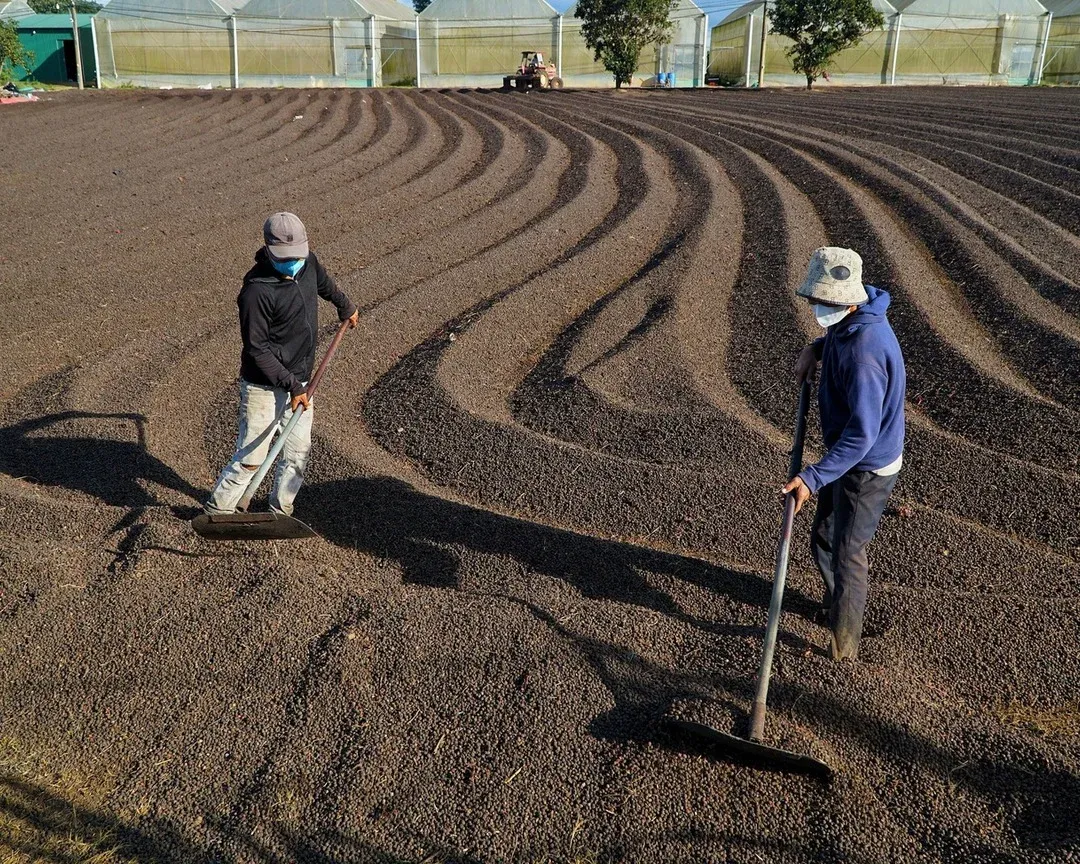

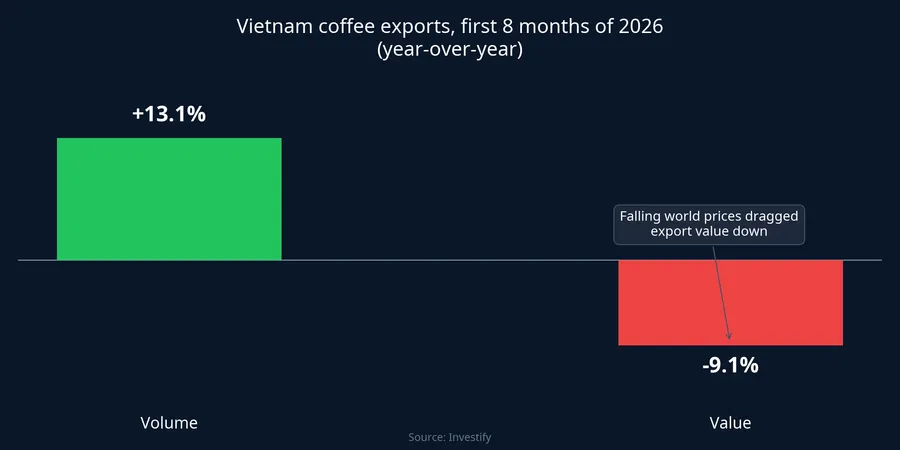
In the first 8 months of 2026, Vietnam exported roughly 1.3 million tons of coffee worth USD 6 billion.Dong Nai DOIT Volume rose 13.1% year over year, but value fell 9.1%. The reason is the average export price, which dropped 19.7% to roughly USD 4,538 per ton.Dong Nai DOIT
These are not two coincidences sitting side by side. The extra volume sold, combined with Brazil's record harvest, is itself part of why the world price has been sliding. The big picture here is a supply story, not a demand story.
Where prices stand
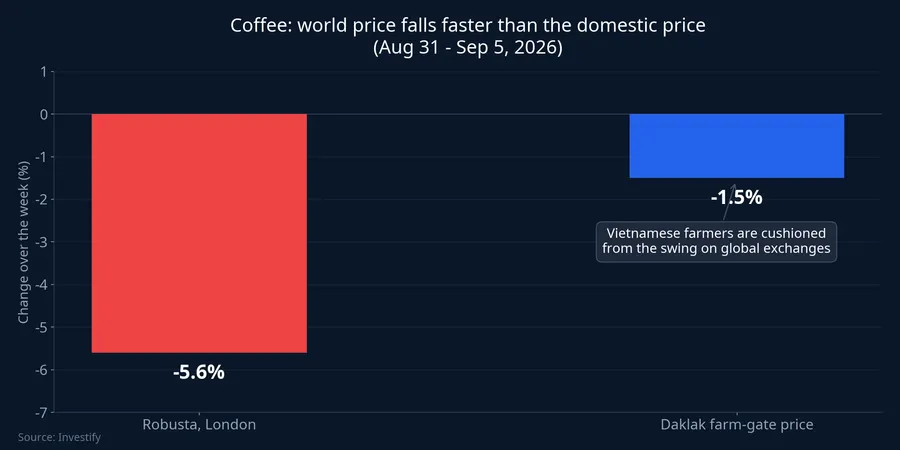
On September 5, robusta futures for September 2026 delivery on the London exchange fell another 0.81%, or USD 27 a ton, to USD 3,298 a ton.Thoi Bao Tai Chinh Viet Nam The November 2026 contract stood at USD 3,374 a ton. Five sessions earlier, on August 31, the September contract had closed at USD 3,492 a ton.Dan Tri In a single trading week, robusta lost 5.6%.
At home, farm-gate prices in the Central Highlands on September 5 fell in unison by VND 500 per kg, to a range of VND 93,200-94,000 per kg, with Dak Lak at VND 93,700 per kg.Thoi Bao Tai Chinh Viet Nam At the end of August, the average purchase price was still around VND 95,200 per kg, with Dak Lak at VND 95,100 per kg.Dan Tri
Put the two numbers side by side over the same week: London down 5.6%, Dak Lak down only 1.5%. Domestic prices are falling considerably slower than world prices, which usually happens when domestic sellers hold back stock rather than accept the new price level. That gap is widening as a result, and if the London price keeps falling, the spread will eventually have to close.
Why prices are falling: supply, not demand
The pressure is coming from the supply side, and from both of the world's largest robusta exporters at the same time.
Brazil is heading into a record crop. StoneX just raised its forecast for Brazil's 2026-2027 output to 77.2 million 60-kg bags, up 23.9% from the prior season.Doanh Nghiep Hoi Nhap More important for Vietnam is the composition inside that number: robusta and conilon alone reached 25.4 million bags — precisely the type of coffee Vietnam sells to the world.
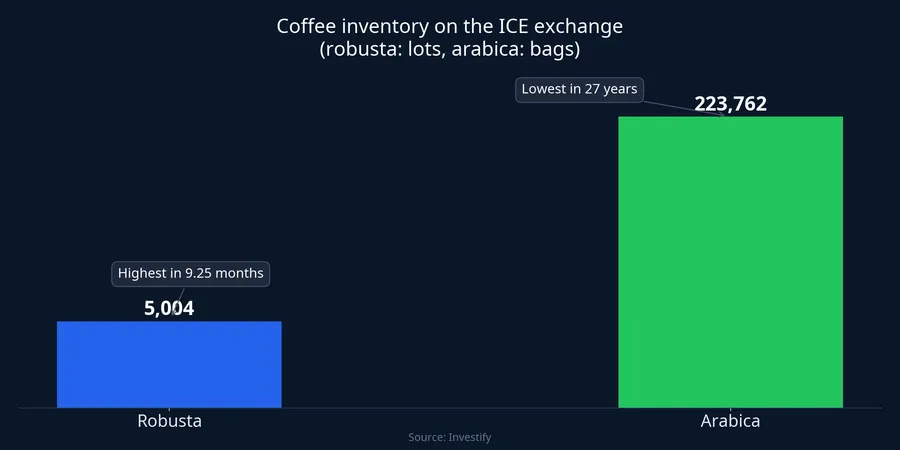
Supply has also flowed into exchange warehouses. Certified robusta stocks at ICE warehouses climbed to 5,004 lots, the highest in 9.25 months.Doanh Nghiep Hoi Nhap When more deliverable stock is on hand, buyers no longer need to bid up prices to secure supply. International analysts point to exactly two drivers behind this pressure: rising inventories and improved supply prospects out of Vietnam.Bao Lao Cai
Nguyen Nam Hai, Chairman of the Vietnam Coffee - Cocoa Association (Vicofa), argues that the rise in global supply mainly reflects roughly three years of sustained high prices, which encouraged farmers in many countries to invest in their orchards and lift yields.Thoi Bao Tai Chinh Viet Nam In other words, three years of high prices generated the very volume now pulling those prices back down.
To be fair, this is not the whole story. The US dollar's exchange rate, speculative fund flows on commodity exchanges, and the pace of Brazil's harvest all move prices session to session. But the decline stretching from late August into early September lines up with inventory and output data, not with any currency shock. Supply remains the most reasonable explanation for this stretch of falling prices.
The overlooked detail: two coffee markets pulling apart
While robusta inventories pile up, certified arabica stocks on the ICE exchange have fallen to 223,762 bags, the lowest level in 27 years.Doanh Nghiep Hoi Nhap These are two opposite signals inside the same industry, and they explain why not every coffee price in the world is falling.
Arabica is being propped up as a result, while robusta is not. On September 5, the September arabica contract on the New York exchange also fell, by 1.23% to 324.35 US cents per pound.Thoi Bao Tai Chinh Viet Nam That decline is far more modest than robusta's, because arabica's price floor is still supported by near-empty warehouses. Vietnam grows almost exclusively robusta, so the country sits squarely on the weak side of this market: the good news about record-low arabica stocks never reaches the Central Highlands.
Who bears the loss
Farmers absorb the damage directly through farm-gate prices. From a range of VND 97,200-98,000 per kg in mid-August, prices have retreated to around VND 93,700 per kg. The new harvest only begins in late November 2026,Tap Chi Kinh Te Tai Chinh so most of what's being sold right now is leftover stock from the previous season, sold at exactly the moment prices are falling fastest.
Exporters face thinner pressure than one might assume for an industry that ships USD 6 billion a year. Per Vicofa, profit margins on revenue in the coffee industry run only 1-2%.Tap Chi Kinh Te Tai Chinh With margins that thin, higher sales volume can't offset falling prices, and the biggest risk is the timing gap between buying domestic beans and locking in an export price on the exchange.
Retail investors have no clean way into this story. The two coffee-linked tickers on the exchange each carry their own problem. VCF (Vinacafe Bien Hoa) is a processor that benefits when raw beans get cheaper, but its share price sat at VND 293,500 on September 5 with matched trading volume at zero for multiple sessions. CPA (Phuoc An Coffee) is the genuine exporter of the two, priced at VND 8,600 a share, but its market cap is only around VND 0.2 trillion and liquidity is virtually nonexistent. Buying in is hard; selling out is harder.
The legal channel with real liquidity for individuals who want exposure to coffee prices is futures contracts through the Mercantile Exchange of Vietnam (MXV). This is a leveraged, margined product, and coffee is a highly volatile commodity, so anyone considering it needs to understand margin-call mechanics before opening a position. For most retail investors, the coffee story right now is better watched as a signal about the agricultural commodity cycle than treated as a position to enter immediately.

What could turn this around
Three specific dates are worth marking on the calendar.
First is EUDR, the EU's anti-deforestation regulation, which officially takes effect from December 30, 2026.Bao Dau Tu European importers are already paying a premium for certified shipments under contracts signed from October 2026 onward, and more than 30% of Vietnam's coffee acreage already holds a sustainable-production certificate.Thoi Bao Tai Chinh Viet Nam That premium won't reverse the broader price trend, but it does pull a portion of Vietnamese supply out of the low price floor.
Second is robusta inventory on ICE. If that number keeps climbing, prices still have room to fall further. If it turns over, the current selloff has likely already passed its peak.
Third is the new domestic harvest, starting in late November. Vicofa forecasts full-year 2026 export volume rising roughly 8-10% versus 2025,Tap Chi Kinh Te Tai Chinh meaning more supply is still headed to market in the coming months.
Given current conditions, the reasonable framework is to treat the 2024-2025 high-price cycle as over, not merely paused. The 2024-2025 crop year closed with output above 1.7 million tons and record revenue of USD 8.4 billion.Tap Chi Kinh Te Tai Chinh Eight months into this year, volume sold is up while revenue is only USD 6 billion. If ICE robusta inventories haven't turned over and Brazil still delivers the forecast crop, any near-term price uptick should be read as a bounce within a downtrend, not the start of a new upcycle. ICE inventory levels and the pace of the late-November harvest are the two signals worth watching most closely in the coming weeks.