


Inside the same banking system, under the same concept — the credit limit a bank can extend to one customer and related persons — two numbers are now moving in opposite directions. One sits in the law and shrinks every year on a fixed schedule. The other just showed up in a draft Circular, roughly 2.5 times higher. For anyone holding bank stocks, the gap between these two numbers determines who gets the extra lending room, and who carries the risk that comes with it.
The general cap: a roadmap that only goes down
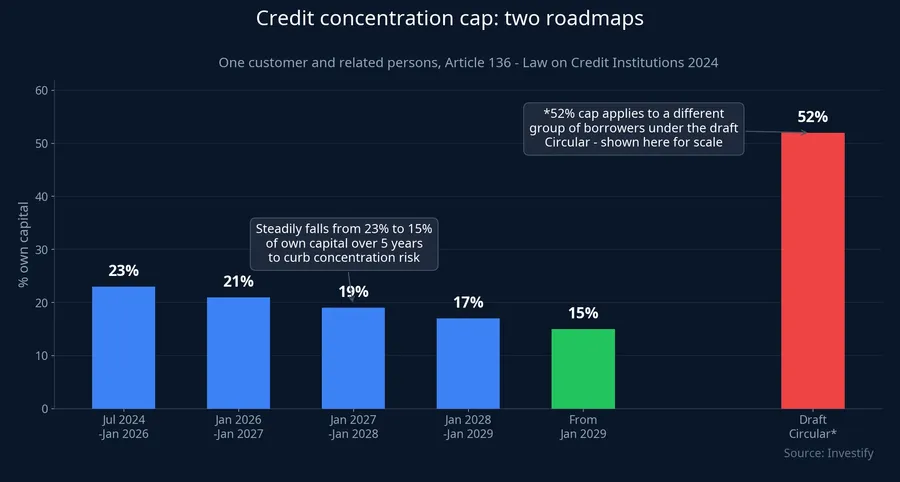
Article 136 of the 2024 Law on Credit Institutions sets a clear declining schedule for the total credit a commercial bank can extend to one customer and their related persons. From July 1, 2024 to before January 1, 2026, the cap is 14% of own capital for a single customer and 23% for a customer plus related persons. That falls to 13% and 21% in 2026, 12% and 19% in 2027, 11% and 17% in 2028, and bottoms out at 10% and 15% from January 1, 2029.VietnamBiz
The logic is easy to read: the less of a bank's capital tied to a single borrower, the less that bank depends on one borrower's health. This exact concentration risk is behind some of the biggest collapses in Vietnamese banking history, which is precisely what the law is now systematically dialing back.
A separate lane: 38% and 52% for Hanoi's mega-projects
Running in parallel, the State Bank of Vietnam (SBV) is currently soliciting comments on a draft Circular that would allow credit extended beyond the standard limit to reach up to 38% of own capital for a single customer, and up to 52% for a customer plus related persons.Tin nhanh chứng khoán The scope is narrow, not a new economy-wide ceiling: it applies only to large, important projects in the capital approved under National Assembly Resolution 258/2025/QH15, and banks may only extend such credit when the conditions under Clause 2, Article 3 of Decision 09/2024/QĐ-TTg are met.Tin nhanh chứng khoán
The gap between the two thresholds is far bigger than the percentages suggest. Own capital at Vietcombank and VietinBank stood at roughly VND 222,722 billion and VND 229,177 billion, respectively, at the end of 2025.CafeF At the 21% cap in effect for 2026, a related-party borrower group could draw up to roughly VND 48,000 billion from either bank; at the proposed 52% cap, that figure could climb to roughly VND 119,000 billion, with a single borrower alone able to access about VND 87,000 billion.CafeF The roughly VND 71,000 billion swing for one customer group at one bank is enough to fund an entire urban rail line.

The price of the extra room: heavier paperwork, clearer liability
The draft doesn't just widen the cap and walk away. In exchange for the extra room, banks must file a far heavier package than usual: loan value, disbursement schedule, purpose of credit, the project's legal documentation, risk assessment and mitigation plans, and the borrower's repayment capacity, all submitted for the Governor's review. Once approved, the obligations don't stop there. The bank remains responsible for appraisal, monitoring fund use, collecting principal and interest, managing risk, and must report to the SBV monthly on how the over-limit loan is performing.Tin nhanh chứng khoán
In other words, concentration risk doesn't vanish. It's simply allowed to grow larger, in exchange for a thicker layer of oversight and a clearer signature on the accountability line.

Two parallel mechanisms, only one already in force
This is where it's easiest for investors tracking banks and real estate to get confused. The first mechanism is already in effect: Official Dispatch 5386/NHNN-TD, dated June 22, 2026, excludes outstanding loans for 18 flagship projects proposed by Vingroup, Sun Group and Masterise, with total capital demand exceeding VND 752,000 billion, from how credit growth quotas are calculated.MarketTimes That's a room exemption: it lifts the limit on how fast a bank's total loan book can grow. The second mechanism is still a draft: the 38% and 52% caps on own capital, which lift the limit on how concentrated exposure to a single customer can get. The two solve different bottlenecks and shouldn't be lumped into one story.
Disbursement is also running behind the pace of policymaking. On August 10, 2026, the Hanoi People's Council had to extend the deadline by six months for six large projects under Resolution 258, since they had not yet met the conditions to break ground, mostly stuck on planning and land clearance.CafeF The mechanism opens up room, but that room only becomes an actual loan once a project clears its legal conditions and a bank agrees to underwrite it.
Who carries the risk, and at what margin
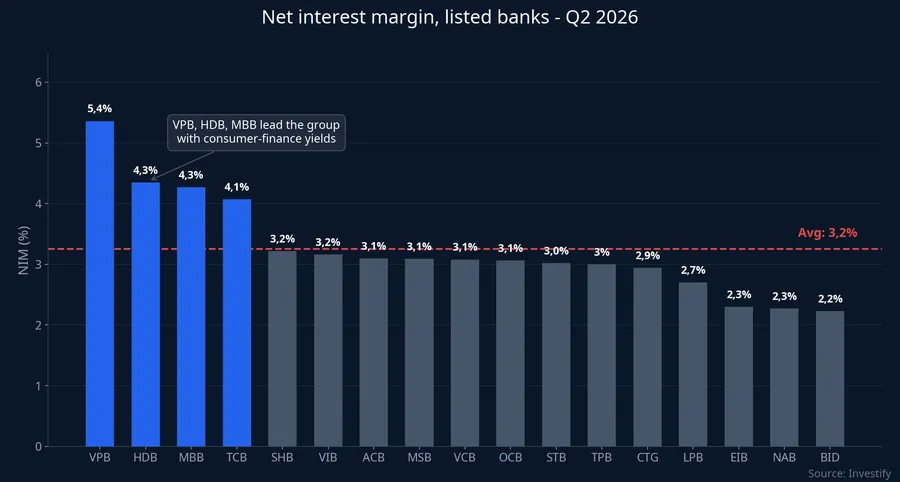
The extra lending room flows to project developers. The concentration risk stays on the bank's balance sheet. Net interest margin (NIM) shows just how uneven that balance sheet currently looks: the average NIM across 17 listed banks in Q2 2026 was 3.25%, with a median of 3.08%. Compared with the prior quarter, 14 of 17 banks improved their margin, up 0.13 percentage points on average; but compared with the same period in 2025, 13 of 17 banks posted a lower NIM, down 0.33 percentage points on average.
Funding cost explains most of that gap. System-wide average deposit rates have risen roughly 61 to 109 basis points from the 2025 trough depending on tenor, about 83 basis points on average; for the 12-month online deposit tenor specifically, rates moved from 5.14% to 6.13%. There is a bright spot: as of August 22, 2026, VND-denominated deposits grew 8.77% year-to-date, outpacing VND credit growth of 8.38%, a reversal after years of credit outrunning deposits. But that funding has a price. It was pulled in with a higher deposit rate, and that cost still has a lag before it fully shows up in NIM over the coming quarters.
VietinBank and Vietcombank posted the sharpest year-on-year NIM improvement, up 0.36 and 0.35 percentage points respectively; SHB, by contrast, fell 1.84 percentage points and HDBank fell 1.59 percentage points. Notably, the state-owned group holds the largest own capital in the system, meaning the largest absolute room to gain if the 52% cap is issued.
What the market is actually pricing
Price action over the past two sessions suggests investors are watching margins first, not the credit cap. On September 3, bank stocks fell 1.74% on average while the VN-Index lost only 0.24%, closing at 1,827.72 points; selling pressure concentrated in large-cap names: Techcombank down 3.89%, VPBank down 3.06%, Vietcombank down 2.33%. Foreign investors were net sellers of more than VND 1,562 billion that same session.Nhân Dân
On September 4, news of the draft Circular hit the press that morning. The VN-Index rose 1.39% to 1,853.08 points, but the 17-bank group gained only about 0.56% on average. VPBank rose 3.15% and Sacombank rose 3.76%, while VietinBank fell 0.32% and MB fell 0.24%. The group joined the market rebound but lagged it, and the dispersion within the group was wider than the average gain itself. That's the behavior of a group of stocks waiting on Q3 numbers, not one that just received good news about extra lending room.
A framework for investors to track
For anyone holding bank stocks, two layers of information need to stay separate. The first is policy: the draft Circular is still in public consultation, not yet issued, and the 38% and 52% thresholds could still change once feedback is compiled. The signal worth watching is the final issued text, not the draft.
The second layer is earnings. The variable that will actually decide bank sector profits over the next four months is funding cost and NIM, not the credit cap, because a cap only creates room, and that room only becomes income once a project is cleared to disburse. The six-month extension granted to six Hanoi projects shows exactly where that bottleneck currently sits.
If the draft is issued with the 52% threshold intact, the state-owned banks with the largest own capital stand to gain the most in absolute terms. But if Q3 NIM data still comes in below last year's level, that extra room stays on paper while the higher funding cost is already sitting in the earnings report. The final text of the Circular and Q3 NIM figures are the two markers most worth watching in the coming weeks.