


On September 4, 2026, four bond tranches worth a combined VND 3,800 billion from Sacombank and Vietcombank began trading on the Hanoi Stock Exchange's private corporate bond system. The highest-paying tranche in that group carries a fixed 10% coupon for its full term.
At the same time, a separate bond on the market is still sitting on VND 3,009 billion in unpaid interest owed to bondholders. That bond once promised a coupon of 10.5% a year, barely higher than the 10% figure above.TheLEADER
Two bonds, two nearly identical coupons, two completely opposite outcomes. What the numbers alone won't tell a first-time investor is that the headline coupon is not a reliable way to tell risk apart. The real risk sits in details that are far less visible.
Side one: VND 3,650 billion from Sacombank, 10% a year
In late July 2026, Sacombank completed three private bond issuances on July 27, 30, and 31, worth a combined VND 3,650 billion, with a 6-year term and a fixed 10% annual coupon.MekongASEAN These tranches are part of a board-approved plan to sell up to VND 20,000 billion in private bonds, aimed at extending the bank's medium- and long-term funding base.
The 10% rate is the highest among bank bond issuers in this period. Per HNX and VBMA data compiled by Dân trí on September 1, bonds from Vietcombank and BIDV issued in August mostly sat in the 7.87-8.2% range, PVcomBank at 9.6-9.8%, and TPBank around 9.1%.Dân trí
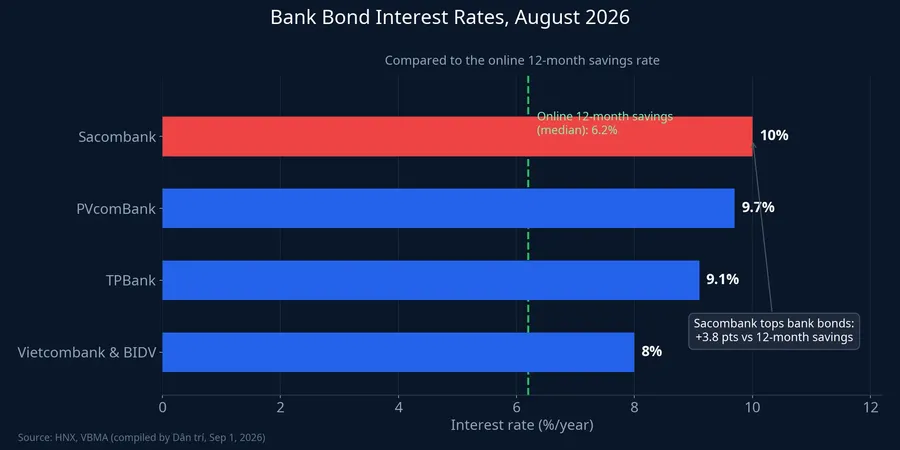
Set next to bank deposits, the gap is fairly clear: for 12-month online term deposits, the median rate across 41 banks as of September 2, 2026 stood at 6.2% a year. Worth noting this is not quite an apples-to-apples comparison: Sacombank's bond runs 6 years, while the deposit data only covers terms up to 12 months.
Why does a bank pay more for the same money? The reason isn't issuer quality. It's funding structure. Per an analysis from VCBS cited by VietnamBiz on August 25, roughly 80% of funding across Vietnam's banking system is short-term, while up to 50% of outstanding loans are medium- and long-term.VietnamBiz To stretch out funding tenors, banks have to pay up for it. The average bank bond rate has climbed from 5.92% at the end of last year to roughly 9% in the first half of 2026.
In other words, the 10% reflects the cost of extending tenor, plus a premium for illiquidity and for the fact that bonds aren't covered by deposit insurance. It is not a high rate because the issuer is weak. It's the price of stretching duration inside a banking system that borrows short and lends long.
Side two: VND 4,800 billion from Bông Sen, 10.5% a year
Bông Sen JSC, a company within the Van Thinh Phat Group ecosystem, issued the BSECH2126003 tranche on October 15, 2021, worth VND 4,800 billion with a 5-year term, a 10.5% annual coupon, and interest paid quarterly.TheLEADER Proceeds funded a project at 152 Tran Phu Street, District 5, Ho Chi Minh City. Tan Viet Securities (TVSI) arranged the deal, and the bond was distributed further to retail investors at a face value of just VND 100,000 per unit, 10,000 times lower than the Sacombank bond's face value.
Bông Sen paid the first three interest periods in full during 2022, totaling roughly VND 346 billion. But starting with the fourth period, around October 2022, the company stopped paying entirely. All of the firm's bank accounts were frozen by authorities as part of the Van Thinh Phat investigation, effective October 14, 2022, the day Trương Mỹ Lan, former Chairwoman of Van Thinh Phat Group, was arrested.
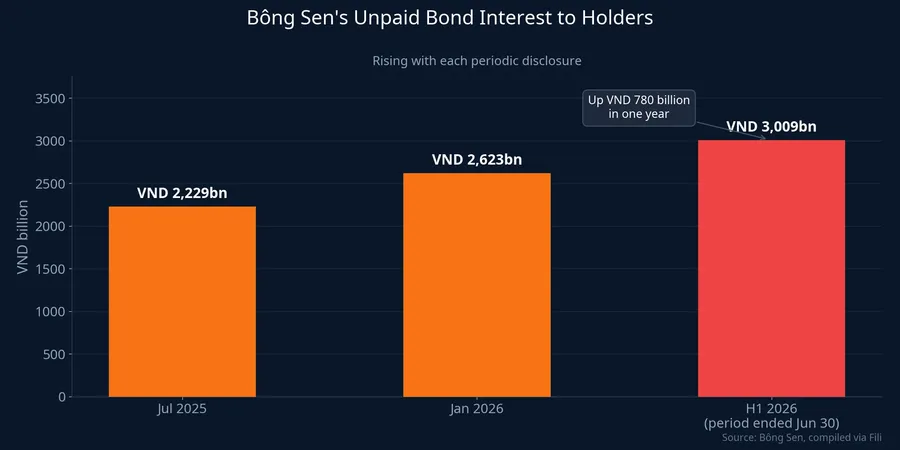
The unpaid balance has climbed with every disclosure: roughly VND 2,229 billion in July 2025, VND 2,623 billion in January 2026, and VND 3,009 billion for the reporting period from January 1 to June 30, 2026.Fili Add the VND 4,800 billion principal, and total overdue bond obligations now exceed VND 7.8 trillion. Because of the payment breach, the tranche is now subject to a penalty rate equal to 150% of the contract rate, or 15.75% a year.
The disclosed collateral consists of a 30% stake in Tri Duc Company, valued at VND 180 billion, and 63.45 million Daeha shares, valued at VND 634.48 billion — Daeha operates the Daewoo Hotel in Hanoi — plus other real estate assets that haven't been given a disclosed valuation.

Together, the two main collateral items add up to roughly VND 814 billion, less than a fifth of the bond's face value. The issuer's financial picture has been eroding for a while: at the end of 2025, Bông Sen posted a net loss of VND 678.57 billion, accumulated losses of VND 3,429 billion, equity of just VND 4,214 billion, and liabilities of VND 9,466 billion, with a current ratio of only 0.89.Người Quan Sát Auditors declined to issue an opinion on the 2025 financial statements, citing doubts about the company's ability to continue as a going concern. The VND 4,800 billion principal on this bond comes due on October 15, 2026, about six weeks away.
What to look at, if not the coupon
Who the issuer is, and who supervises it. Sacombank is a listed commercial bank under ongoing State Bank of Vietnam supervision for capital adequacy and liquidity, and it publishes quarterly financials. Bông Sen is an unlisted company that issued bonds to fund a real estate project, and its latest financial statements received a disclaimer of opinion from auditors.
Whether the collateral has an independent valuation. Bank bonds typically carry no collateral at all. Buyers are effectively lending against the bank's whole balance sheet. Collateralized corporate bonds sound safer, until you compare the disclosed value against face value. Bông Sen's VND 814 billion against a VND 4,800 billion face value shows that collateral isn't automatically a thick enough cushion.
Payment history. This is the simplest and easiest criterion to check, via HNX's dedicated corporate bond disclosure portal. A company that has paid in full, on time, across many periods has a fundamentally different track record from one that stopped paying from its fourth period onward.
The coupon relative to peers in the same group. In August 2026, Vinhomes issued a VND 2,000 billion, 3-year tranche with a first-two-period rate of 12.5%, while Tandoland raised VND 258 billion over 5 years at up to 13% in its first two periods. The market's highest coupons still belong to the real estate sector, the same sector Bông Sen sat in when it issued back in 2021.
A 10% bank bond still isn't a savings deposit
One clarification, to avoid the opposite misunderstanding: a bank bond is not a higher-yielding version of a savings account. Bank deposits are covered by deposit insurance up to a maximum of VND 350 million per person per institution, under a cap effective since July 13, 2026.Deposit Insurance of Vietnam Bonds fall outside that coverage. For Tier-2 capital bonds specifically, holders also rank behind depositors when the issuer runs into trouble. A 6-year term is far longer than a typical savings account too. Exiting early means selling on the secondary market at whatever price it fetches, with no guarantee of getting face value back.
The issuer itself is under its own pressure. For the first six months of 2026, Sacombank posted VND 4,136 billion in pre-tax profit, down 43.6% year-on-year, as provisioning expenses jumped 542.7% to VND 7,119 billion.MekongASEAN In exchange, its bad-debt coverage ratio rose from 50% to 57%, a sign the bank is provisioning more actively rather than avoiding the issue.
What matters most for individual investors
Both bonds discussed here were privately placed, and the door into that market has narrowed since Decree 200/2026/ND-CP, issued by the government on June 5, 2026. Individuals who want to buy or receive a transfer of privately placed bonds must now hold a listed securities portfolio worth at least VND 2 billion, averaged daily over a minimum of 180 consecutive days, excluding any margin-financed positions.LuatVietnam That professional-investor status is valid for one year.
On top of that, each Sacombank bond has a face value of VND 1 billion, so the 10% figure making headlines isn't a rate most readers who see it could actually access. That's the biggest difference between 2021 and 2026: the Bông Sen tranche had a VND 100,000 face value and was distributed onward to retail investors through a securities firm. Today's legal framework doesn't allow that structure to repeat the same way.
For individual investors who haven't reached professional-investor status, the realistic options narrow to two channels: term deposits, or bond fund certificates, where a fund manager takes on the job of vetting issuers and spreading risk across many names. The yield will be lower than the 10% headline number, but it comes bundled with the right to actually buy in, plus a layer of intermediary due diligence.
The nearest date to watch is close. On October 15, Bông Sen's VND 4,800 billion principal comes due. More broadly, total corporate bonds maturing in the final months of the year add up to VND 98,295 billion, with real estate accounting for more than half.Dân trí How that group of issuers handles its maturities will say more about the quality of Vietnam's bond market than any advertised coupon rate ever could.