

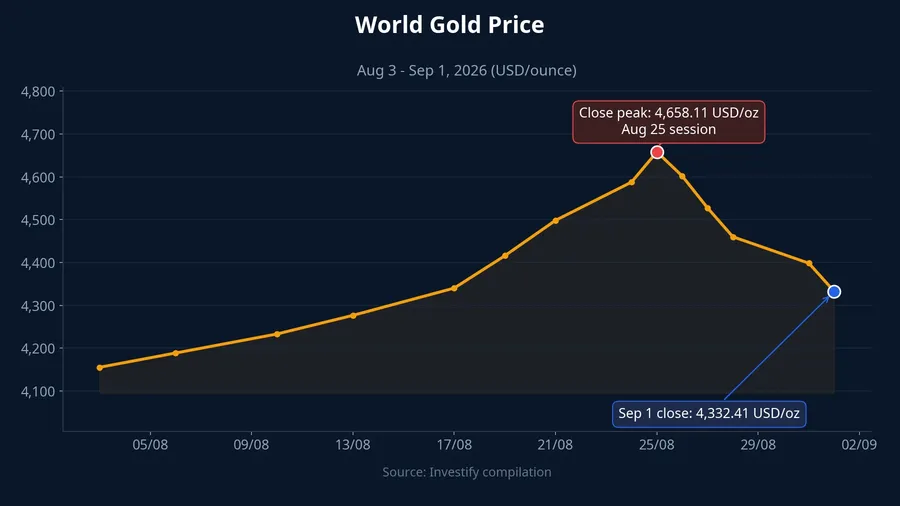
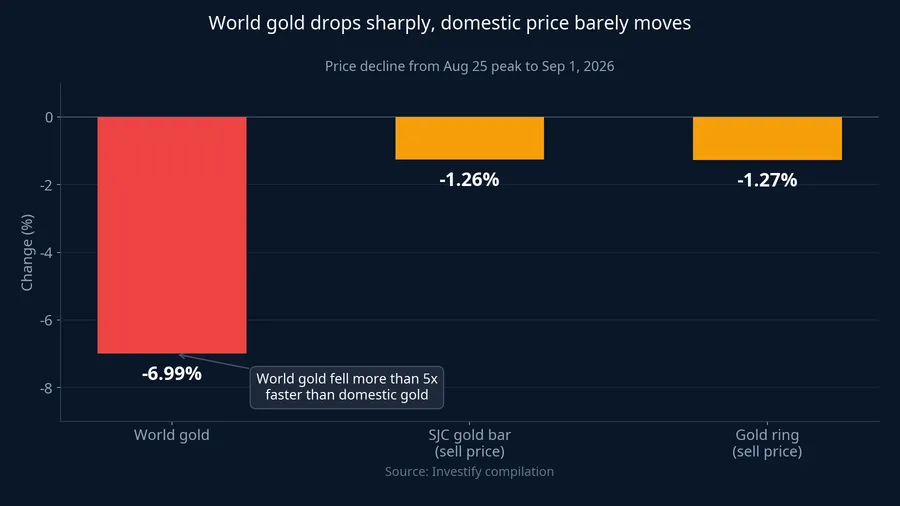
Gold's story this week reads as two contradictory halves. On the world market, the closing price on August 25 hit 4,658.11 USD/ounce, the highest level of the period.CafeF Just a week later, by the September 1 session, that figure had fallen to 4,332.41 USD/ounce, a drop of 325.7 USD per ounce, or 6.99%. Meanwhile, SJC gold bars in Vietnam only slipped from VND 150.6 million to VND 148.7 million per tael, down 1.26%.Báo Lào Cai Gold rings fell a comparable 1.27%, from VND 149.1 million to VND 147.2 million per tael. Domestic gold buyers have captured almost none of the discount the world market just handed out.
The drop started with a speech, but the speech alone doesn't explain it
The timeline is fairly clear. On August 28, Federal Reserve Chair Kevin Warsh spoke at the Jackson Hole symposium, reaffirming that the 2% inflation target is fixed and arguing the Fed still has "more work to do" before it can conclude that core inflation has returned to target.Federal Reserve He flagged the 3.7% PCE inflation reading as concerning, noting that summer data had not shown a genuine underlying improvement.MarketTimes That same session, gold fell sharply by 3.21%, its steepest single-day drop of the month, while the dollar index rose 0.4% to 99.55 and 2-year US Treasury yields climbed 12 basis points to 4.35%.
The transmission mechanism here isn't complicated. Gold pays no interest and no dividend, so when US rates and yields are expected to stay elevated for longer, the opportunity cost of holding gold rises and capital tends to tilt toward income-generating assets. By the September 1 session, 10-year US Treasury yields had climbed to their highest level since January 2025, gold fell another 2.45%, and the market-implied probability of a Fed rate hike at the September 16 meeting edged up to roughly 66%, from 57% the prior weekend.Kenh14
Still, attributing the entire decline to one speech isn't fully convincing. At least two other factors contributed. First, profit-taking after a hot rally: gold climbed from 4,055.13 USD/ounce on August 3 to a peak of 4,658.11 USD/ounce on August 25, a 14.9% gain in just three weeks, large enough that some holders were primed to lock in profits at the first piece of bad news. Second, oil: Brent crude pushed back above 90 USD/barrel following military tension around the Strait of Hormuz, nudging inflation expectations higher and reinforcing the case for a hawkish Fed.CafeF
The data currently lean toward rate expectations as the primary driver, since all three sharp-decline sessions coincided with rising US yields and a stronger dollar. But had gold not just gone through a near-15% rally in three weeks, the reaction would likely have been milder.
Why the domestic price isn't following
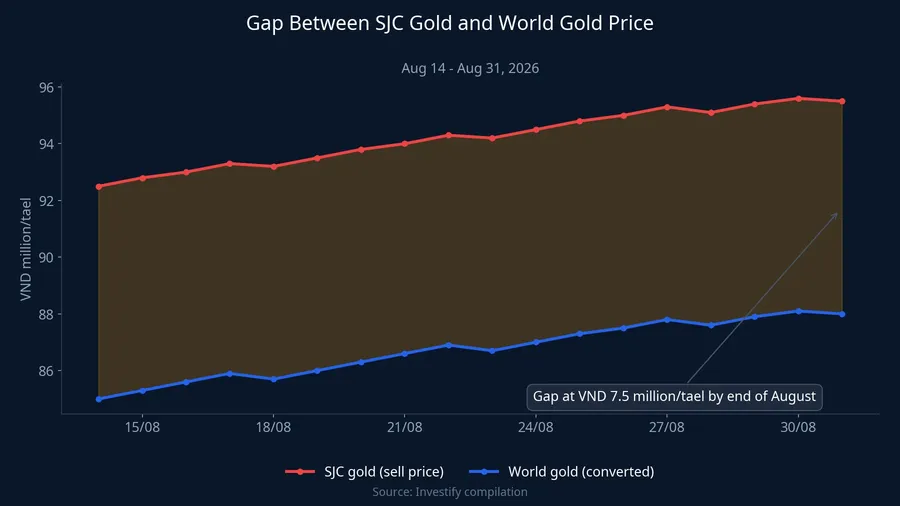
The gap between the two price boards has widened noticeably over the past few weeks. Converting the world price to VND at the 26,096.5 VND/USD exchange rate, with one tael equal to 1.20565 troy ounces, the world gold price on August 28 worked out to roughly VND 140.1 million per tael, while SJC was selling at VND 150.2 million, a 7.2% gap. By September 1, the converted world price had fallen to about VND 136.3 million per tael, while SJC remained unchanged at VND 148.7 million.Tiền Phong The gap has widened to roughly VND 12 million per tael as a result.

There are two main reasons for this lag. Domestic gold bar supply remains tight relative to demand, so retail prices are anchored more by local supply-demand balance than by session-by-session international pricing. On top of that, gold traders typically adjust selling prices more slowly on the way down than on the way up, protecting the cost basis of inventory they already purchased.
For individual investors, the practical consequence is that this gap becomes a real cost. Buyers today are paying roughly VND 12 million more per tael than the converted world price, and that premium is only recovered if the gap holds steady by the time they sell. The gap itself is far from stable: it moved from near zero on August 19 to 7.2% just nine days later, which means it isn't a number investors can safely rely on staying put.
Two data branches will decide September's direction
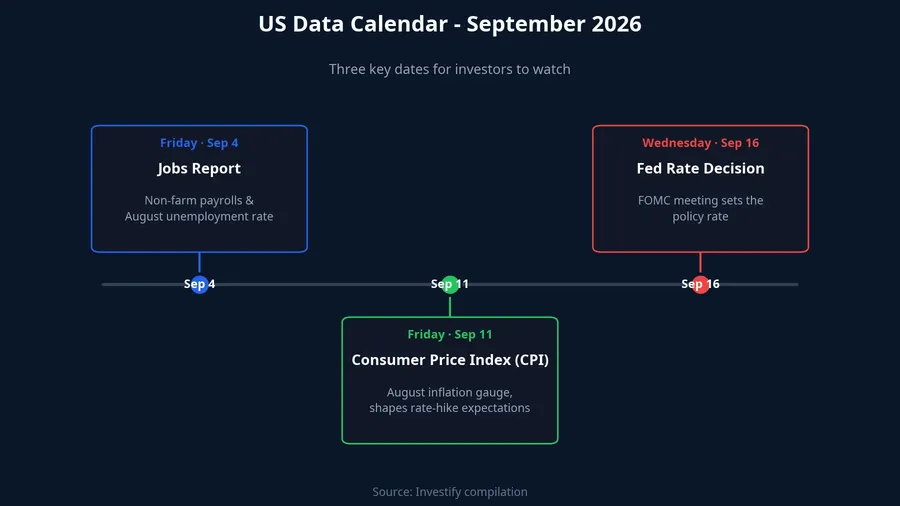
Where world gold goes next hinges on a specific sequence of US data releases, not on vague forecasting. The August non-farm payrolls report, due out Friday evening September 4, is the nearest milestone.Polymarket Trader Analysts expect roughly 55,000 jobs added, following a 23,000 decline in July, with unemployment holding at 4.1%.FinancialJuice
In the branch where data confirms a hawkish stance: if the actual print clearly beats forecasts and the CPI reading due around September 11 shows no cooling, the case for a rate hike at the September 16 meeting strengthens. In that scenario, world gold likely faces further pressure, and this is also when the domestic price will struggle to hold steady, since the VND 12 million gap is already elevated and gold traders will need to cut prices to avoid sitting on cost-basis risk.
In the opposite branch, given the US labor market already lost 23,000 jobs in July, another soft August print is a real possibility. If jobs come in below forecast or inflation cools, September rate-hike odds would likely ease back from the current 66%, the dollar would soften, and gold would have room to recover from the 4,330 USD/ounce area. Worth noting: domestic buyers won't capture the full rebound, because when the world price rises while the domestic price is already elevated, the gap tends to narrow, and that narrowing eats into returns.
What both branches share is that the Fed's September 16 decision is where risk concentrates most heavily. Ahead of that date, two-way volatility tied to each data release should be expected, rather than a clean trend in either direction.
A monitoring framework for current and prospective gold holders
For long-term gold holders, the current pullback has only given back about half of August's gain. Compared with the start of August, world gold is still up 6.8%. Over a multi-year horizon, gold's role in a portfolio is typically hedging, not generating weekly returns, so a 7% correction on its own doesn't change the underlying reason for holding it.
For those considering a new purchase, the watch list is already laid out in order: the non-farm payrolls report Friday evening September 4, US CPI around September 11, then the rate decision on September 16. Alongside those dates sits an indicator Vietnamese investors can track daily without waiting on US news: the gap between the domestic price and the converted world price. Buying while that gap is widening means prepaying a cost that could disappear by the time you sell.
Investors may want to consider: given gold's hedging role, a common allocation for individual portfolios sits in the single digits up to roughly 10%, and buying in staggered tranches is a standard approach during a stretch of sharp two-way volatility like the one ahead.
At this stage, gold is trading on US rate expectations rather than physical demand, so the US data calendar over the next two weeks will say more than the price board outside any gold shop. Friday evening's jobs report on September 4 will be the first signal of which scenario is gaining the upper hand.