

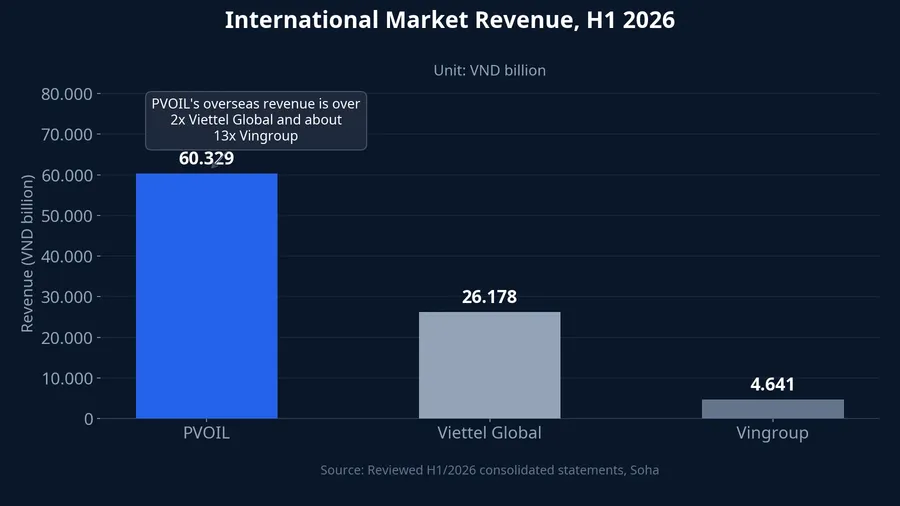
PVOIL's reviewed consolidated H1 2026 financial statements, released September 2, contain one striking line: revenue from international markets alone reached VND 60,329 billion, up nearly 95% from VND 30,951 billion a year earlier and accounting for more than 44% of total net revenue of VND 136,569 billion.Soha Put that number in context: over the same six months, Viettel Global recorded only about VND 26,178 billion in overseas revenue.Soha A fuel retailer that most individual investors know only from its gas station signage is generating overseas revenue more than double that of Vietnam's largest telecom investor abroad, and roughly 13 times Vingroup's international revenue.
But the impressive figure doesn't stand alone. In that same growth period, PVOIL posted its first quarterly loss in almost four years. Two metrics moved in opposite directions inside the same report, and the explanation lies in profit structure, not revenue scale.
Where the money comes from
PVOIL's international revenue isn't retail fuel sold in Laos or Cambodia, even though the company holds legal entities in both countries. Most of it flows through PVOIL Singapore, the trading arm that markets and sells crude extracted in Vietnam alongside Petrovietnam's overseas crude. This is large-scale crude oil trading, not end-consumer retail.Markettimes
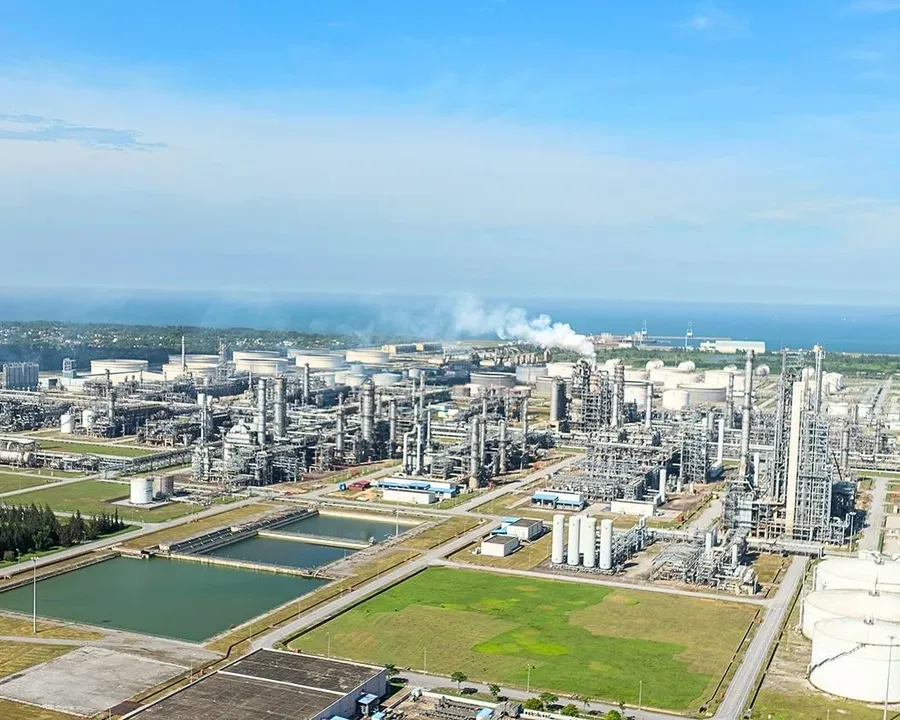
The clearest expansion this year is the crude supply chain feeding the Nghi Son Refinery. In June 2026, PVOIL Singapore delivered nearly 2 million barrels of Iraqi Basrah crude to Nghi Son. PVOIL's board subsequently approved transactions with PVOIL Singapore to join a consortium supplying crude to the refinery, worth roughly $600 million and running from July through the end of 2026.CafeF
Beyond expanding volumes, oil prices themselves inflate the revenue line: crude trading revenue is booked on the value of cargo shipped, so whatever the oil price gains, revenue expands by roughly the same amount at a constant volume. Scale doesn't equal efficiency for a commodity trading business.
Record revenue, quarterly loss
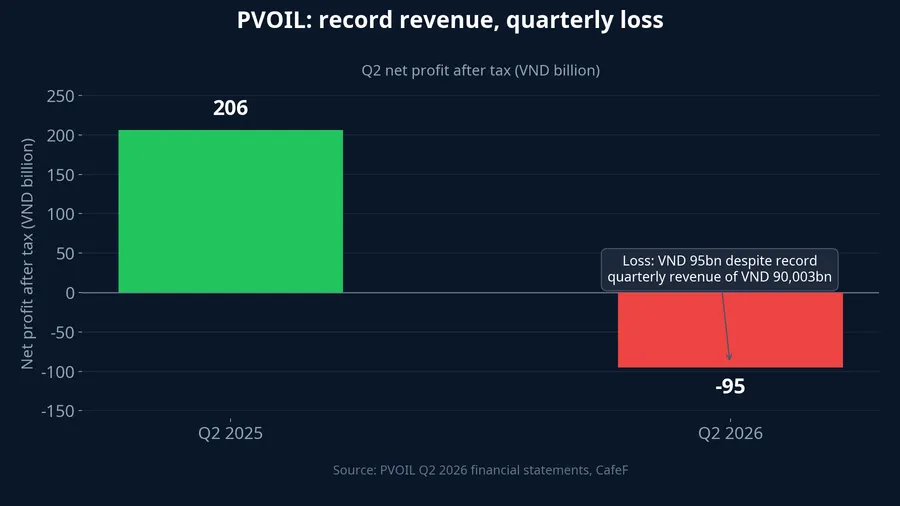
This is where the story turns. Per the Q2 report released in late July, PVOIL posted net revenue of VND 90,003 billion in Q2, up 126% year-on-year and the highest quarterly revenue in company history.CafeF That same quarter, the company posted a consolidated net loss after tax of VND 95 billion, versus a profit of VND 206 billion in Q2 2025. It was PVOIL's first loss-making quarter in nearly four years.
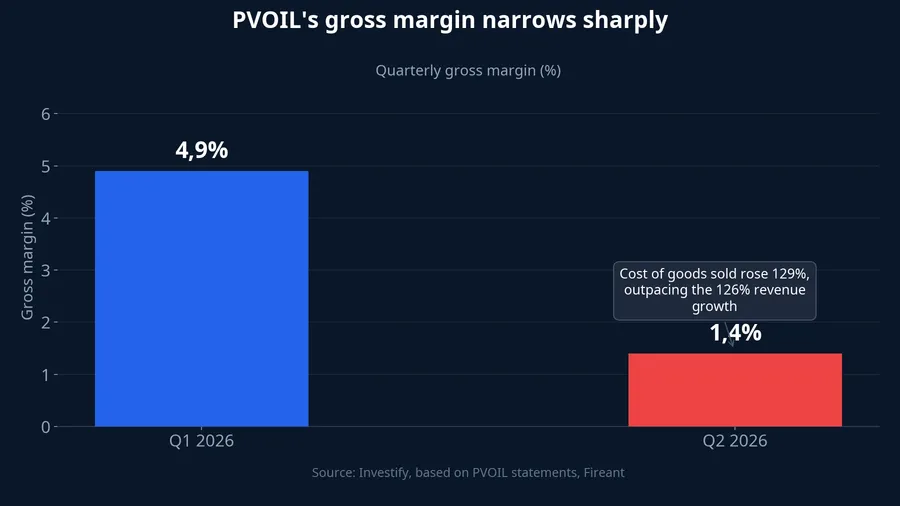
The cause sits entirely in the income statement. Cost of goods sold rose 129% to VND 88,725 billion, outpacing the 126% revenue growth. Gross profit reached just VND 1,278 billion — a gross margin of about 1.4% — up only 10% from VND 1,164 billion a year earlier despite revenue more than doubling. Financial expenses simultaneously climbed from VND 103 billion to VND 244 billion, with interest expense alone accounting for VND 185 billion.
Why the margin compressed so fast
The backdrop: average Q2 Brent DTD crude prices reached $104.5 a barrel, up 54% year-on-year.Fireant For a fuel trading company, a fast-rising oil price is not good news: domestic retail prices adjust on a seven-day cycle, while import costs change daily. When world prices climb mid-cycle, the company buys at the new, higher level but still sells at the old regulated price, and that gap gets swallowed in the trading margin.
Inventory amplifies the swing further. PVOIL's inventory jumped from about VND 2,793 billion at the start of the year to over VND 11,191 billion at end-Q1, then retreated to about VND 5,921 billion at end-Q2, with inventory write-down provisions rising from VND 15 billion to VND 232 billion.Fireant Minimum-reserve requirements force fuel importers to hold large volumes at all times, so every time prices reverse, inventory gains or losses get magnified relative to the true profit of the distribution business.
H1 profit still up, but heavily front-loaded into Q1
Taken together, H1 consolidated net profit after tax still rose to VND 498.9 billion, up more than 115% from VND 231.9 billion a year earlier.Soha That growth is real, but it's almost entirely front-loaded into Q1, when the company was selling inventory bought at lower prices while oil was climbing. In Q2, that same mechanism reversed.
Against the full-year plan approved at the April shareholders' meeting — revenue of VND 150,700 billion and net profit after tax of VND 656 billion — the two targets are tracking very differently.CafeF H1 revenue has already reached more than 90% of the full-year target and will likely overshoot it. Profit has only covered about three-quarters of the distance, and the remainder depends on whether oil prices stay flat or reverse sharply again in H2.
The market already repriced OIL shares
Looking at the price chart, investors appear to have reacted to this structure well before the half-year report landed. OIL shares closed the most recent session on August 28 at VND 13,600, with a market cap around VND 14,100 billion, versus VND 11,200 on January 5. Year-to-date, the stock is still up about 21%, but the path in between is the more revealing part.
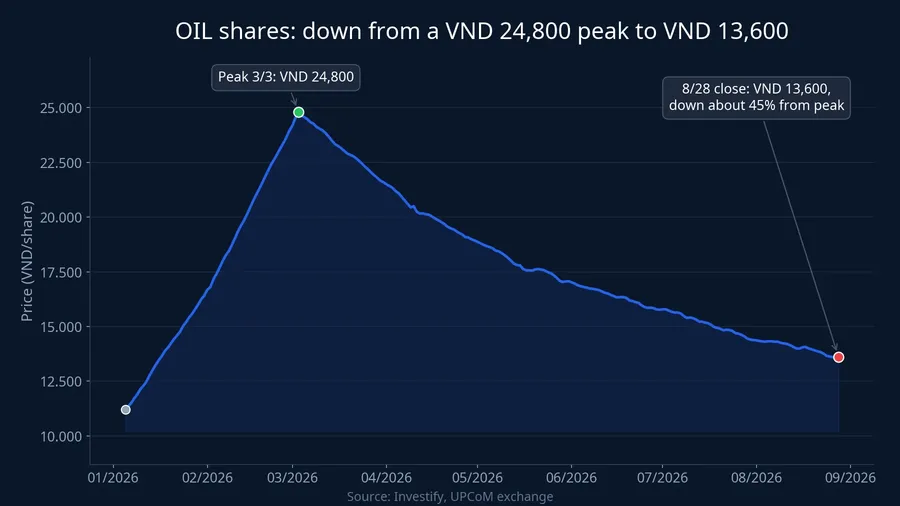
OIL climbed to a closing peak of VND 24,800 on March 3, riding the oil-price rally and growth narrative, then fell steadily to its current level, down about 45% from that peak. The period of strongest international revenue growth was also the period of the steepest share-price decline. The two trends overlap in time, but they aren't necessarily driven by the same cause. A more plausible explanation is that the market was pricing in the margin compression and inventory risk that showed up gradually across quarterly reports, rather than reacting to the size of international revenue. Liquidity wasn't the issue: matched trading volume in several August sessions ranged from over 1 million to more than 8 million shares, fairly deep for a UPCoM-listed name.
Ownership structure explains part of the valuation too. Petrovietnam still holds 80.52% of PVOIL, leaving only a small float of freely tradable shares. The company also just closed its shareholder registry on September 7 to pay a 2025 dividend of 2.5%, or VND 250 per share, totaling about VND 258.6 billion, of which Petrovietnam receives more than VND 208 billion.Mekong ASEAN The low payout ratio is deliberate: retained earnings are being used to cover outstanding provisions.
What investors should watch
OIL's clearest medium-term catalyst is the exchange-listing roadmap, not revenue growth. PVOIL is targeting eligibility to move from UPCoM to HOSE by 2027, conditional on fully resolving audit qualifications tied to its investment in PVB and the Ethanol Phu Tho project, and on avoiding any accumulated losses.BNews That makes H2 2026 results a milestone with real substance, not just another quarterly print.
For investors holding or considering OIL, three metrics matter more than revenue: quarterly gross margin (4.9% in Q1, down to about 1.4% in Q2, which signals whether the company is actually profitable before revenue growth muddies the picture); inventory value and write-down provisions at each quarter-end, a direct gauge of exposure to oil-price swings; and progress resolving the audit qualifications, the precondition for the 2027 listing story.
VND 60,329 billion in international revenue is an impressive number, and it reflects PVOIL's real role in Vietnam's energy supply chain. But for shareholders, crude oil trading is a business that exchanges large volumes for very thin margins. This company's durable profit still comes from its domestic distribution network, while the international segment delivers scale and volatility risk in roughly equal measure. H2 2026 results, especially the Q3 gross margin, will be the next test of that story.