
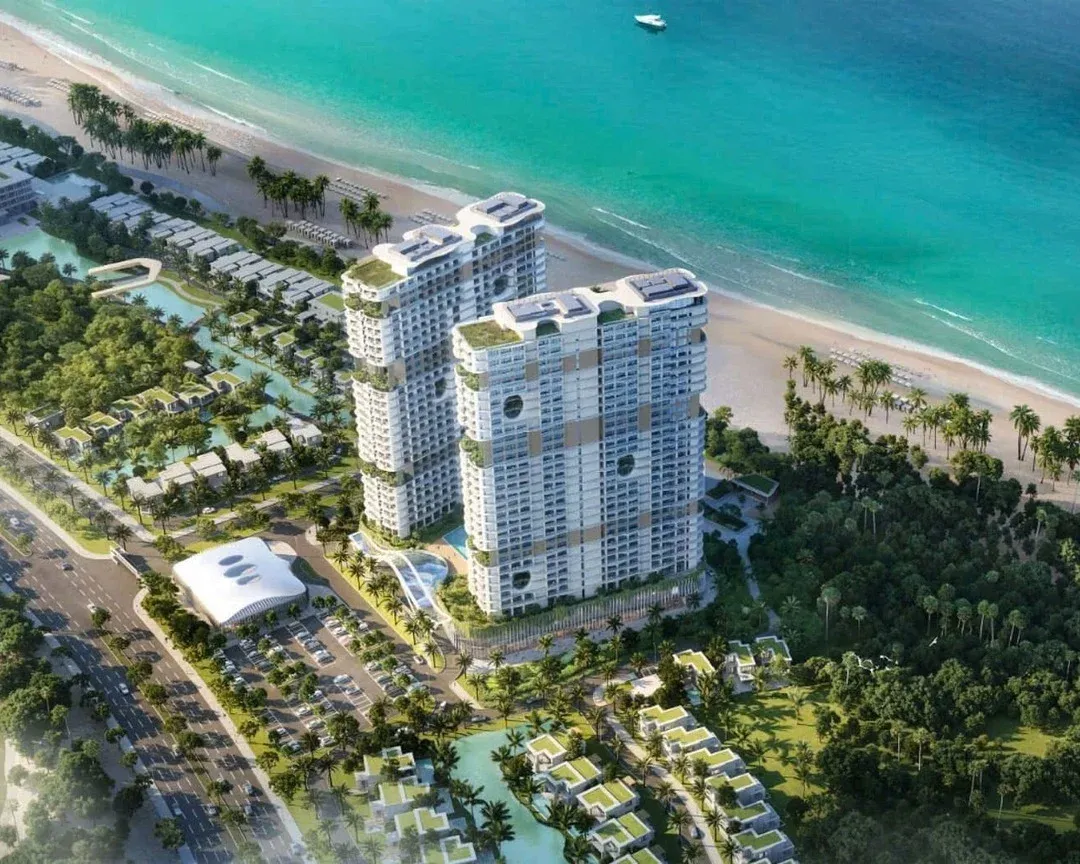

In 2018, more than 100 buyers put down money for units at the Grand Hotel Ha Long project, then signed a second contract on top of the first: leasing the unit they had just bought back to the developer in exchange for a guaranteed annual return. That was the standard condotel model at the height of the boom. Buyers didn't need to find guests or clean rooms. They just collected a check on schedule.
Payments came for a few cycles, then stopped. Between 2019 and 2020, FLC Ha Long Investment and Development Co. repeatedly fell behind on rental payments, at one point switching unilaterally to paying with internal consumer vouchers instead of cash as the contract required.Báo Đầu tư It wasn't until late March 2026 that the Quang Ninh Provincial People's Court ruled to terminate all of the more than 100 lease and management contracts, ordering the company to return the units and furnishings and pay back rent, late-payment interest, and an 8% penalty. Compensation per investor ranged from a few hundred million to several billion dong, and in some contracts, the gap between the missed payment and the court ruling stretched past five years.CafeF Who compensates investors for five years of waiting? No one, aside from whatever the court eventually orders.
One ruling, and 146,438 units behind it
Ha Long is not an isolated case. On September 2, figures widely cited across Vietnamese media showed roughly 146,438 resort real estate units nationwide stuck in legal limbo, most from projects developed between 2007 and 2020.CafeF That figure includes about 82,900 condotel units, more than 28,000 tourism villas, over 12,600 hotel rooms, and more than 10,000 officetel units, concentrated in Khánh Hòa, Đà Nẵng, An Giang, and Lâm Đồng.Tiền Phong
Worth distinguishing: this is a legal backlog, not unsold inventory. Many of these units were fully paid for years ago. They simply never received a title deed. For buyers, that distinction offers little comfort. The money is gone and ownership is still in limbo.
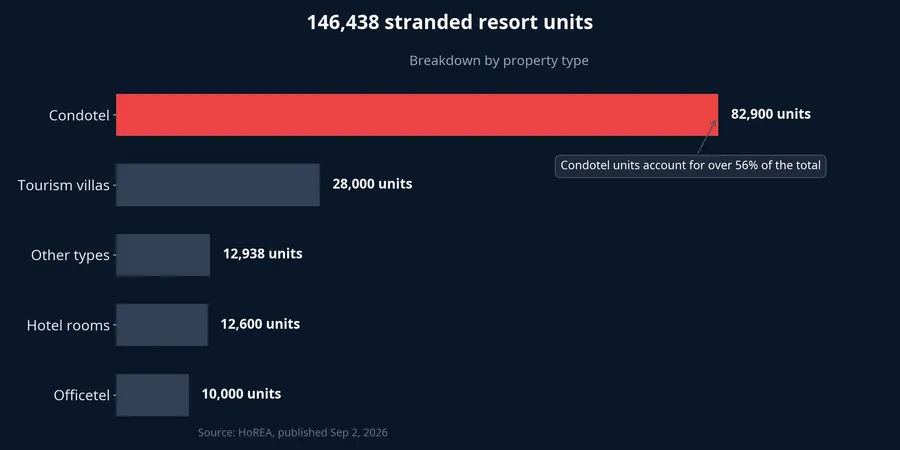
The law opened up. The number didn't move.
The common explanation is that condotel is stuck because the law never caught up. That was true for 2016-2019. It's outdated now. Vietnam's 2024 Land Law classifies condotel as accommodation structures on commercial-service land, eligible for title certificates matching the project's land-allocation or lease term: typically 50 years, capped at 70.
The National Assembly then passed Resolution 29/2026/QH16 on April 24, 2026, effective May 1, 2026, establishing a mechanism to issue title certificates for condotel and officetel units at stalled "residential land without residential units" projects.CAND Four months after that resolution took effect, the figure published on September 2 was still 146,438 units. If legal gaps were really the only bottleneck, that number should have started moving by now. It hasn't, and that's a signal the real problem sits somewhere else.
A formula that never balanced
The profit-commitment model looks simple on paper: developers sell units bundled with an 8-12% annual return commitment, then lease those same units back to run as hotel rooms, using operating cash flow to pay buyers. The catch is that operating cash flow is rarely enough. Hospitality researchers estimate actual operating yield for Vietnam's resort hotel industry at only around 6-7.5% a year.Fireant From the moment the ink dried, the committed return sat 4-5 percentage points above what the asset itself could realistically generate.
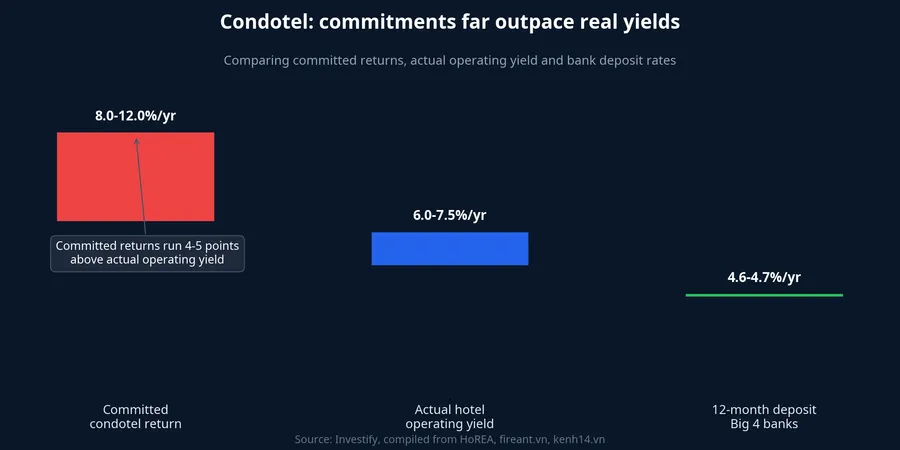
That gap has to come from somewhere. In practice, it gets folded into the original sale price and paid back out under the label "guaranteed profit." That's not real profit. It's a form of reverse installment plan funded by the buyer's own money.
To be fair, the tourism industry has done its part. In 2025, Vietnam welcomed nearly 21.2 million international visitors, up more than 20.4% from 2024 and the highest figure on record.Hà Nội Mới Demand for lodging isn't the problem. So why hasn't confidence in condotel come back?
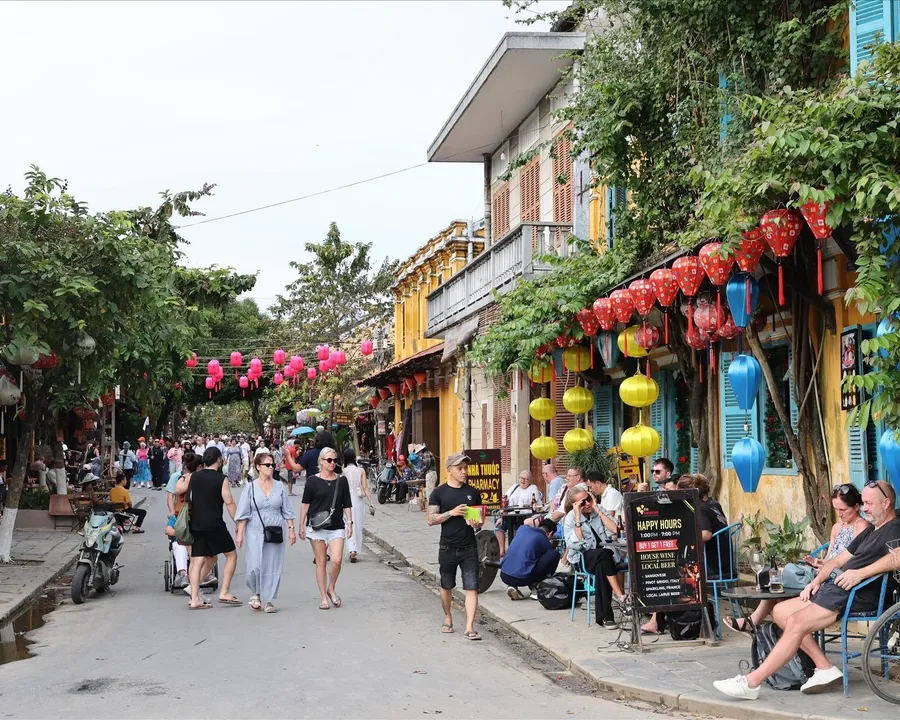
Hotels filling up doesn't make the condotel commitment model viable, because the two are independent of each other. The hospitality industry can thrive on occupancy and room rates alone, while the bundled return commitment remains a debt the developer can't afford to pay, whether rooms are full or empty. The risk sits in the structure of a financial product disguised as real estate, not in lodging demand.
What the foreign-buyer proposal actually fixes
On September 2, Lê Hoàng Châu, Chairman of the Ho Chi Minh City Real Estate Association (HoREA), put forward three policy proposals for condotel: letting foreign individuals with legal entry status buy resort real estate under rules similar to condo purchases, adding a standard short-term lease contract template for cross-border booking platforms, and legally recognizing electronic contracts from Airbnb, Booking.com, and Agoda, paired with a mechanism for platforms to withhold personal income tax on the owner's behalf. The association also proposed capping foreign ownership at no more than 30% of units in any single building.MarketTimes
Worth being clear here: this is a proposal submitted during public consultation on the draft amended Law on Real Estate Business, not an issued regulation. The three proposals also don't carry equal weight. Opening up a new pool of buyers could add liquidity to unsold inventory, but it doesn't fix the yield math underneath: foreign buyers will run the same occupancy and cost calculations as domestic investors, and they have no obligation to accept an unrealistic commitment just because they're now allowed to buy.
The other two proposals, by contrast, go straight at operating cash flow. If electronic contracts on booking platforms get legal recognition and tax mechanics get clarified, owners can operate their own units instead of depending entirely on a developer's promise. That's the change that would actually alter the model, not just add buyers to a structure that was skewed from the start.
A checklist for any guaranteed-return product
The lesson here isn't that resort real estate is bad. It's that the word "guaranteed" carries entirely different legal weight depending on the product. A bank deposit rate is an obligation of a licensed, supervised credit institution, backed by deposit insurance up to VND 125 million per person per bank. In early September 2026, 12-month deposit rates at the Big 4 state banks sat around 4.6-4.7% a year, while some joint-stock banks paid 7% or more.Kenh14 A condotel return commitment is nothing like that: it's a civil agreement between buyer and developer, with no regulator overseeing the cash flow, no reserve fund, and no third party standing behind it if the developer can't pay. When the money runs out, the only path left is a lawsuit, and the Grand Hotel Ha Long case shows that path can take more than five years.
For any product sold with a fixed-return commitment, four checks are worth running before signing. One, run the cash-flow math yourself: multiply the area's actual room rate and occupancy by nights operated, subtract operating and management costs, and see whether the result actually reaches the committed return. Two, ask who's backstopping the commitment: collateral, a bank guarantee, or just a signature on a contract. Three, read the land classification and term on the title certificate closely. 50-year commercial-service land doesn't price the same as freehold residential land. Four, ask about the exit directly: if you want to sell in three years, who's buying, and at what price.
When a committed return clearly exceeds the operating yield of the industry it's supposedly built on, that gap isn't coming from genuine business performance. It's coming from the buyer's own money, and the buyer is always the one left holding the shortfall. For the resort market, the signal worth watching over the coming months isn't how many new projects launch for sale. It's how fast title certificates get issued under Resolution 29 in Khánh Hòa and Đà Nẵng, and what the final text of the amended Law on Real Estate Business looks like once it passes.