


At 9am on Thursday, September 3, Vietnam's trading boards lit back up after the National Day holiday that began August 29. The last number investors saw was 1,832.12 points, the closing level from the August 28 session.Tinnhanhchungkhoan But while the boards sat dark for three days, global markets ran through three full trading sessions of turbulence that Vietnamese share prices had not caught up with at all.
The big picture here isn't simply "the world went up or down." Those three sessions split cleanly into two phases: the first two saw oil climbing while Asian equities stayed in the green, and the third flipped everything at once. Separating what domestic prices already absorbed before the holiday from what's still hanging in the air is the key to reading the September 3 reopen correctly.
What changed while the boards were dark
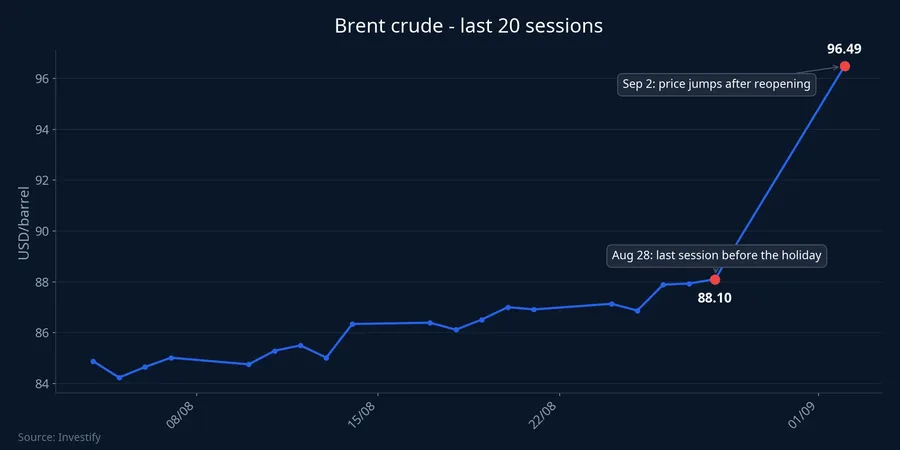
The variable that moved hardest was Brent crude. When Vietnam's market closed on August 28, Brent sat at $88.10 a barrel. By the end of September 2, that figure had jumped to $96.49, a gain of $8.39 in just three sessions, or 9.52%.
The direct trigger was a chain of US-Iran strikes and counter-strikes around the Strait of Hormuz. On August 30, US forces attacked two Iranian missile launch sites on Larak Island. On August 31, Iran retaliated with ballistic missiles and drones targeting US bases in Jordan, the UAE, and Bahrain.CafeF On September 1, the US struck further targets near the strait, and Iran fired back again almost immediately.CafeF
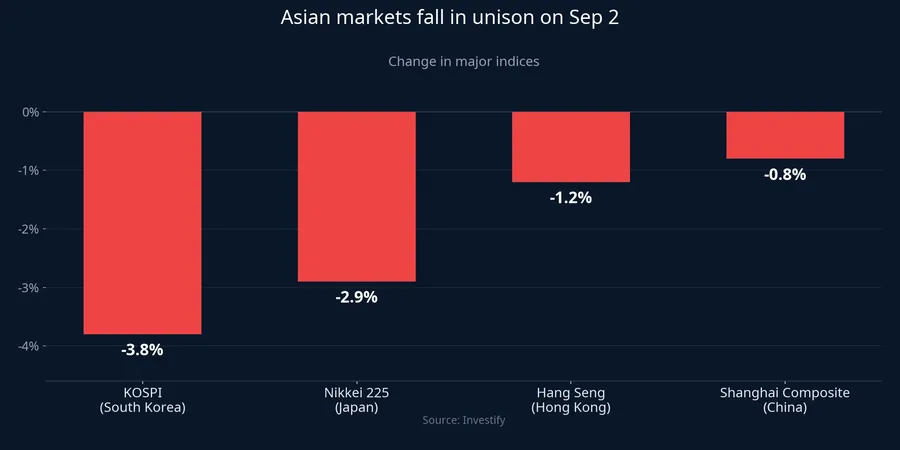
Global capital reacted right away in the September 2 session. Japan's Nikkei 225 fell a sharp 2.9% to 64,274 points, South Korea's KOSPI dropped even further, down 3.8% to 6,577.08 points, while Hong Kong's Hang Seng and China's Shanghai Composite slipped a milder 1.2% and 0.8% respectively. A session earlier, the Dow Jones had already fallen 0.8%, closing out the week down 1.5%.
The exchange rate was the rare bright spot in an otherwise grim picture. The dong strengthened slightly against the dollar, with USD/VND easing from 26,096.5 on August 28 to 26,072.5 on August 31, a 0.09% gain for the dong, moving against a dollar index that had climbed roughly 0.74% over the same week. That's not the variable to worry about on reopening day.
Bonds are saying something equities haven't said yet
When conflicts escalate, the textbook reaction is capital fleeing into government bonds for safety, pushing yields down. The last three sessions did the opposite, and that's the most telling signal of all.
On September 1, Japan's 10-year government bond yield touched 3% for the first time since 1996, while the US 10-year yield climbed to 4.78%, its highest level since early 2025.VnExpress Bonds were being sold, not bought, at exactly the moment the world should have been at its most fearful of war.
At the same time, the probability of a Fed rate hike at the September meeting climbed to roughly 65%, up from 34% before the Fed Chair's speech at Jackson Hole.VnExpress In other words, the market is adding energy costs to its inflation math, then layering higher rates on top of that for equity valuations.
This isn't the only way to read it. The Asian selloff on September 2 could just as easily reflect profit-taking after a strong run-up, or worry about shipping disruption through Hormuz hitting energy-importing economies like Japan and South Korea directly. What makes the inflation reading more convincing is the direction of yields: if markets were purely afraid of war, capital would have flowed into government bonds and yields would have fallen, not risen.
Why 9.52% shouldn't be read as a straightforward opportunity
$96.49 a barrel sounds like uncharted territory, but it isn't quite that. On August 21, Brent had already closed at $94.39 before pulling back to $86.94 by August 26. The market stood in the $94 range less than two weeks ago, and Vietnam's oil and gas stocks already had a full repricing cycle around that level.
That repricing cycle left a clear trail on August's price charts. GAS climbed from VND 71,200 to VND 84,200, a gain of 18.26%. PVS rose from VND 34,500 to VND 39,600, up 14.78%. Most of the rest of the oil and gas group peaked around August 19-24, then came under profit-taking pressure as soon as Brent turned lower toward month-end. Chasing this group at the open on September 3 is largely paying for news that's already out, with the added risk that the Hormuz standoff could cool off unexpectedly.
Input costs are the part not yet priced in
On the flip side, businesses that use oil as an input cost are where the impact still lies ahead, not yet visible on any price chart. Per the cost formula Vietnam Airlines has previously disclosed, every $1-a-barrel rise in fuel adds roughly VND 300 billion to its annual costs.Người Quan Sát Applied to the $8.39-a-barrel jump that just happened, simple multiplication produces a sizable figure if this price level holds.
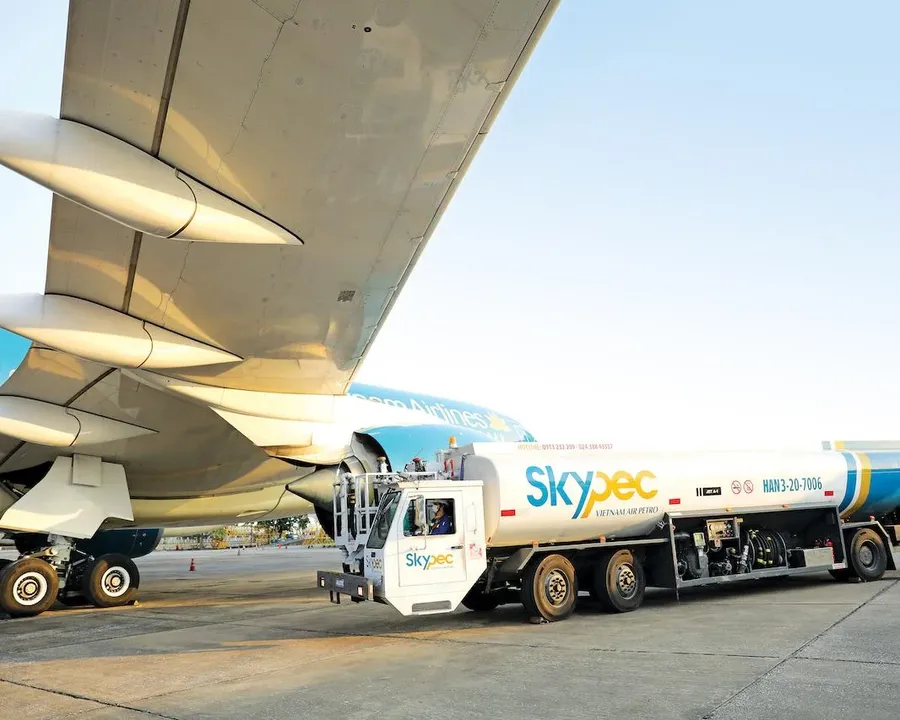
Transport and logistics companies absorb fuel costs almost immediately. Plastics and chemicals feel it through raw material prices, but with a lag of a few months while low-cost inventory works through the system. Seafood exporters feel it indirectly, through packaging and freight. The common thread across all three groups is that August's share prices haven't reflected any of this yet, simply because the pressure will show up in the coming quarters' financial reports, not in today's headlines.
What else to watch on September 3
The reopening isn't just about the trading board. Vietnam's domestic fuel price adjustment period falls exactly on September 3, and per Thanh Nien's forecast, gasoline prices may rise while diesel eases slightly, with the band under VND 1,000 per liter or kilogram before accounting for the price stabilization fund.Thanh Nien That figure is a direct read on how much of the energy cost shock is passing into the domestic economy.
S&P Global's August manufacturing PMI is also due out the same day. This index measures order demand, and set against rising input costs, it tells you whether businesses still have room to pass costs on to buyers or have to absorb the difference themselves.
Technical levels were already marked out by brokerages before the holiday. Per a roundup from Người Quan Sát, Vietcap set a target range of 1,840-1,850 points with support near 1,810-1,820, while VCBS and Kafi stayed neutral, warning of volatility within the 1,810-1,850 band.Người Quan Sát Tinnhanhchungkhoan leans toward a consolidation scenario around 1,800-1,820 to rebuild the price base.Tinnhanhchungkhoan
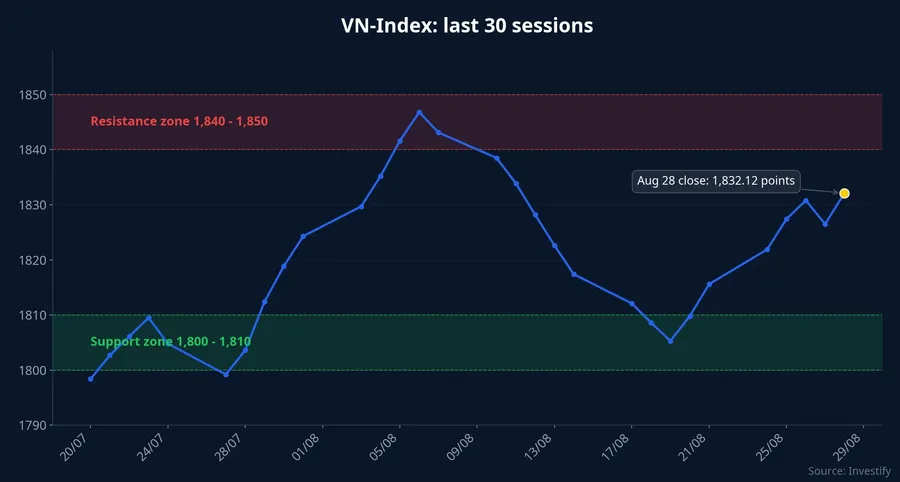
One historical data point worth noting: per FireAnt's statistics, over the past 10 years the VN-Index has risen on the first trading day after the September 2 holiday only 3 times, and the first session after the 2024 holiday fell as much as 28 points.FireAnt That statistic describes a tendency, not a rule, and on its own it isn't enough to forecast this particular September 3 session.
Domestic liquidity is still solid, and that's the cushion
The final trading week before the holiday wasn't weak at all. Average daily trading value on the HOSE reached VND 18,560.1 billion, 12.1% above the prior 20-session average, and the VN-Index had cleared the 1,800-point resistance zone to close the week at 1,832.12 points.
Foreign capital flows are a different story depending on which data set you read. Matched-order data on HOSE shows foreign investors were slight net sellers of VND 59.7 billion during the August 24-28 week, while Tinnhanhchungkhoan recorded net buying of over VND 1,100 billion across all three exchanges.Tinnhanhchungkhoan The gap comes down to statistical scope and how negotiated trades are counted, but both versions point to the same conclusion: foreign flows that week hovered around neutral, not a deliberate pullout.
A framework for the reopening session
Given all this, the sensible defensive posture isn't guessing whether the index opens green or red. It comes from separating what's already priced in from what isn't.
What's priced in is the Hormuz-driven oil story. Oil and gas names already ran through August, and $96.49 a barrel is only about $2 above the prior peak. Chasing this group at the open is largely paying for news that's already out.
What isn't priced in is the input-cost hit facing airlines, transport, plastics, and seafood exporters, layered on top of a higher global rate environment. Both of these flow into Q3 and Q4 earnings reports, not into Thursday morning's trading board. For portfolios already fully invested and carrying margin, the 1,830-1,850 range is the resistance zone nearly every brokerage has flagged, so trimming leverage before the index reaches that zone is a common way to cut risk. For portfolios still holding meaningful cash, the 1,800-1,810 level is the test: holding it keeps the price base intact, losing it triggers a pullback scenario toward 1,780-1,800.
The decisive signal isn't the opening minute, it's the session's full-day liquidity. If trading value holds around the VND 18,500 billion level from the pre-holiday week even as the index wobbles, domestic capital is staying put. If liquidity contracts sharply while the index falls, that's the moment the energy cost shock is genuinely starting to get priced in.