


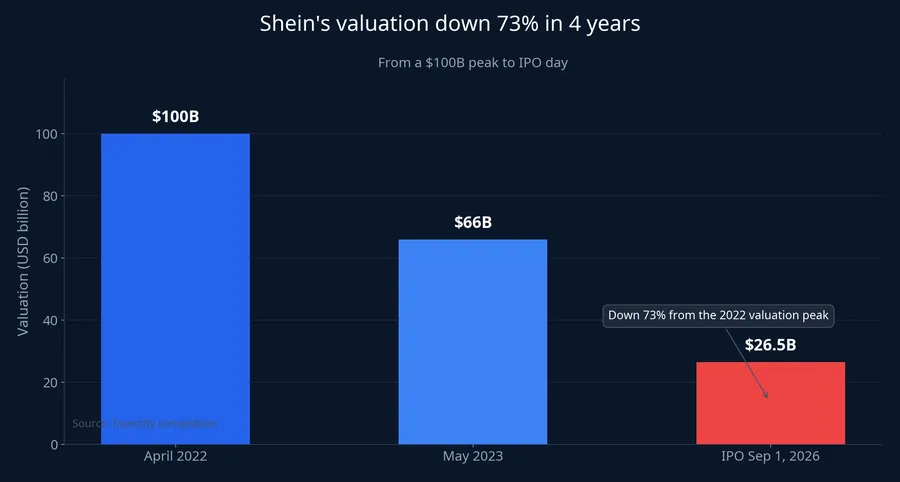
On September 1, 2026, Shein shares began trading on the Hong Kong Stock Exchange under ticker 00625. The company sold 280 million shares at HK$48.56 apiece, raising roughly $1.74 billion and valuing the entire business at approximately $26.5 billion.Asharq Al-AwsatCryptobriefing Four years earlier, the same company had been valued at nearly $100 billion.
What the headline number doesn't say upfront: that 73% gap didn't come from Shein losing money or losing customers. It came from a single US customs provision, one that any government can erase in a morning. For Vietnamese investors, this story deserves a closer read than a routine IPO headline, because the legal risk Shein just absorbed in full is also hanging over the country's own garment export sector.
Revenue kept rising, value kept vanishing
In April 2022, a funding round involving General Atlantic, Tiger Global and Sequoia Capital China valued Shein at $100 billion, higher than the combined market caps of H&M and Zara at the time.TechCrunch A year later, the company raised another $2 billion but cut its own valuation to $66 billion.FashionDive The market didn't even wait for the official debut: on the evening of August 31, Shein shares on Futu's grey market closed down 13.1% at HK$42.20, after falling as much as 28% below the offer price at one point.SCMP On listing day itself, the stock slipped a further 7%.CNBC
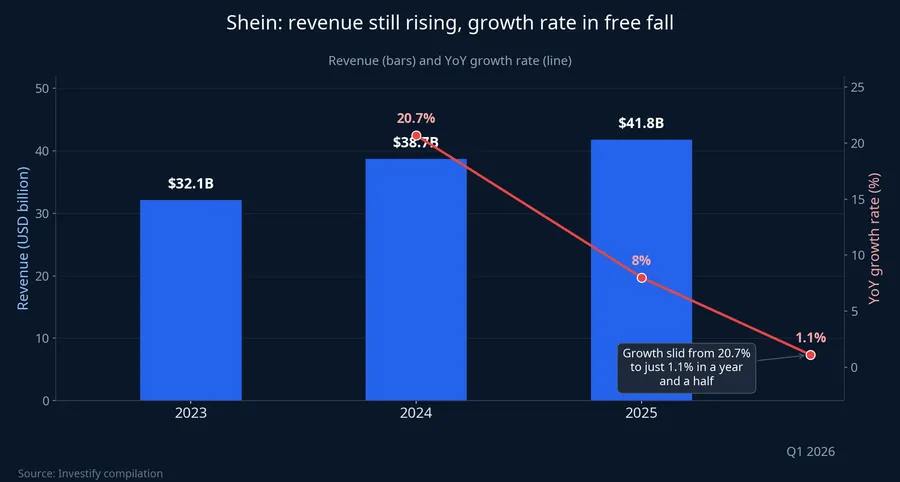
What's notable is that Shein didn't actually shrink during the period its valuation evaporated. Per the prospectus filed with HKEX, revenue climbed from $32.1 billion in 2023 to $38.7 billion in 2024 and $41.8 billion in 2025.ChineSellers The problem is the pace: revenue growth was 20.7% in 2024, slowed to just 8% in 2025, and fell to 1.1% in Q1 2026.WWD Net profit moved the same direction: 2025 net profit fell 38.7% to $2.064 billion, down from $3.365 billion in 2024.ChineSellers In Q1 2026, Shein posted a net loss of $99 million, reversing a $395 million profit in the same quarter a year earlier, while operating profit fell 26% to $258 million.WWDBusiness Model Analyst
Here's the real risk: over the past two years, every additional dollar of revenue left Shein with just 3.4 cents of profit.Business Model Analyst The company kept growing in size, but most of that growth barely generated any value, and that's exactly the kind of growth investors are willing to pay very little for.
A tax loophole, not a competitive moat
Why did the quality of growth shift so fast? The answer fits in a single US customs rule. Shein's model ships goods directly from Chinese factories to American doorsteps as small individual parcels. Under the de minimis exemption, any shipment under $800 entering the US was exempt from import duties and almost all paperwork. Shein's $5 t-shirt paid no tax at all, while the same shirt shipped in bulk through a traditional retail chain would face standard apparel tariffs.

On May 2, 2025, the US ended the de minimis exemption for goods from China and Hong Kong, imposing a 30% duty or a flat $25 fee per parcel, raised to $50 from June 1, 2025.Easyship On July 30, 2025, US President Donald Trump signed an order eliminating de minimis for goods from every country, effective a month later.VietnamBiz The impact was immediate: Shein's US user base fell as much as 47% in May 2025 alone and remained roughly 30% below its pre-tariff level as of April 2026, while US revenue in Q1 2026 dropped 14%.Measure ProtocolVietnamBiz
In other words, what pushed Shein to a $100 billion valuation was never a deep competitive moat. It was a line of customs regulation that any government can erase overnight.
Vietnam already tested the rest of the thesis
Shein had a plan B, and Vietnam was it. In late 2024, once it became clear the US would tighten de minimis, Shein encouraged its largest Chinese suppliers to set up production in Vietnam, paying up to 30% more to offset relocation costs, and leased a 15-hectare bonded warehouse near Ho Chi Minh City, at the time the largest logistics facility of its kind in the country.Báo Đầu tư
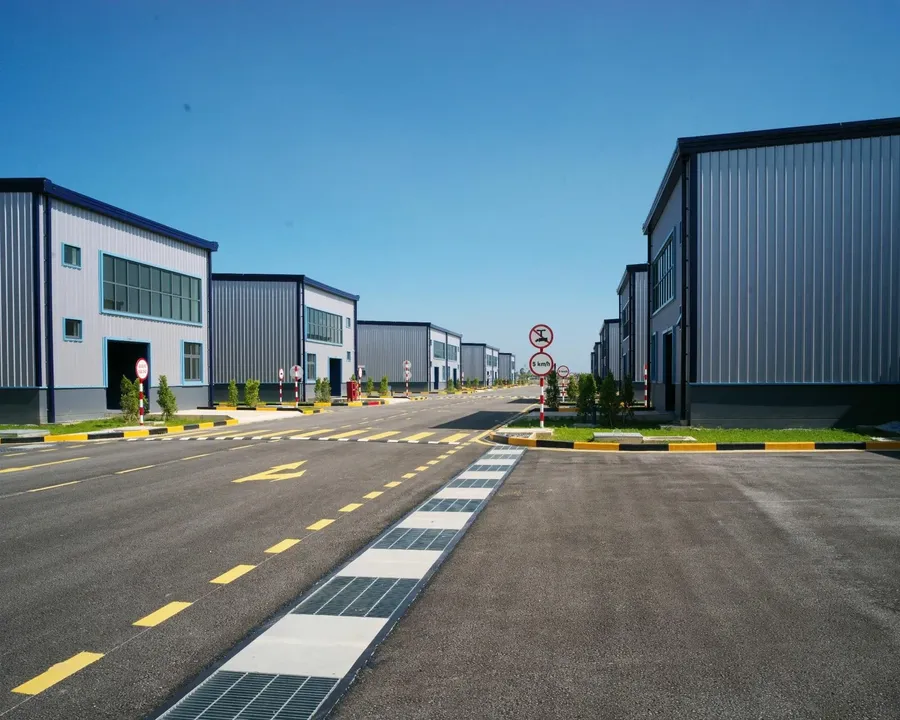
Plan B didn't hold up. Shein's leased footprint has shrunk to just 6 hectares, with only about a third of the originally planned area actually in use, and layoffs that began in April 2026 have cut some departments down to one in every four employees.VietnamBiz
Why the experiment failed matters more than the failure itself. Vietnam isn't short on garment-making capacity, but it hasn't been able to replicate the cost structure that Guangzhou's network of small workshops accepts: producing batches of a few dozen pieces, delivering within days, at a margin of roughly $0.15 per item. Without that network, Shein's model loses its speed advantage. Sheng Lu, professor in the Department of Fashion and Apparel Studies at the University of Delaware, told The Japan Times that diversifying supply chains away from China has real limits, particularly for companies whose competitive edge depends entirely on speed and micro-batch production.University of Delaware The result: Shein pivoted back to China. In February 2026, founder, chairman and CEO of Shein Group Sky Xu made a rare public appearance to commit more than 10 billion yuan to a smart supply-chain system in Guangdong.AsiaOne
It isn't just tariffs
It would be an oversimplification to pin the entire 73% valuation drop on one customs rule. At least three other factors played a role. First, valuation levels: the $100 billion mark from April 2022 was set at the peak of a global tech valuation cycle, and the May 2023 round had already cut that to $66 billion, meaning a third of the value was gone before tariffs entered the picture. Second, the choice of listing venue: Shein once targeted New York, then London; the London plan was approved by UK regulators but never cleared by the China Securities Regulatory Commission, amid prolonged questions over labor conditions in its supply chain and the origin of its cotton.Business Standard Hong Kong was the remaining option, and retail valuations there run considerably lower than in New York. Third, supplier-side competition: thousands of small workshops that once worked exclusively for Shein now sell through Temu or Amazon storefronts.
Still, the data leans clearly toward the policy explanation. The inflection point in both revenue and profit lands precisely in the quarter after de minimis was eliminated, not spread gradually across several years, and the 3.4-cent profit margin on each incremental dollar of revenue shows that post-tariff growth generated almost no value.
Same policy lever, very different footing
For Vietnamese investors, the Shein story lands in two places. The first is US tariff policy, a channel Vietnamese exporters are standing in too. On July 23, 2026, the Office of the US Trade Representative released its Section 301 investigation findings on goods made with forced labor, and Vietnamese goods have faced an additional 12.5% duty since July 24, 2026.Trung tâm WTO Bangladesh, Cambodia, Indonesia and Malaysia received a three-year tariff-rate-quota mechanism; Vietnam and China did not.
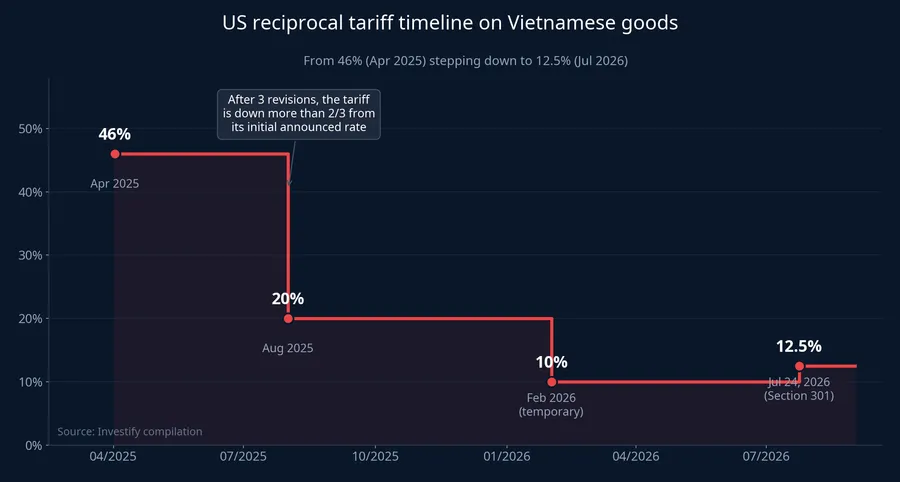
But Vietnamese garment makers' footing is very different from Shein's. They don't run on a tax exemption, they run on manufacturing capability, and the sequence of US tariffs on Vietnam has moved from 46% announced in April 2025, down to 20% from August 2025, down again to 12.5% now, an easing trajectory rather than a tightening one. In the same window that Shein pulled back from its Ho Chi Minh City warehouse, May Song Hong saw a sharp increase in contract manufacturing orders as business shifted away from Bangladesh and China, and most listed garment companies still grew net profit in 2025.
The second place it lands is how to read an IPO itself. Shein went into its first trading session with a more transparent filing than most: the prospectus disclosed the quarterly loss, the growth slowdown to 1.1%, and the 14% drop in US revenue. The market read those numbers correctly, priced the company 73% below its old peak, and kept selling through both pre-listing grey-market trading and the official debut. An IPO price is the outcome of a negotiation between sellers and buyers, not a certification of value.
What to watch
For Shein itself, the deciding variable over the next few quarters isn't tariffs, it's margin. Q1 2026 revenue was nearly flat while the company had already passed most of the tax cost through to prices. If Q2 and Q3 continue to produce negative or near-zero margins on flat revenue, the $26.5 billion valuation will face further pressure; conversely, if the 10-billion-yuan investment in Guangdong's supply chain brings costs down while European revenue offsets the US shortfall, this could mark the cycle's bottom. The evidence available today isn't enough to tilt clearly toward either scenario; Shein's Q2 and Q3 2026 financial results will be the clearest checkpoint.
For Vietnamese equity portfolios, the signals worth tracking in the second half of 2026 are the outcomes of the two remaining Section 301 investigations, on intellectual property and overcapacity, along with individual garment companies' gross margins as international buyers keep pressing for lower prices. Stocks in this group are trading around 5 to 9 times P/E, a level that has already priced in a lot of bad news but also reflects shrinking profits at some names. May Song Hong last closed at VND 30,550, and TNG closed at VND 16,900.
The broader lesson Shein leaves behind is simpler than any spreadsheet: when most of a company's advantage comes from a regulation rather than a capability, its valuation is really a bet that the regulation won't change. Vietnam's garment exporters sit on the opposite side of that comparison, but they still need to watch the two remaining Section 301 investigations closely to see whether that footing holds.