


There's a near-default belief among Vietnamese retail investors: government bonds are the safe lane, buy them and relax, volatility is nowhere near stocks. That belief has a real basis, because a government borrowing in its own currency almost never runs out of ability to repay.
Japan is the extreme case for that "safe" half of the story. Its public debt tops 200% of GDP, the highest among developed economies, and yet no one questions whether Tokyo can pay it back. But Japan's own bonds just demonstrated the other half of the story.
Yield breaks a 30-year mark, long bonds lose double digits
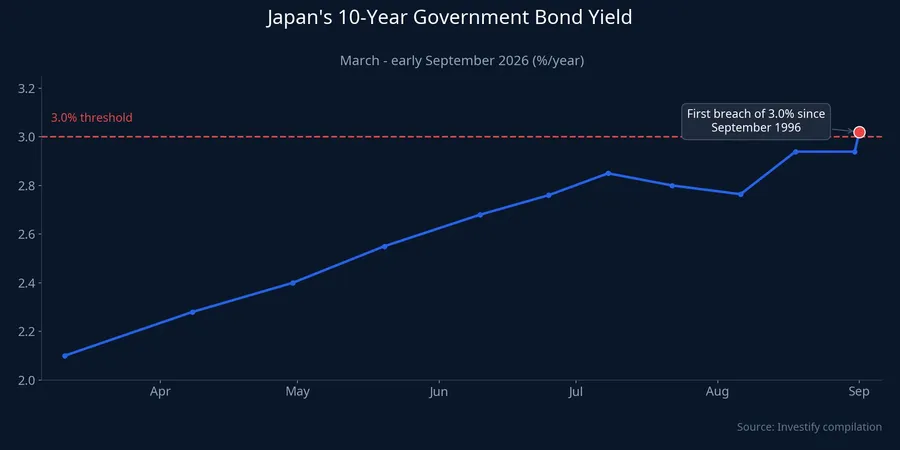
On September 1, the yield on Japan's 10-year government bond broke above 3% for the first time since September 1996.Japan Times The highest level since 1996 had actually already formed by mid-August, when the yield closed at 2.939%; the September 1 session was just the final step through that psychological threshold.Báo Tin Tức
Longer maturities went even further. The yield on Japan's 30-year government bond rose from 3.442% on March 11 to 4.124% on August 31, up 68.2 basis points in under six months. This is where the "safe" narrative collides with math: bond prices and yields always move in opposite directions, so a rise in required yield forces the market price of already-issued bonds down.
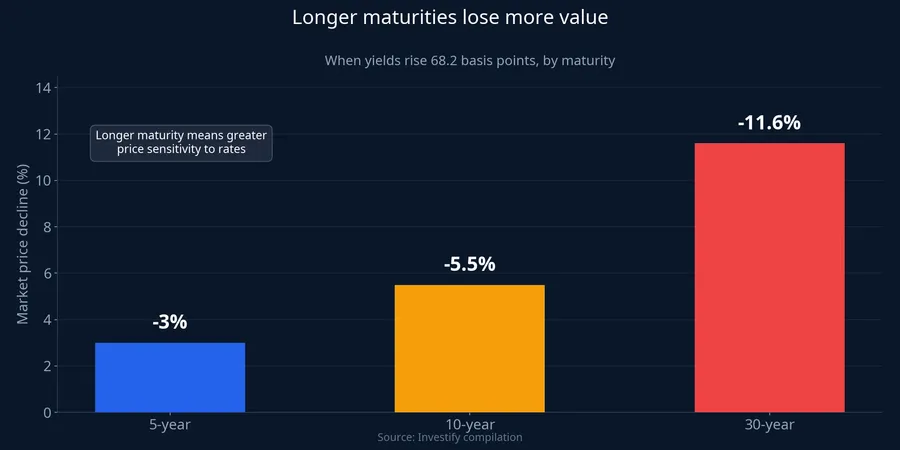
For a 30-year bond issued at par with a 3.44% coupon, a rise to 4.12% translates to a market-price decline of roughly 11.6%. Anyone who bought a 30-year Japanese government bond back in March is now sitting on a loss of about 11% in market value, even though Japan hasn't missed a single interest payment. That loss rivals a stock-market correction, and it comes from an asset called "government bond."
Why Japanese yields are rising: BOJ expectations are the lead driver
Four forces are pushing Japanese yields higher, but only one is truly leading: expectations that the Bank of Japan (BOJ) will raise rates. The BOJ currently holds its policy rate at 1.0%, the highest since 1995. At its early-August meeting, the board held rates in an 8-1 vote and left the door open for a hike in September; market-implied odds of a September hike rose from around 30% in late July to 79% by mid-August. August's yield peak lined up exactly with when that probability got fully priced in, which is why BOJ expectations are seen as the dominant force.
The other three forces contribute and amplify, but don't explain the magnitude on their own. Loose fiscal policy under Japanese Prime Minister Sanae Takaichi, including a planned 370 trillion yen investment program plus tax-cut proposals, has stoked concern about new bond supply. A weaker yen, down 2.07% in August alone, pushed up energy import costs and added another reason for the BOJ to act. US Treasury Secretary Scott Bessent said he expects Japan to take action to strengthen the yen, following the two countries' coordinated currency intervention with a rate hike.Japan Times Japan hasn't confirmed that reading: Japanese Finance Minister Satsuki Katayama played down suggestions that Bessent is pushing the BOJ to hike, saying only that both sides agree the recent currency intervention was beneficial.FMT
Why the 3% mark matters beyond psychology
Japan's cabinet approved a record fiscal 2026 budget of 122.3 trillion yen, with debt-servicing costs in that budget calculated on a 3.0% yield assumption.VTV The market just hit the exact number the government used as its assumption. For fiscal 2027, Japan's Ministry of Finance plans to raise that assumption to 3.8%, which would push debt-servicing costs up 17.1% to a record 36,640 billion yen. That's still a budget-drafting projection, not an approved budget, but it shows interest costs growing heavier in an economy carrying more than 200% of GDP in debt.VietnamPlus One notable counter-signal: right after the 10-year yield hit 3%, an auction of the same-maturity bond still showed solid demand. The market is demanding a higher price for taking on this risk, not turning its back on Japanese debt.
"Global bond selloff" isn't one bloc
Yields are rising in many places at once, but not for the same reason. Over July and August 2026, the correlation of daily yield moves among the US, UK, and Germany sat between 0.67 and 0.87, meaning the Western bloc has moved almost in lockstep under a shared pressure: an oversupply of long-dated debt and persistent inflation concerns.
Japan stands almost alone. The correlation between Japanese 10-year yields and those of the US, UK, and Germany is just 0.05 to 0.16. Japan's move is coming from domestic matters, not spillover from the US or Europe.
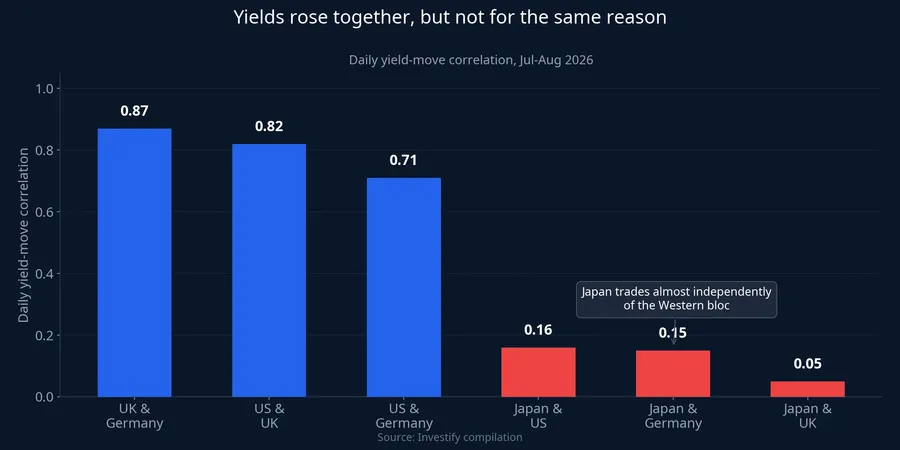
You can't infer from "Japanese bond yields are rising" that "every bond market is riding the same wave." They're rising for different reasons, and they can reverse at different times.
Where the belief holds, where it breaks
The more accurate picture starts by separating two risks that retail investors tend to lump together. Default risk is the chance an issuer can't repay principal and interest. For government bonds borrowed in the issuer's own currency, that risk really is low, and Japan proves it: debt above 200% of GDP, yet no one doubts its ability to repay.
Interest rate risk is the chance a bond's market price falls when the general rate level rises, and the "government" label offers zero protection here. It depends almost entirely on maturity: the longer the term, the more price damage the same yield increase causes. At the same 68.2 basis-point yield increase, a 30-year bond loses about 11.6% of its value, while a 5-year bond loses only about 3%.
The phrase "government bonds are safe" should be re-read as: safe in terms of repayment, not safe in terms of price during the holding period. If you hold to maturity and never need to sell early, price swings never turn into a real loss. Interest rate risk only materializes if you must sell before maturity, or if you hold indirectly through an open-end fund that marks its assets to market every day.
For Vietnamese investors: read by maturity, not by label
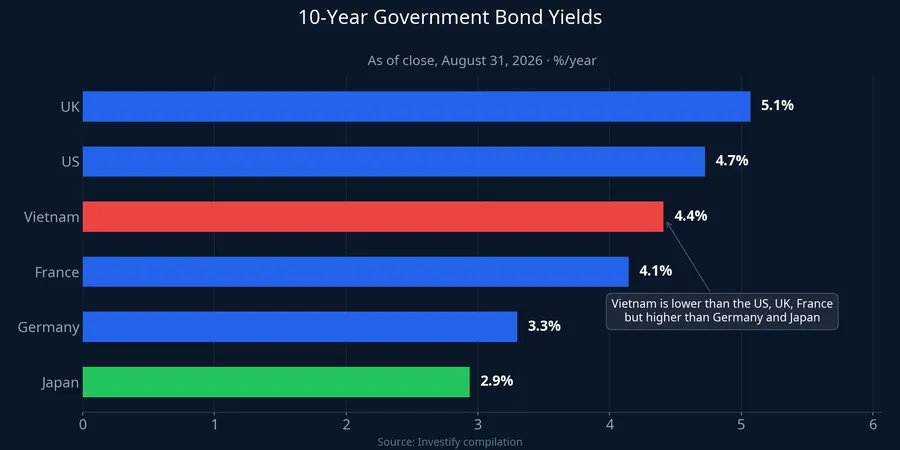
Domestic yields are currently at the high end of the past 12 months. Vietnam's 10-year government bond yield sits at 4.41%, about 0.31 percentage points below the equivalent US Treasury yield. Big-bank 12-month savings rates hover around 5.9% a year at the counter, while online channels at some smaller banks offer 7% a year or more.Dân Trí
Domestic open-end bond funds have posted solid results year-to-date: 23 of 24 funds show positive returns, with the leaders at 4.5% to 5.1% after eight months. That result comes from regular coupon income at an elevated rate level, not proof that these funds' NAV is immune to interest rate risk. Funds with heavier bond weightings and longer portfolio duration are far more sensitive to yield swings than funds holding more short-term deposits, which in turn post lower returns of just 2.2% to 3.2%.
The transmission channel from Japan to Vietnam, if the BOJ hikes in September, is mainly global risk-off sentiment, as positions that borrowed cheap yen to fund higher-yielding assets get unwound. Foreign investors have net-sold on HOSE for six straight months, roughly VND 95,100 billion from March through August, though the pace of selling narrowed to VND 5,645 billion in August from a May peak of VND 23,174 billion. That foreign-flow scale is relatively small against the overall market and has been absorbed by domestic money all year.
Bottom line: maturity is the variable, "government" is not
Japan's lesson lands on a specific conclusion: what determines how much volatility you must bear when holding a fixed-income product is maturity, not the issuer's label. Money you'll need within 6 to 12 months should stay in short maturities — 6-to-12-month savings deposits, or funds that hold a high share of cash deposits — since rate swings barely touch that money at all. Money you can leave untouched for 2 to 3 years or longer, if you can stomach price swings along the way, can reach for longer maturities in exchange for higher yield. When holding indirectly through an open-end bond fund, check its bond weighting and portfolio duration before looking at the year-to-date return figure.
The nearest signal to watch is the BOJ's policy meeting on September 17-18. The market has already priced in a rate hike almost fully, so any delay signal could trigger a meaningful reversal in Japanese yields; conversely, if the BOJ acts as expected, the 3% mark is likely not the stopping point.