


On August 13, 2026, Prime Minister Le Minh Hung met with the State Bank of Vietnam (SBV) and the banking system, instructing credit institutions to cut costs, stabilize the overall rate level, and genuinely lower lending rates. The Government Office also directed the SBV to sanction any institution that fails to comply.Dân trí A directive rarely comes with penalties spelled out this clearly.
The lending side reacted almost immediately. Agribank rolled out a VND 70,000 billion package priced 1-2 percentage points below its average rate for comparable terms; Vietcombank and VietinBank each added VND 50,000 billion at least 1 point below standard.Người Quan Sát But exactly three weeks after the directive, on the deposit side, almost nothing has moved. Heading into September, Agribank, BIDV, Vietcombank and VietinBank are still listing around 6.6% a year for 6-9 month terms, while ACB leads the joint-stock group at 7.6-7.8%.Dân trí
Same banking system, same directive, two sides of the balance sheet moving in opposite directions. This isn't defiance. What the directive doesn't say is that a piece of arithmetic sits behind the savings-rate board, and no administrative order can erase it.
Banks are lending out more than they're taking in
By the end of July 2026, system-wide credit growth reached almost 9% versus the end of 2025, while deposit mobilization grew only 5.75%.Người Quan Sát That gap of more than 3 percentage points didn't appear in a single month; it has been accumulating all year.
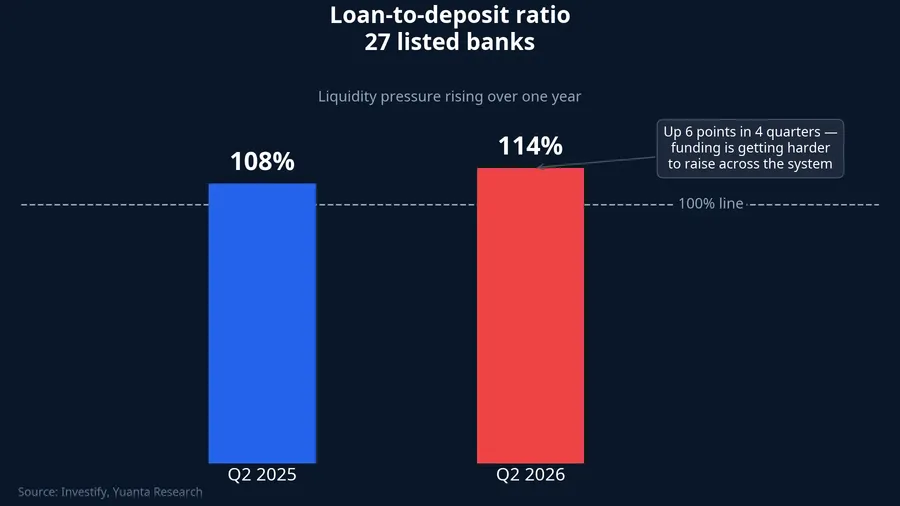
Yuanta Research data on 27 listed banks shows the consequence more precisely: the loan-to-deposit ratio (LDR) climbed to 114% in Q2 2026, up from 108% a year earlier. In other words, for every VND 100 raised in deposits, this group of banks is lending out VND 114. That extra VND 14 doesn't appear out of nowhere. It has to come from somewhere else, and that somewhere else is always more expensive than retail deposits.
Every dollar plugging the gap is expensive money
This is the part the directive never mentions. Since the start of 2026, VPBank, Techcombank, HDBank and ACB have drawn syndicated international loans worth roughly USD 3.4 billion combined.Người Quan Sát Yuanta estimates the dollar cost of these loans at roughly 5.0-5.3% a year, before adding FX-hedging costs and arrangement fees. Stack the layers of cost together, and this capital is no cheaper than domestic deposits.
At the same time, the cheapest layer of funding is shrinking. The share of non-term deposits (CASA) has fallen to 20.9%. When non-term money walks out the door, banks have to replace it with term deposits, paying a higher rate for the same volume of capital.

Here's where the real risk sits: Q2 2026 results show the cost of funds rose 105 basis points year-on-year to 4.79%. Yield on assets rose 92 basis points to 7.70%. Net interest margin (NIM) came in at 3.15%, up 16 basis points quarter-on-quarter but still down 10 basis points year-on-year. Per Yuanta Research, the quarter-on-quarter improvement came mainly from loan repricing and a higher share of long-term lending, not from a falling cost of funds.
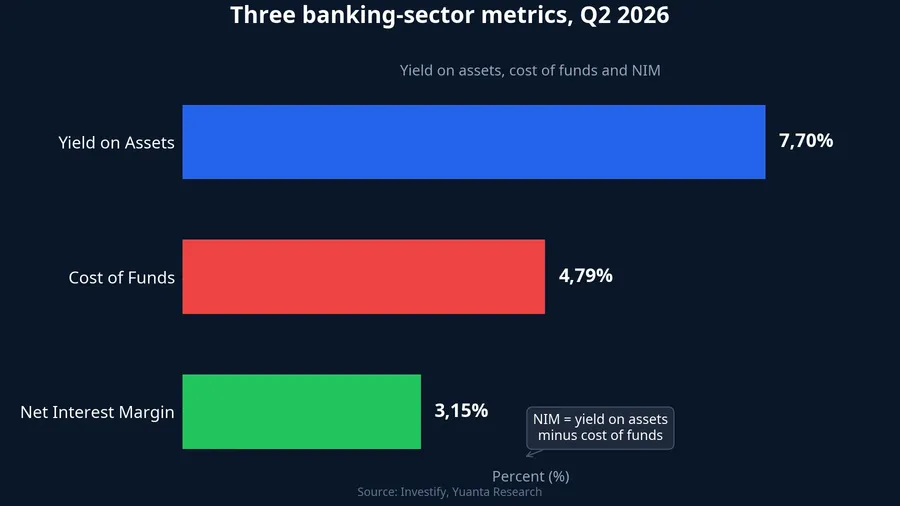
The gap between 7.70% and 4.79% is the entire cushion banks have to cover operating costs, loan-loss provisions and profit. That cushion is now carrying extra weight: system-wide bad debt stands at roughly VND 300,000 billion, up 17% from the end of 2025, with the average industry NPL ratio above 2% and both Group 2 and Group 5 debt trending higher.Người Quan Sát Rising bad debt forces higher provisioning, which eats directly into the cushion just described.

Why the only workable answer is selective cuts
Set the 4.79% cost of funds next to the 7.70% yield on assets and the 3.15% NIM, and the real room to maneuver looks thin. Cutting lending rates across the entire loan book by another percentage point would cut straight into an already-thin margin, right as provisioning costs are climbing.
That's why every discount package shares the same shape: a pre-announced cap, a designated customer segment, an expiration date. It's a way to subsidize a slice of the loan book without repricing the entire balance sheet. Notably, the PM's directive doesn't call for lowering policy rates either. The SBV was instructed to keep managing policy rates actively and flexibly while boosting liquidity supply. These are two tools that ease short-term funding costs but can't replace the long-term capital that credit growth actually needs.
It's worth acknowledging that the credit-deposit gap isn't the only reason deposit rates are staying elevated. High global interest rates keep pressure on the exchange rate, forcing Vietnam to maintain positive real rates domestically; competition from other investment channels also pushes banks to pay more to retain depositors. But the evidence leans toward the funding gap as the dominant factor: it's the one explanation that accounts for the 114% ratio, the syndicated borrowing, and the 105-basis-point jump in cost of funds within a single year.
Who's actually absorbing the spread
Today's savings rates don't come from bank generosity. They come from banks needing capital to lend. For depositors, that reading carries a few concrete implications.
Term structure clearly rewards longer maturities. Terms under 6 months are capped by regulation, with most banks listing around 4.65-4.75% a year, while 12-month terms range 6.8-7.8% depending on the group.Dân trí The 2-3 percentage-point gap between these terms is wide compared with most past periods.
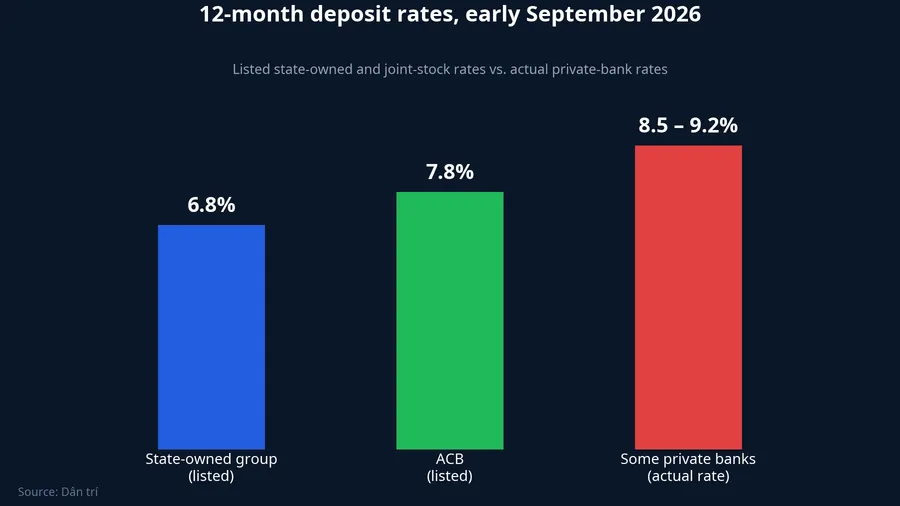
The gap between banks now matters more than the gap between time periods. At the same 12-month term, the state-owned group pays 6.8% while ACB lists 7.8%. Dân trí also found some private banks quietly offering 8.5-9.2% actual rates for 6-12 month terms, well above their published rate cards. For depositors, the biggest spread today comes from choosing the right bank, not from waiting for a better moment.
One last point worth stressing: this rate level was born from pressure, not from a deliberate easing cycle. It will persist as long as the pressure persists, and it will cool once the pressure eases. No administrative decision is required to reverse it.
What to watch next
The number that will decide the next move is the gap between credit growth and deposit growth. If that gap narrows in Q3 results, pushing the loan-to-deposit ratio back below 114% and CASA back above 20.9%, the cost of funds will ease on its own and savings rates will drift down without any further directive. If the gap keeps widening as credit accelerates toward its full-year target, the deposit-rate level will likely hold where it is through year-end, regardless of how many more discounted lending packages get announced.
For bank-stock investors, the same dataset flags a risk worth tracking closely: a 3.15% net interest margin squeezed between rising funding costs and pressure to cut lending rates, while provisioning costs climb alongside bad debt. Q3 results will show whether Q2's margin improvement was a genuine turning point — or just one favorable quarter of loan repricing.