


Vietnam's banks are closing for five straight days over National Day, from Saturday, August 29 through Wednesday, September 2, with branch counters reopening only on Thursday, September 3. Monday, August 31 was already swapped for a working Saturday on August 22.VNBA The stock exchange follows the same rhythm: its last session closed at 1,832.12 points on August 28, and trading won't resume until September 3.
But one thing doesn't take the holiday off: a savings deposit whose maturity date lands on August 30, 31, September 1, or September 2. The date printed on your deposit slip doesn't move with the bank's holiday calendar. What moves is only the moment you can sit down at a counter and say what you want done with that money next.
Here's the simple version: for those five closed days, your deposit is quietly "deciding for itself," following whatever instruction you ticked back when you opened it. Most savers no longer remember what they ticked, and that's exactly where this gets interesting.

Online deposits: the system processes right through the holiday
For online savings accounts, the holiday barely exists. Digital banking runs through all five days, so once a deposit matures, the system automatically executes whichever instruction you selected when you opened it: close it out and sweep principal plus interest into your payment account, roll over just the principal, or roll over both principal and interest.CafeF
Those two settings lead to very different outcomes. If your account is set to roll over, your money enters a new term right in the middle of the holiday, usually matching the old term length. The rate applied to that new term is whatever the bank is quoting at the exact moment of rollover, not necessarily what you earned last term.CafeF In effect, you've just signed a new contract without checking the price.
If your account is set to close out, principal and interest flow into your payment account the moment it matures. From then until you redeposit it, that money earns only the no-term interest rate, which sits well below any term deposit rate. Over this five-day break, that idle window can stretch to September 3 or longer, depending on when you next open your banking app.
Branch-opened deposits: everything stays frozen until September 3
For accounts opened at a physical branch, nothing happens during the five-day break at all. The decision point gets pushed entirely to the first working day after the holiday, which is exactly why September 3 matters more than most savers realize.

VIB has published the most detailed plan for this situation among Vietnamese banks. Per its notice, customers holding VND deposits opened at a branch or transaction office, maturing between August 30 and September 2, should visit their nearest branch on September 3 if they want to close the account.CafeF In that case, they earn the term deposit rate for the actual number of days held through September 3, and need to complete a form requesting a change to their term deposit details. If they don't close it out, the deposit auto-renews on the date printed on the passbook.Người Quan Sát
This part is worth reading closely. The term-rate treatment for those waiting days is VIB's own commitment in its own notice, not an industry-wide rule. At other banks, how interest is calculated for the extra days after the maturity date follows each bank's and each deposit product's own policy.CafeF Savers at banks that haven't issued their own notice should call the hotline directly rather than assume VIB's treatment applies to them too.
The cost of letting the default run
Auto-rollover sounds harmless, until you set it against the rates currently on offer in the market.
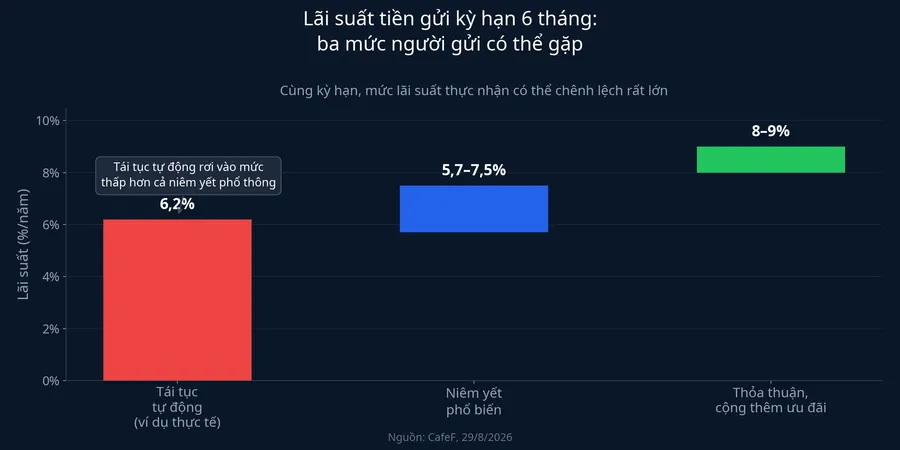
CafeF cites the case of a saver in Hanoi: a 6-month deposit opened in 2024, set to roll over both principal and interest, matured this past July and was renewed at 6.2% per year.CafeF At that same moment, many banks were negotiating rates as high as 8-9% per year on the very same 6-month term, and at her own bank, an online deposit with a promo code could reach 8.7% per year.
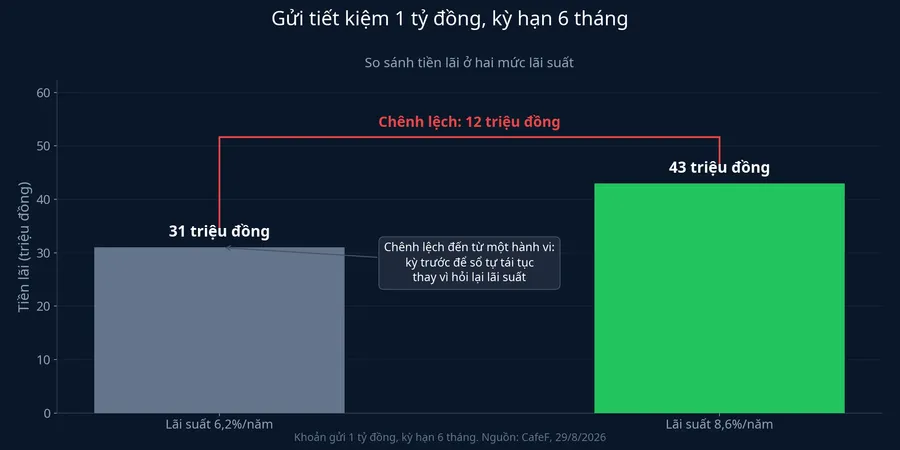
That gap translates into real money. Also per CafeF, a VND 1 billion deposit for 6 months at 6.2% per year earns roughly VND 31 million in interest, while at 8.6% per year it earns roughly VND 43 million.CafeF The roughly VND 12 million gap traces back to one single habit: letting the old deposit auto-renew last term instead of asking for a new rate.
The backdrop to that gap is worth knowing too. A CafeF survey found listed rates for 6-12 month terms at many large banks currently cluster around 5.7-7.5% per year, while bonus programs or individual bank policies can push the actual rate received up to 8-9% per year.CafeF The difference isn't about deposit size. Savers themselves report that some banks add bonus rates even for deposits of just a few hundred million dong. The real difference is whether the customer actively asked about promotional terms before depositing. Savers who let their accounts auto-renew at maturity tend to land in the group that gets the ordinary rate.
What to do on September 3
The one signal that tells you which branch you're on is the maturity-handling instruction attached to your specific deposit, checkable right on your banking app during the holiday. Paired with the maturity date printed on your passbook, these two small details determine most of what happens next.
For anyone holding a deposit maturing between August 30 and September 2, here's the standard playbook. If your account is set to roll over and you haven't decided otherwise, letting it roll over is still safer than letting the money sit in a payment account earning no-term interest for the whole holiday. But know the trade-off going in: once it has rolled over, switching to a better rate means closing it out early, and the new term's interest gets calculated at the no-term rate instead.

That's why September 3 should be a day for checking prices, not a day for signing on autopilot. Before deciding whether to keep the new term or switch, line up three numbers:
- The new term rate your deposit was just auto-renewed into.
- The promotional rate your own bank could apply to your deposit if you actively asked for it.
- The best rate currently on offer through an online deposit, including at other banks.
With a gap of 5.7-7.5% per year against 8-9% per year coexisting in the market right now, that difference is worth far more than the cost of one phone call to a hotline. The larger the deposit, the more that cash difference is worth a few minutes of confirming before letting the account drift into its new term.
September 3 is also the day the stock exchange reopens. But for savers, the task that needs finishing first isn't checking the ticker board — it's reopening the passbook that quietly rolled into a new term while the counters were closed, and confirming whether the rate now attached to it is still the best one available.