

A draft decree now open for public comment contains a pairing rarely seen in the same document: the drafting agency agrees to let artificial intelligence (AI) place stock trades on its own, then bans that exact activity in the one basket that covers roughly 77% of Vietnam's market capitalization.Dân trí This is the draft decree on a controlled regulatory sandbox for the securities sector, drawn up by Vietnam's Ministry of Finance. For individual investors, the gap between those two clauses is the part worth reading, not the "AI can trade" headline itself.
What the draft actually allows
Under the draft, AI-enabled fintech solutions would be piloted with no more than 1,000 investors.VTC News Participants must qualify as professional securities investors, and the pilot covers two categories: AI-based investment advisory, and AI placing trades directly. The trial period runs up to 5 years, depending on the solution, starting from when the State Securities Commission issues a participation certificate.Dân trí
A stop mechanism is written into the draft as well. If a solution creates risk to financial or monetary system security, to the safety of stock-market IT infrastructure, or to public order, the State Securities Commission can suspend or terminate it. The proposing organization carries full responsibility for its own operations and must comply with anti-money-laundering rules.
How much of the market gets carved out
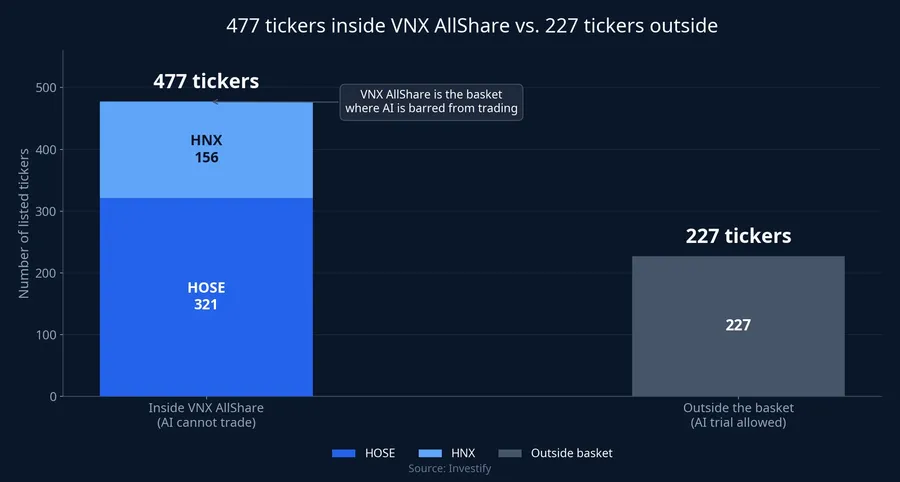
The most contentious limit is the stock universe. Under the draft, any stock AI uses for trading or market-making must fall outside the VNX AllShare basket, the combined index for the HOSE and HNX exchanges. As of the data cut-off on August 28, 2026, that basket held 477 tickers, 321 on HOSE and 156 on HNX. Press coverage citing the draft put the basket's share of market cap at roughly 77%.Tiền Phong
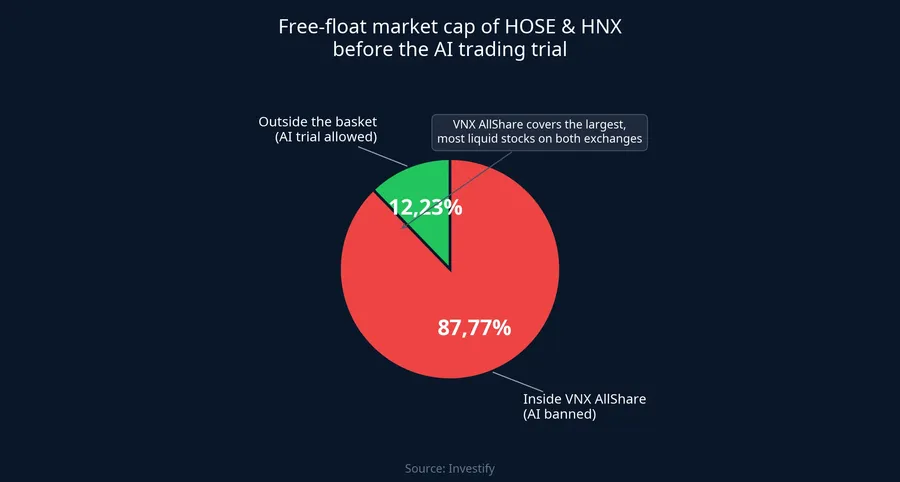
There's a more trading-relevant way to measure it. Counting only free-float shares, the ones investors can actually buy and sell day to day, VNX AllShare covers 87.77% of the free-float market cap of both exchanges, equivalent to VND 2,361.8 trillion out of a total VND 2,690.8 trillion. What's left for AI is only about 12% of free-float shares, spread across 227 tickers outside the basket. By listed market cap, AI is locked out of 77% of the market; by shares that actually change hands each session, the excluded share is even larger.
Why the drafting agency is being cautious
The Ministry of Finance frames this sandbox around investor protection and financial-system safety, and the draft revised Securities Law adds a dedicated article for the mechanism.Thời báo Tài chính Việt Nam The caution has a real basis. Bùi Văn Huy, CEO of FIDT Joint Stock Company, notes that robot-driven trading was previously deployed in Vietnam's market, but brokerages were told to suspend it starting in 2023.Dân trí In his view, if trading algorithms return, regulators need to tightly control three risk categories: market manipulation via high-speed algorithms, system overload from spikes in order volume, and abnormal price swings triggered when algorithms fire off batches of orders in very short windows.
The draft has not published a separate rationale for excluding VNX AllShare, so the exact reasoning remains speculative. Three readings are plausible: capping potential damage by confining faulty algorithms to smaller stocks, shielding the basket that drives the index and index-tracking funds, or the reality that real-time automated order surveillance hasn't been proven at scale. The evidence available leans toward the first reading, since early-stage sandboxes generally prioritize capping downside over optimizing the quality of pilot data.
The technical paradox built into that same limit
The problem is that algorithms need liquidity to function properly. A Ho Chi Minh City broker quoted by Dân trí notes that excluding VNX AllShare effectively pushes AI down into small-cap, thinly traded stocks.Dân trí In that segment, a single automated order can be enough to send a stock to its daily limit up or down, distorting prices and corrupting the very algorithm being tested. As a result, data collected from the pilot may not reflect how AI actually behaves in a normal market, and professional investors would struggle to deploy meaningful capital into stocks they can barely exit once the market turns.

The same broker proposes two adjustments. One is letting AI trade within VN30 or VNX AllShare, offset by capping capital per pilot account at roughly VND 500 million to 1 billion. The other is adding VN30 index futures to the pilot scope, since the derivatives market has high liquidity, trades both directions, and doesn't require waiting for settlement.
The gap that matters more than the stock universe
On legal timing alone, this isn't this year's story. It remains a draft under public consultation, not yet issued. Under the draft revised Securities Law, the law itself is expected to take effect March 1, 2027, while the sandbox provision specifically is expected to apply from March 1, 2028, pushed back a further year to allow time for implementing guidance.VietnamBiz The entry bar is narrow too: a maximum of 1,000 investors, all required to qualify as professional securities investors, meaning individuals holding at least VND 2 billion in listed securities, taxable income of at least VND 1 billion a year, or a securities practicing certificate. By comparison, Vietnam's market had more than 13.65 million securities accounts as of end-July 2026.Nhân Dân
But one issue doesn't wait until 2028 to matter: every service currently advertising "AI investing for you" on social media sits outside any sandbox, because no sandbox exists yet. Nguyễn Xuân Quang, Assistant to the Chairman of the Board at SSI Securities Corporation, cautions that a fair amount of AI-generated data and commentary sounds convincing but is fabricated, and there's currently no clear rule on who bears responsibility when a customer loses money.Dân trí
This matters more given that the draft under consultation proposes exempting the State from administrative, disciplinary, and civil liability when damage arises from objective causes and all parties complied with the pilot's rules.Thời báo Tài chính Việt Nam Liability falls on the organization proposing the solution, not the licensing authority. That's a reasonable design for a sandbox, but it also means: if an AI product operating outside any sandbox causes losses for individual investors right now, there is no state compensation mechanism to invoke.

What to watch next
In the short term, this draft doesn't change how the market functions and doesn't create a clear group of stocks that stands to benefit directly. For individual investors, the reasonable response right now is to note the development, stick with current practice, and stay more skeptical of any service billing itself as "AI investing" while operating outside a legal framework.
What's worth tracking is the next draft that emerges after this consultation round, specifically on three points: whether the stock scope widens to include VN30 alongside a per-account capital cap, whether derivatives get added to the pilot, and how precisely compensation liability gets defined when an algorithm causes customer losses. If the scope stays as narrow as it is now, the pilot will likely run small, with few firms willing to register, exactly the concern brokers are already raising.