

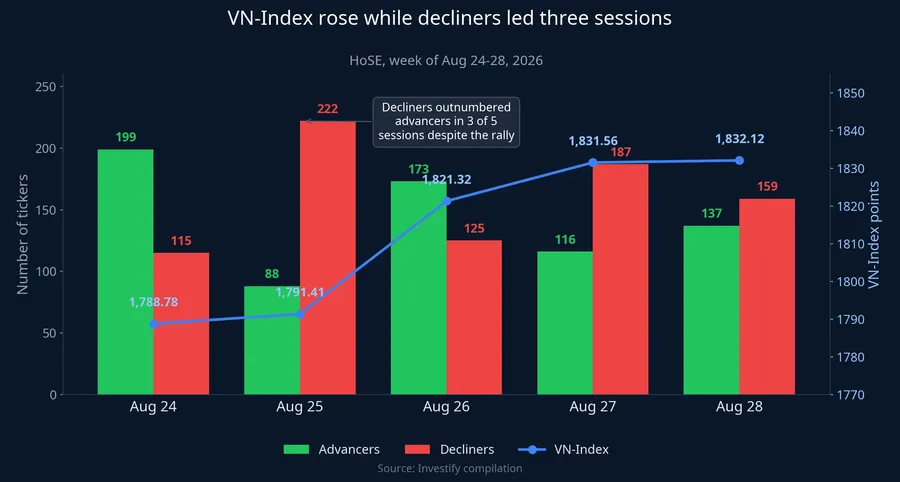
Look only at the headline number and the week of August 24-28 looks clean: VN-Index closed at 1,832.12 points, up 64.00 points from the prior week, a gain of 3.62%. All five sessions closed higher, and trading volume rose 27.4% from the week before.Báo Nhân Dân But stop there and you miss the most important thing that happened all week: on three of five sessions, decliners outnumbered advancers on HoSE. On Aug 25 it was 88 advancers versus 222 decliners, on Aug 27 it was 116 versus 187, and on Aug 28 it was 137 versus 159. An index climbing while most of the board is red only happens when the gains are concentrated in a very narrow group.
Early week: cheap money set the stage
Monday Aug 24 opened the week with a 20.66-point gain, 199 advancers against 115 decliners. It was the best-breadth session of the week, and also nearly the last session where the whole market moved in the same direction.
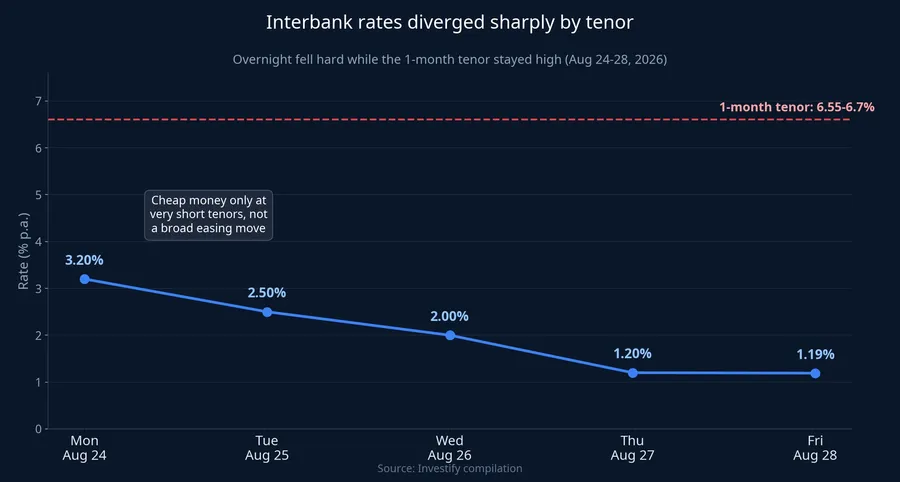
The support for that move came from the money market. The overnight interbank rate stood at 3.2% per year on Aug 24,Người Quan Sát then eased session by session to close the week at 1.19% per year.Thời báo Tài chính Việt Nam Behind that easing was the State Bank of Vietnam: over the week it injected roughly VND 54,893 billion net through open-market operations, a reversal from the prior two weeks of net withdrawals totaling more than VND 19,000 billion.
The move needs to be read correctly. Injecting liquidity ahead of a long holiday is routine central-bank operating procedure, meant to keep the banking system from tightening up while the market is closed for several days. It creates a cheap-money base at very short tenors, not a broad easing cycle. The evidence sits on the same rate table: while the overnight rate fell toward 1%, the one-month tenor stayed anchored around 6.55-6.7% per year.
By Tuesday Aug 25, breadth broke immediately: the index edged up just 0.15% while 222 tickers declined against only 88 advancers. Cheap money had arrived, but it wasn't flowing evenly across the market.
The hinge session: Techcombank and a strategic-shareholder rumor
Aug 26 was the hinge of the entire week. VN-Index rose 29.91 points, the largest single-session gain of the week, and the driver was concentrated in almost one name. TCB rose 6.87% to close at VND 33,450 per share, with matched volume of 55.8 million shares, nearly triple the prior session. TCB alone contributed roughly 6.38 points to the index that day. The push came from expectations of a foreign strategic shareholder, after reports that two foreign banks were negotiating to buy a stake.
On the afternoon of Aug 27, after the market closed, BNP Paribas said it had no plans to buy a stake in Techcombank. On Aug 28, TCB fell 2.05% to VND 33,400.
This is where the week's story takes its most notable turn. The rumor died, but the index didn't fall with it. On Aug 28, VN-Index still edged up 0.56 points, holding the week's gains, powered by SSB hitting its daily ceiling at +6.88% and VPB adding another 1.46%. Money didn't leave the market when a single-stock story lost its edge. It simply rotated to another ticker in the same sector.
Foreign investors didn't buy "banks," they swapped bank types
Foreign investors were net buyers of VND 951.7 billion on HoSE for the week,Báo Nhân Dân a reversal after a stretch of net selling. But the headline figure hides the most interesting part: the buying and the selling landed in two different types of banks.
The strongest net buying was in TCB at VND 711.3 billion, followed by FPT at VND 430.7 billion, VIC at VND 379.8 billion, VPB at VND 279.9 billion and SHB at VND 123.7 billion. Net selling, meanwhile, concentrated in state-controlled banks: VCB at VND 203.7 billion, CTG at VND 190.5 billion and BID at VND 113.7 billion.
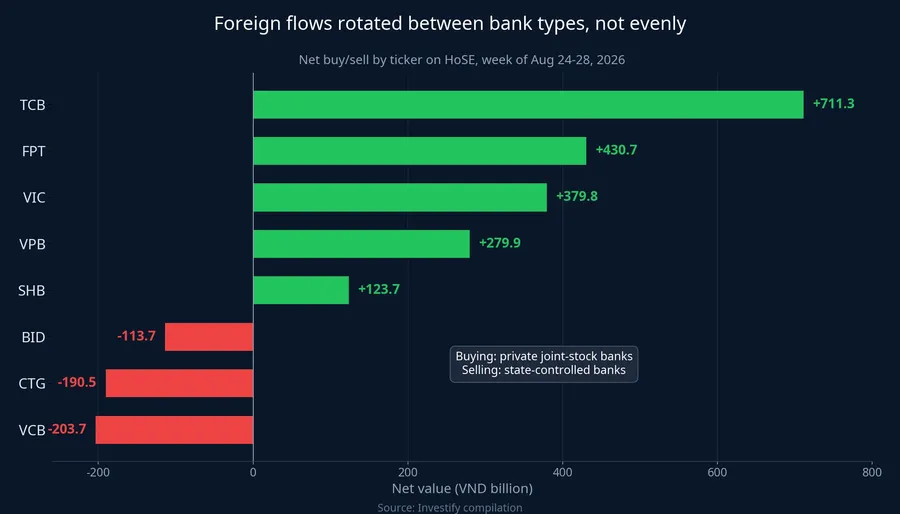
In other words, this wasn't fresh money flowing evenly into bank stocks. It was foreign investors trimming state-controlled banks to buy private joint-stock banks. At the same time, a name far less talked-about than TCB was actually the single largest point contributor to the index for the week: VPB rose 8.17% and added roughly 6.81 points, more than the 5.20 points from TCB.

Why did foreign flows reverse? There are at least three equally plausible explanations, and this week's data isn't enough to cleanly separate how much each one contributed. First, FTSE Russell published its global index reconstitution on Aug 21, adding 27 Vietnamese stocks, ahead of the market-upgrade effective date of Sep 21. This could be positioning ahead of the rebalance. Second, the TCB strategic-shareholder story alone pulled in VND 711.3 billion, roughly three-quarters of the week's total net buying. Third, cooling short-term rates reduced the cost of holding VND-denominated positions. Looking at how concentrated the flow was, the data leans toward the first two explanations: the weight on TCB is too large to call this broad-based allocation, and the additional buying in FPT and VIC overlaps with names that carry heavy index weight and that FTSE-tracking funds typically hold.
Heading into a five-day holiday
Average daily trading value for the week reached roughly VND 18,560 billion, up 24% from VND 14,952 billion the week before. But the rally stayed narrow: VN30 gained 2.86% while HNX-Index edged up just 0.25%. Small and mid-cap stocks largely sat out the move.
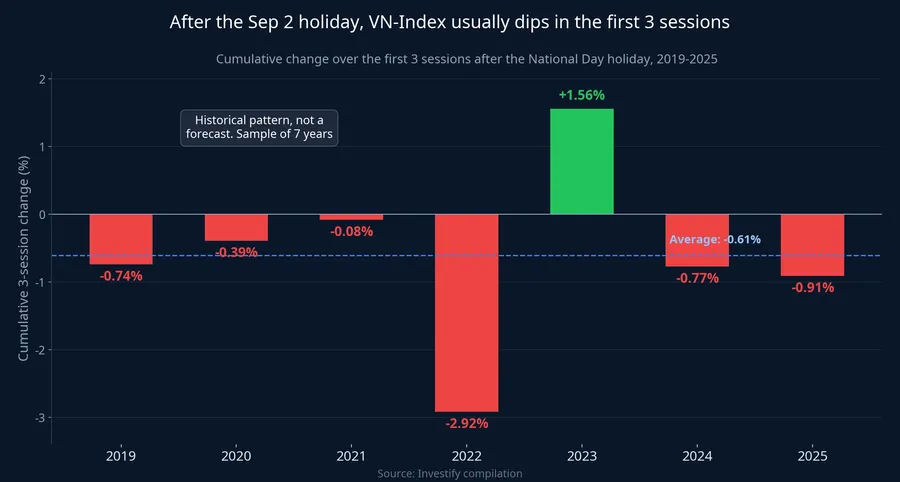
The market closes from Aug 31 to Sep 2 and reopens on the morning of Sep 3. A look at seven National Day holidays from 2019 to 2025 shows the first session back tends to be fairly neutral, averaging a 0.25% gain with three gains out of seven years. But cumulated over the first three sessions, the average is a 0.61% decline, with only one out of seven years closing positive. This is a historical pattern with a small sample, not a forecast for this year.
What to watch: breadth, not the index level
Last week's rally rested on a narrow group, mostly private joint-stock banks. That means the most important signal when the market reopens on Sep 3 isn't how many points the index moves, but whether advancers outnumber decliners. If breadth widens beyond banks and VN30, the rally gains a broader base to build on, and this week's foreign-flow reversal would have a better claim to being durable rather than a short-lived pop from the TCB story. If the index keeps climbing on a handful of pillar stocks while the board stays red, most individual portfolios will keep underperforming the index, just as they did on three of five sessions last week.
The technical level to watch is already clear: 1,832.12 points sits about 1.2% below the 1,853.70 peak from the July 8 session. That zone has been a reversal point before, and how the index reacts to it in the early sessions of September will show whether this rally is being carried by broadening capital or by a handful of stocks holding the whole index up.