

On the afternoon of August 28, Vietnam's stock exchange closed for its final session before the National Day holiday. Per the Ministry of Home Affairs' holiday schedule, workers get a continuous break from Saturday, August 29 through Wednesday, September 2, with trading resuming Thursday, September 3.Chinhphu.vn From today's closing bell, the board sits frozen for 5 straight days.
That sounds simple enough: just a holiday. But if you placed a buy order in the August 28 session, or you're carrying a margin balance, those 5 days touch two things that keep running quietly while you're off: the settlement cycle and the interest clock. Here's what actually happens to your account while the exchange is closed.
The index barely moved, but money didn't leave
The VN-Index closed August 28 at 1,832.12 points, up just 0.56 points, or 0.03%. Breadth was almost split down the middle, with 156 gainers against 155 decliners. It's the familiar picture of a pre-holiday session where nobody wants to make a big move.
Liquidity told a different story. Matched value on HOSE hit VND 15,434 billion, 8.7% above the prior 20-session average of VND 14,198 billion, and well above the August 27 session's VND 13,712 billion. Total matched volume also ticked up to 643.9 million units, versus 604.7 million units the session before.
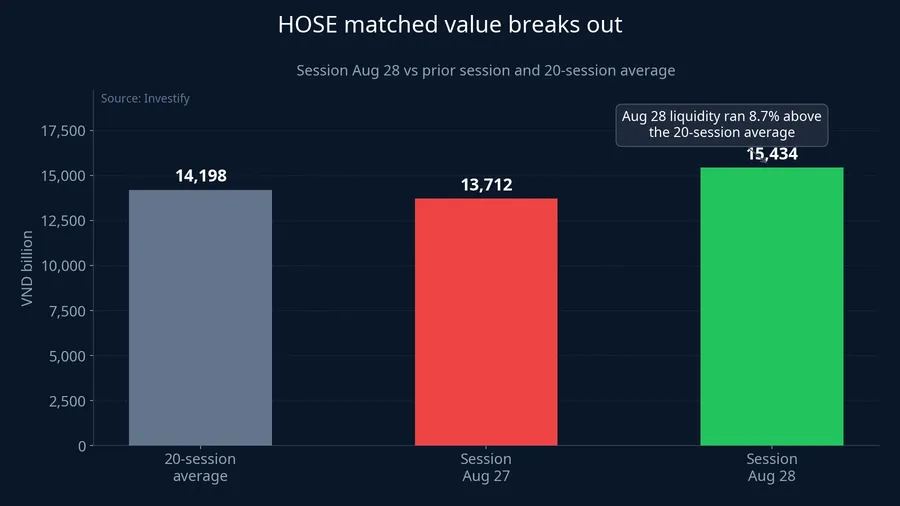
What stands out is that this runs against years of habit. Looking at 11 long holidays since 2021 — 6 Lunar New Year breaks and 5 National Day breaks — the last session before a holiday typically sees liquidity shrink: 9 of 11 periods came in below the 20-session average, averaging just 93.3% of the baseline. August 28 hit 108.7% of baseline, landing squarely on the opposite side of that pattern.
So the "market went quiet ahead of the holiday" reading doesn't match the data. Money didn't pull out before the break. It stayed in the market and rotated between stocks, to the point where buying and selling pressure roughly canceled out at the index level.
Where the money rotated to
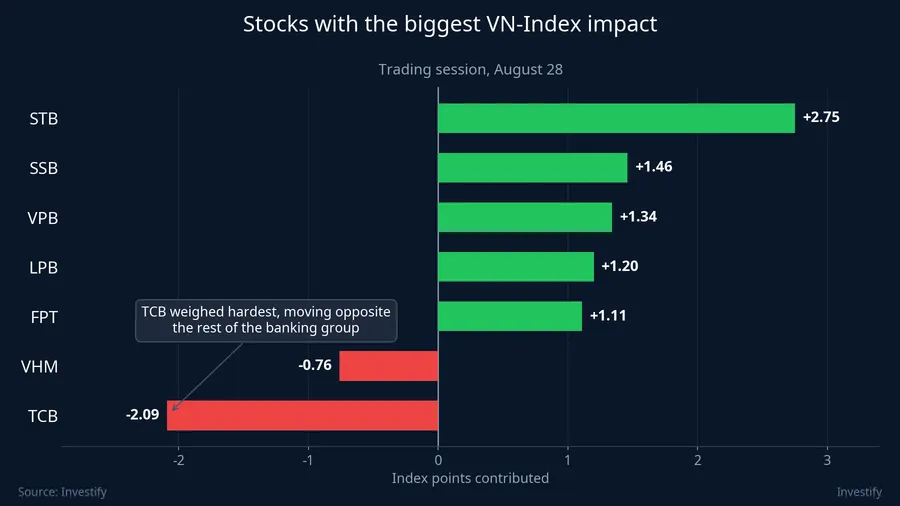
The heaviest drag of the session was TCB, down 2.05% to VND 33,400, shaving 2.09 points off the VN-Index. That gave back part of the 6.87% rally on August 26, when rumors circulated that two foreign banks wanted to buy a stake in Techcombank. Per Vietstock's session coverage, TCB fell after BNP Paribas denied any stake-purchase plan, but the stock still pulled in nearly VND 300 billion in liquidity in the first half of the session alone, the most of any bank stock.Vietstock
On the other side, the stocks lifting the index were also mostly banks. STB rose 2.72% to VND 75,500, contributing 2.75 points. SSB jumped 6.88% to VND 17,100, adding 1.46 points. FPT gained 1.39% to VND 73,200, contributing 1.11 points.
Foreign flows leaned toward buying too. Through the morning session of August 28, foreign investors were net buyers of VND 103.34 billion across all three exchanges, concentrated most heavily in FPT at VND 150.95 billion, while VIC saw net selling of VND 115.22 billion, the heaviest of the session.Vietstock VIC itself closed flat at VND 236,000, sitting outside both the leading and dragging groups.
Why did liquidity run above baseline on exactly the pre-holiday session? At least three explanations hold up, and the evidence isn't sufficient to settle on just one. First, profit-taking in TCB after the rumor cycle. Second, upgrade expectations: Vietstock noted 8 bank stocks being added to the FTSE GEIS index basket, raising expectations of fresh passive inflows into STB and SHB. Third, routine month-end portfolio rebalancing, unrelated to the holiday itself. The available data leans toward the first two explanations, since liquidity concentrated clearly in bank stocks, but it isn't enough to rule out the third.
Three things that actually change in your account over the holiday
This is the part that matters most if you're holding an open position, whether you paid cash or bought on margin.
First, stock bought today is locked up longer than usual. Vietnam's market runs on a T+2 settlement cycle, and T+1/T+2 only count business days: weekends and holidays don't count.BSC For an order matched on August 28, T+1 falls on September 3 and T+2 falls on September 4. Shares land in the account before 1pm on September 4, meaning you can only sell from that afternoon onward. Seven calendar days pass between placing the buy order and actually having the right to sell. Proceeds from a sale made on August 28 also don't land in the account until the morning of September 4, not before.
Second, margin interest keeps accruing while the exchange is shut. Securities firms charge interest based on calendar days the balance is outstanding, including Saturdays, Sundays, and holidays.Tin nhanh Chứng khoán For every VND 1 billion in margin debt, the 5-day holiday alone generates a fixed interest cost, one you have no trading session to work around or pay down.
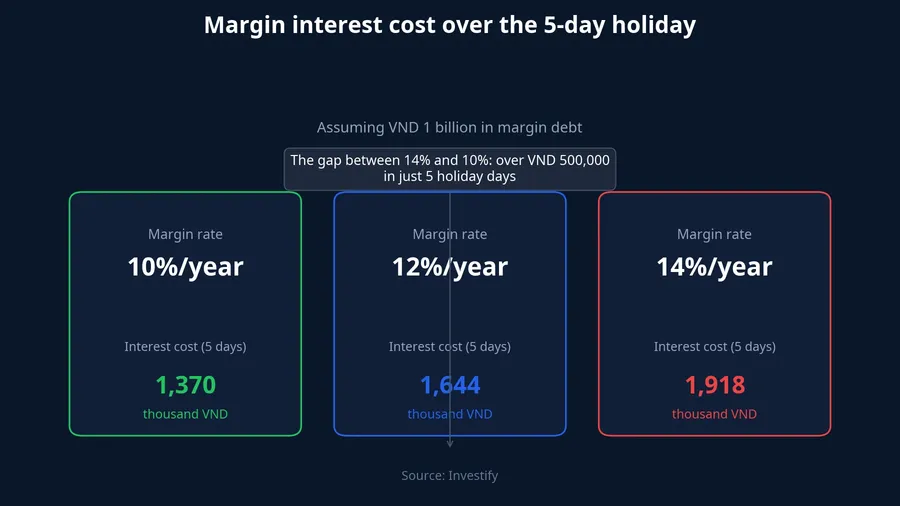
At a 10%/year rate, that cost runs roughly VND 1.37 million per billion in debt. At 14%/year, it climbs to nearly VND 1.92 million. For an account carrying several billion dong in margin debt, the gap between brokers charging different rates can add up to several million dong over a single holiday.
Third, a 5-day information blackout. Global markets keep trading while Vietnam's exchange is shut. Domestic investors can't react with an order until the morning of September 3, even if unfavorable news breaks. For an account with a margin ratio sitting close to the maintenance threshold, that's compressed risk: a sharply lower open could trigger a margin call the moment the market reopens, with zero days beforehand to prepare.

What to watch when trading resumes September 3
Three signals will say more than the index level alone on that first session back.
First is TCB. It carries a heavy weight in the VN-Index and just went through a full rumor-and-denial cycle. Whether the price stabilizes around VND 33,000 or keeps sliding will show how much of the August 26 rally is left standing.
Second is foreign flow. Foreign investors sustained net buying for several consecutive sessions through late August, concentrated in FPT and bank stocks. If that streak breaks the moment trading resumes, the upgrade-anticipation thesis needs a second look.
Third is liquidity itself. If matched value holds above the 20-session average, above VND 14,000 billion, the "money stayed in the market" reading from August 28 gets confirmed. If it drops sharply on the first session back, August 28 was more likely just month-end rebalancing.
Seasonal data doesn't clearly favor leveraged position-holders through this particular holiday either: over the last 5 National Day breaks, only 2 saw the first post-holiday session close higher, with an average move near zero. That's an observed pattern, not a forecast.
What investors might consider
The playbook for this holiday breaks down fairly clearly by account type.
For unleveraged portfolios, the cost of holding through the 5-day break is zero, and a seasonal pattern with less than 1% average amplitude isn't enough to justify selling and rebuying just to "avoid holiday risk."
For accounts with margin balances sitting close to the maintenance threshold, trimming leverage ahead of a long holiday is a standard defensive move: interest cost is certain to accrue, while the ability to react by order is effectively zero for the full 5 days.
The one date every account, leveraged or not, should remember before leaving the screen this afternoon is September 4. That's the day shares bought in the August 28 session can finally be sold, and the day proceeds from today's sales actually land in the account.