
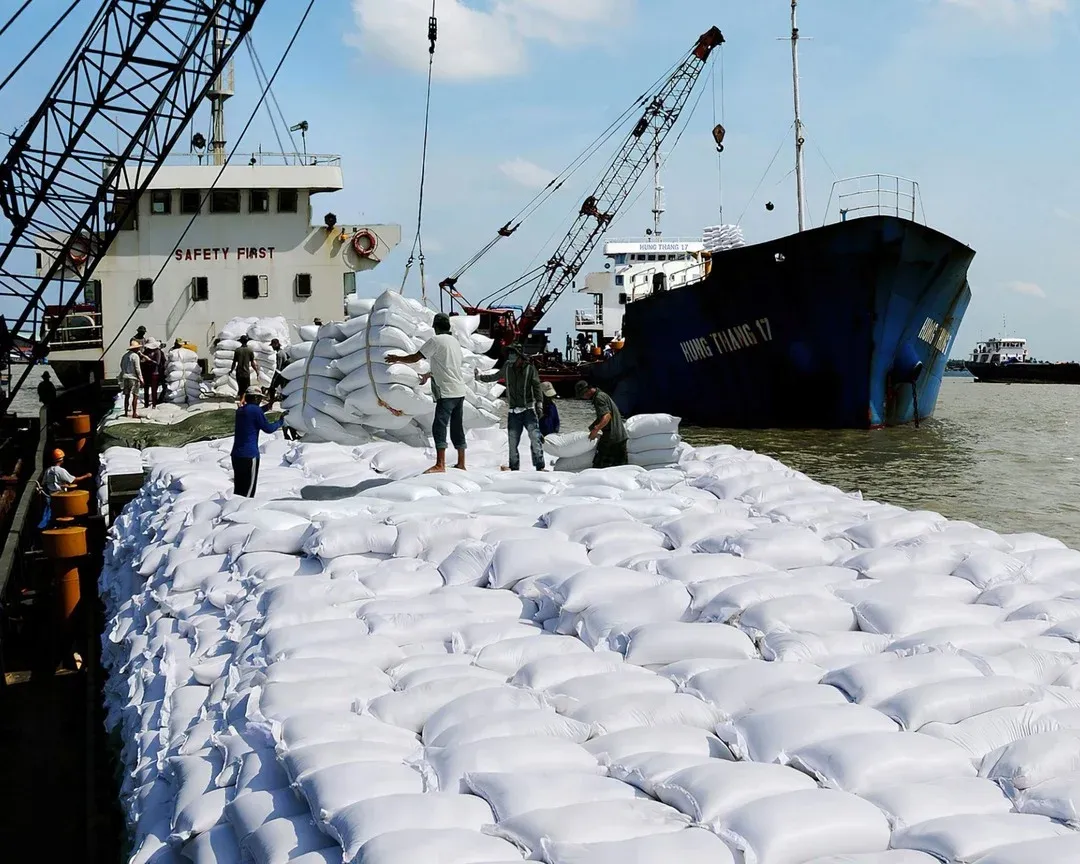

World rice futures closed on August 27 up 28.8% from the same day last year, and roughly 54% above the level at the end of 2025. In August alone, the average price hit 14.25 versus 13.69 in July, a 4.1% increase and the fourth straight monthly gain.
Behind that rally sits a weather forecast that hasn't happened yet. International climate models are leaning toward a strong El Nino forming by late 2026, potentially the strongest in more than 70 years. Multiple countries are responding pre-emptively by building food reserves, and it's that precautionary buying, not an actual shortage on the ground, that's pushing prices up.
Prices Are Rising While the World Still Has a Rice Surplus
This is the detail easiest to miss when staring at an upward-sloping price chart. The International Grains Council forecasts global rice production for the 2026-2027 season at roughly 545 million tonnes, a surplus of about 2 million tonnes over demand. Supply from India remains abundant: in the first half of 2026, the country exported 12.27 million tonnes, up 5% year-on-year, with no new export ban or export tax imposed in July or August.
In other words, the current price level is built on expectations and pre-emptive stockpiling, not on an actual supply-demand gap. That kind of price structure is sensitive to any signal that eases the fear, which is why this year's rice story needs to be read branch by branch, not as a straight line up.
The Philippine Tariff Mechanism: A Cushion When Prices Rise, Not a Brake
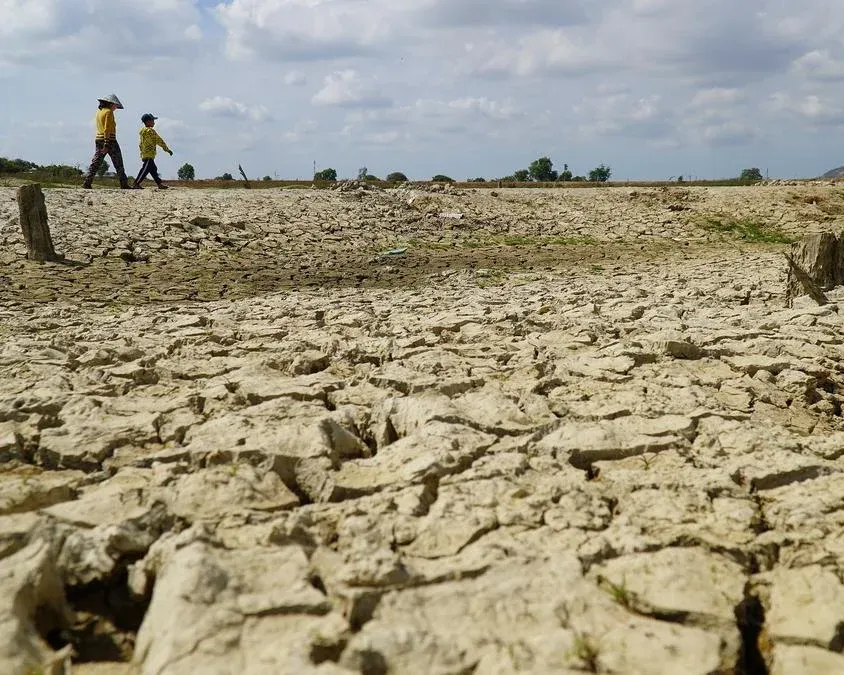
The Philippines is the world's largest rice importer and Vietnam's largest rice export market. On August 4, the country's Department of Agriculture said it would not impose a rice import ban despite the approaching El Nino, because it needs reserves for the dry season from December through April, when domestic paddy output is projected to fall short by about 750,000 tonnes.
Much of the earlier coverage described the Philippines' quarterly price-indexed tariff mechanism, effective January 1, 2026 under Executive Order No. 105, as an automatic "brake": the higher rice prices climb, the higher the tariff, discouraging the very buyers driving the rally. But reading the original USDA report published in February 2026 shows the mechanism runs the opposite way. Tariffs range from 15% to 35%, indexed to the FAO-published FOB export price for Vietnam 5% broken rice: for every 5% rise in international prices, the tariff falls by 5 percentage points, and for every 5% decline, it rises by 5 points. The mechanism is designed to protect Philippine farmers when prices are low, while easing the burden on consumers when world prices spike.
That means if El Nino genuinely pushes rice prices higher in the final quarter, the Philippines' import tariff will fall in step, not rise to slow the buying. This tariff mechanism does not automatically brake the rising-price scenario the way the popular narrative assumes. If anything, it removes cost friction for importers exactly when prices are high, while tariffs rise again to protect domestic farmers once prices cool, which is a genuine headwind for imports in the falling-price scenario.
The real policy risk lies elsewhere. The Philippine Tariff Commission is running a safeguard investigation into rice imports, with a conclusion expected in September. Farmer groups are proposing a 30% safeguard duty on top of the existing quarterly tariff schedule. This proposal is still under investigation, with no decision issued yet, but if approved it would be the one shock genuinely independent of weather, hitting Vietnam's largest rice export market right as Indian supply stays cheap.
Three Branches, Three Different Triggers
Weather intensifies. If El Nino peaks in November and December as the models suggest, the Philippines will have to keep buying to cover the production gap, while the quarterly tariff mechanism keeps easing, making that buying cheaper rather than harder. Vietnam still has meaningful export room in the last four months of the year: as of August 15, exports had reached only about 5.726 million tonnes against a full-year plan of 7.738 million tonnes, leaving roughly 2 million tonnes still to be shipped.
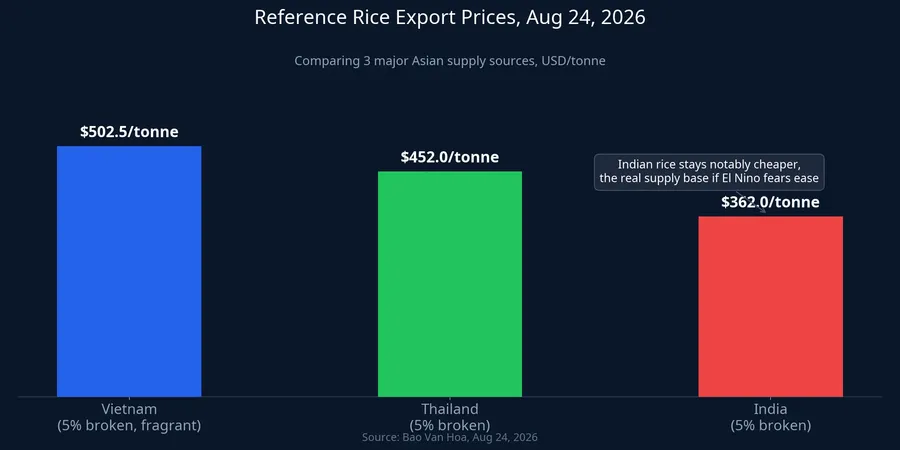
Weather eases. If Q4 climate updates downgrade the forecast, precautionary stockpiling loses its rationale. The market then reverts to the real supply base: a 2-million-tonne surplus per the International Grains Council, and Indian 5% broken rice around $360-364 per tonne, notably cheaper than Vietnamese rice. In this scenario, the Philippines' quarterly tariff would rise again to protect local farmers, making imports more expensive right as world prices are already cheaper, a double headwind for Vietnamese rice exports. Prices built on expectations deflate at the same pace expectations do.
Policy, independent of weather. This is the safeguard investigation conclusion expected in September. If the proposed 30% duty is adopted, the market that absorbs nearly half of Vietnam's rice exports gets more expensive regardless of whether El Nino materializes, and regardless of which direction the quarterly tariff mechanism moves.
The Lag Into Corporate Results Is Real
Individual Vietnamese investors don't trade world rice futures directly, so there's essentially one way into this story: stocks of companies across the rice value chain. First-half results show that higher world prices haven't translated into higher profits yet.
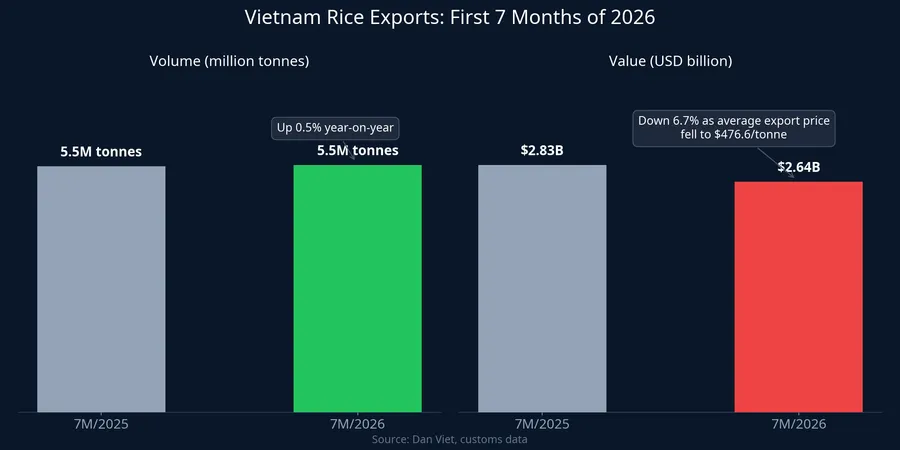
In the first seven months of the year, Vietnam exported 5.5 million tonnes of rice for USD 2.64 billion, up 0.5% in volume but down 6.7% in value year-on-year. The average export price fell to $476.6 per tonne, down 7.1%, because the average reference price in the first half of this year still sat below the first half of 2025, with the rally only really starting in May.
That shows up clearly in the financials. Vinafood II posted a net profit of VND 4.0 billion in H1, up 50.5% year-on-year, but with a net margin under 0.1%. Trung An remained in a net loss of VND 24.2 billion despite gross margin improving from 4.1% to 5.5%. Angimex was the hardest hit, with gross margin at -54.3% and a net loss of VND 57.3 billion. PAN Group posted a net profit of VND 795.7 billion, up 222.5%, but as a diversified group spanning seafood and food processing, that gain can't be fully attributed to rice. Vinaseed improved gross margin to 29.3% while net profit still fell 14.9%, consistent with the nature of the seed-supply link in the chain: it takes at least one crop cycle for demand to feed through to revenue.
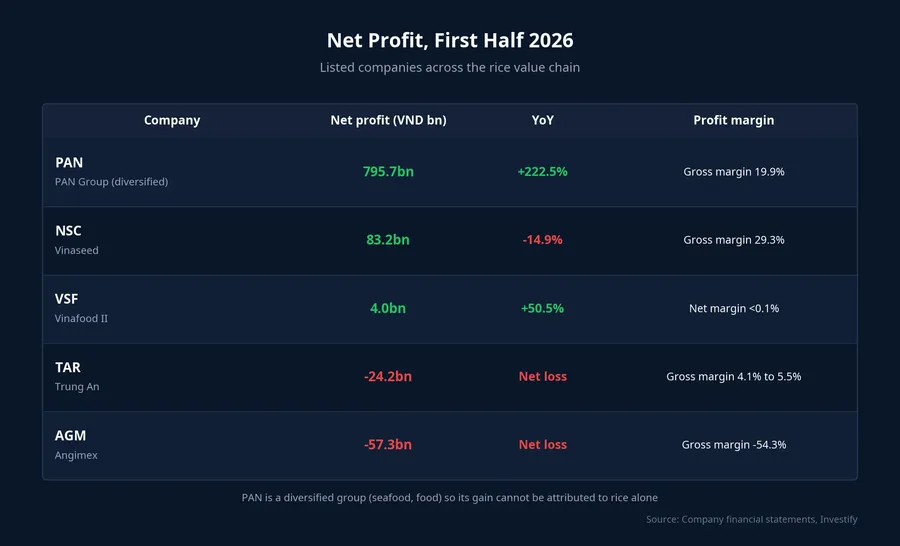
If the current price level holds, the improvement is more likely to show up in Q3 and Q4 results, once contracts signed at the new prices are delivered. But there's a counterweight risk to keep in view: domestic paddy prices are rising too, and if companies buy paddy at elevated prices, the export-price gain gets eroded right at the processing stage.
Where the Order Book Shows Up Before the Financials Do
In the Mekong Delta, IR 504 and CL 555 paddy prices both slipped back to the VND 9,600-9,700 per kg range after three straight declining sessions through August 24, while fresh paddy prices stayed flat. The reason cited is specific: buying by mills and export companies remains weak, with traders not yet stocking up in volume.
This is the single most notable point in the whole picture. World futures have climbed for four straight months, yet where the real buying happens, real orders still haven't heated up. When a company lands a new export contract, it has to source raw paddy first, so Mekong Delta paddy prices typically react months ahead of the financial statements.
Three Measurable Signals Ahead of One Forecast
The sensible watch order right now is: Mekong Delta paddy buying activity, the Q4 tariff rate the Philippines announces under its quarterly adjustment mechanism, then the safeguard investigation conclusion expected in September. All three have specific announcement dates and are measurable, while a forecast for the strongest El Nino in 70 years remains just a forecast until the dry season actually arrives. For rice stocks, any profit improvement is likely to surface first in real Mekong Delta order flow, ahead of the Q3 financial statements.