
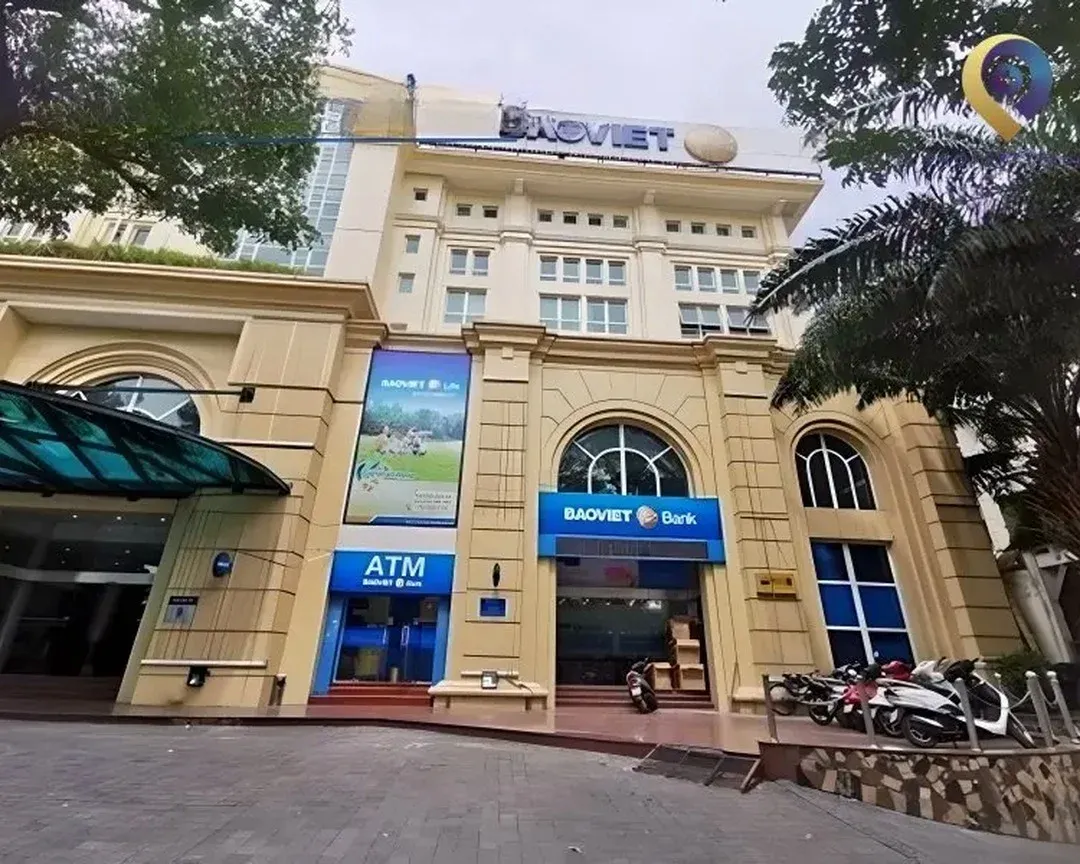

In the first half of 2026, Bao Viet Group earned VND4.926 trillion in bank deposit interest, up 42.3% year-on-year.MarketTimes Over the same period, the group's consolidated after-tax profit was VND1.863 trillion. Deposit interest income alone was 2.6 times the entire remaining profit after all costs.
This isn't unique to Bao Viet. It's a scaled-down picture of how most of Vietnam's non-life insurance sector is making money this year.
Insurers hold other people's money before they have to pay it out
The story starts with a timing gap. Customers pay premiums the moment they sign a policy, while claims are only paid out when an insured event occurs, sometimes months or years later. In that window, insurers hold a large pool of money that, in substance, isn't theirs. Regulation requires them to set aside technical reserves against it, and most of that pool gets invested in assets with stable cash flows.
In other words, insurers act as institutional depositors and bond buyers, not individual savers chasing high rates. Their scale gives them the leverage to negotiate preferential rates that retail depositors simply can't access.
Bao Viet's portfolio: 94% of assets sit in deposits and bonds
Bao Viet's balance sheet shows just how large that pool has become. As of June 30, 2026, consolidated total assets reached VND315.683 trillion, of which the financial investment portfolio accounted for VND297.244 trillion, or 94% of total assets.MarketTimes Deposits at credit institutions alone were VND166.709 trillion, more than half of total assets. The bond portfolio reached VND118.485 trillion, comprising VND72.783 trillion in government bonds and VND45.703 trillion in corporate bonds. Listed shares, at cost, were only VND3.836 trillion, about 1.3% of the portfolio. Vietnam's largest insurance group is barely betting on equities at all: it's putting nearly everything into fixed-income assets.
The rates it earns also look nothing like the deposit rates offered to retail customers: deposits with terms of three months to under a year earn up to 8.9% annually, deposits over a year earn up to 8.6%, and bonds with terms of 3 to 30 years yield up to 10%. More notable is the shift in mix: short-term deposits fell from VND123.877 trillion to VND115.668 trillion, while deposits over a year rose from VND27.443 trillion to VND51.041 trillion, an 86% increase. That's the behavior of an institution locking in high yields for years to come, rather than waiting to see where rates go next.
Claims are outpacing premiums, but the non-life sector is still growing
At the market level, two growth rates are diverging. Per General Statistics Office data cited by VietnamBiz, total insurance premium revenue across the market in H1 2026 was an estimated VND117.9 trillion, up 2.2% year-on-year, with the non-life segment alone reaching roughly VND49.1 trillion, up 13.5%.VietnamBiz At the same time, total insurance benefit payouts across the market were an estimated VND52.3 trillion, up 18.2%.
Payouts are growing faster than premium income, which is compressing underwriting margins, and the gap is being covered by financial income.
Who leans hardest on financial income
Breaking it down company by company, dependence on financial operating income varies sharply. Across the six non-life insurers with available data, financial income accounted for anywhere from nearly half to almost the entirety of H1 2026 after-tax profit.
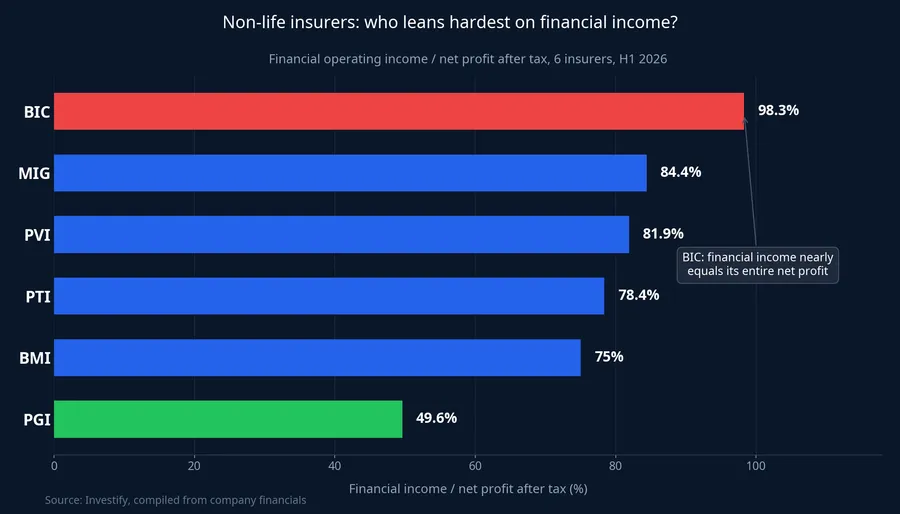
BIDV Insurance (BIC) is the most extreme case in the group: core underwriting profit was only VND96.0 billion, while financial income was VND217.8 billion, equal to 98.3% of after-tax profit of VND221.6 billion. Almost all of BIC's after-tax profit comes from deposits and bonds, not from selling insurance. MIG and PVI aren't far behind, at 84.4% and 81.9% respectively.
At the other end, Petrolimex Insurance (PGI) posted core underwriting profit of VND137.5 billion, well above its financial income of VND85.4 billion, putting its dependency ratio at just 49.6%. PGI is the only company in the group where the core insurance business still generates most of the profit.
The financial cushion can help, and it can also fall short
This is where the story is easy to tell one-sidedly. A large financial portfolio isn't an unconditional shield. It's tied to interest rate levels and asset prices, both of which can change.
BIC illustrates the point best. The company most dependent on financial income in the group is also the one whose profit declined in Q2, as financial income fell 7% while claims expense rose 43%, pulling Q2 pre-tax profit down to VND162 billion.VietnamBiz BIC's claims ratio against net retained premium jumped from 33.6% in H1 2025 to 44.3% in H1 2026. The cushion thinned right as the pressure built.
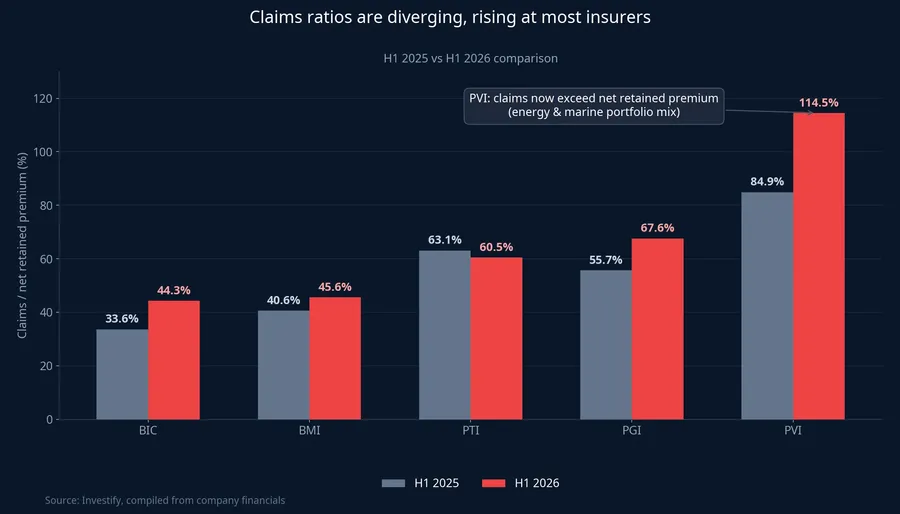
Claims ratios are diverging across the group: Bao Minh at 45.6% (up from 40.6%), PTI at 60.5% (a modest improvement from 63.1%), Petrolimex Insurance at 67.6% (up sharply from 55.7%). PVI stands out at 114.5% versus 84.9% a year earlier, meaning claims expense has exceeded net retained premium. That figure needs context: PVI's energy and marine portfolio carries large losses that cluster in single periods, and the company has been ceding more risk to international reinsurers.
The H1 profit growth also doesn't trace back to one cause. Elevated long-term deposit rates are the biggest factor, visible in Bao Viet's 42.3% jump in deposit interest income, but a favorable equity market also played a role, and for PVI specifically, reinsurance claim recoveries offset a meaningful share of payout pressure. Attributing everything to interest rates would oversimplify the picture.
What individual investors can take from this
The first takeaway concerns how to value an insurance stock. Buying BVH or BIC means buying, in large part, a portfolio of deposits and bonds, plus a thin-margin insurance business on top. At the August 28 close, BVH traded at VND64,000 per share, BIC at VND21,650, and PVI at VND66,000. For this group of stocks, the deposit rate environment and claims trends are the two variables worth watching before premium revenue.
The second takeaway is a broader reference point for personal portfolios. A professional institution holding nearly VND300 trillion like Bao Viet still allocates about 94% of assets to deposits and bonds, and only about 1.3% to listed equities, because its payout obligations have defined maturities, so the matching assets need certain cash flow. Individual investors with near-term spending needs, such as tuition due in the next 12 months or an emergency fund, face the same problem at a smaller scale: a fixed-income channel doesn't produce the highest return, but it produces a known one. One difference worth acknowledging is access: Bao Viet earns up to 8.9% annually on tens of trillions of dong in deposits, a rate no individual savings account can get. The lesson lies in matching assets to the maturity of your obligations, not in the absolute yield figure.
What to watch in the second half

The second half will answer two questions. First, how far will storm season, which concentrates most of the year's property and vehicle losses, push claims ratios for the smaller names. Second, whether deposit rates hold their current level, because if they fall, the income line currently carrying 75% to 98% of profit for most of the group will shrink first.
For companies where core underwriting still generates real profit, like PGI, that contraction is manageable, since there's another leg to lean on. For companies with almost no such leg, like BIC, these are the two variables worth watching closely in upcoming quarterly reports.