

On the evening of August 27, Reuters updated the story it had run the day before: BNP Paribas confirmed it has no plan to buy a stake in Techcombank.CafeF The problem is timing. That statement landed more than four hours after HOSE had closed, right after TCB had just wrapped up its second straight rally session.
All of the buying across August 26 and 27 happened while the market had no idea that one of the two named partners had already walked away from the story. August 28 is the first session in which TCB gets repriced with complete information.
The original story flagged its own limits. The market skipped past them
On the morning of August 26, Reuters cited two anonymous sources saying BNP Paribas and KB Kookmin Bank were separately negotiating to buy at least 15% of Techcombank as strategic investors, in a deal that could be worth around $2 billion.FILI The original report itself flagged three caveats: no agreement had been signed, valuation was the biggest sticking point, and Techcombank would likely pick only one of the two suitors.
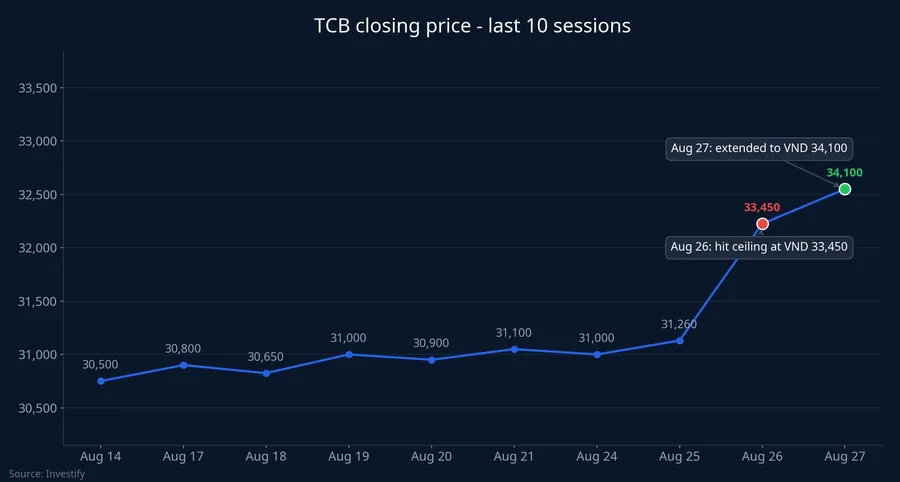
The market largely ignored all three caveats. TCB closed August 26 at its ceiling price of VND 33,450, up 6.87%, on total volume of 55.8 million shares, several times the roughly 15 million shares TCB typically traded per session in August. The most attractive figure in the report wasn't the 15% stake; it was the valuation, roughly 2 times book value, about 55% above TCB's price before the news broke. That number, more than the stake size, is what pulled money in.
KB Kookmin responded the same day. Few read it closely
That same day, a KB Kookmin Bank representative spoke to Seoul Economic Daily and significantly downplayed the story. The Korean bank said that when it considers stakes to expand its operations, it routinely screens dozens of financial institutions at home and abroad, adding: "Techcombank is just one of them, and we are not at the stage of concrete negotiation or discussion about an acquisition."CafeF
The gap between the two descriptions is wide. Reuters used the word "negotiating." KB Kookmin used the phrase "screening candidates." One implies a deal already at the table; the other implies a shortlist where Techcombank sits alongside dozens of other names. That distinction matters, and it shouldn't get flattened into a single headline like "foreign bank wants to buy Techcombank."
August 27: money kept coming despite a narrower story
KB Kookmin's response didn't slow the flow. TCB opened August 27 at VND 33,500, touched VND 35,200 intraday, then pulled back to close at VND 34,100, up another 1.94%, on matched volume of 32.3 million shares.
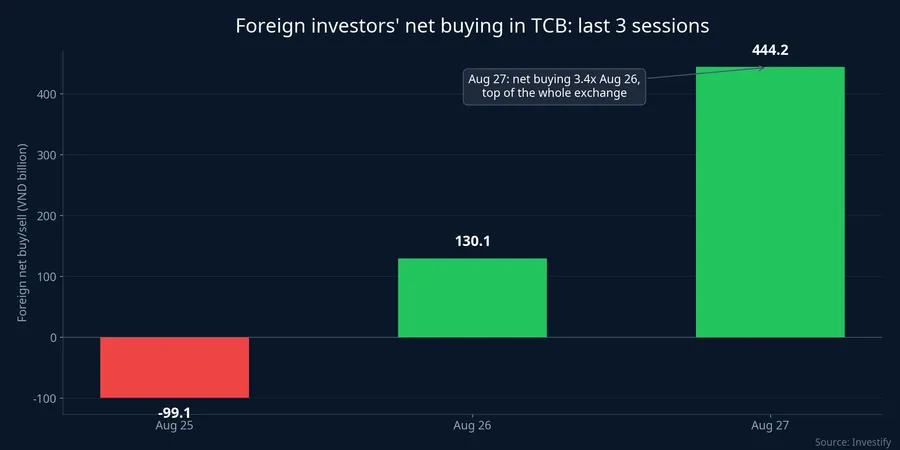
The most notable detail is foreign flows. Foreign investors net-bought VND 444.2 billion of TCB on August 27, 3.4 times the VND 130.1 billion of August 26, putting TCB at the top of the entire exchange for net foreign buying that day. Just two sessions earlier, on August 25, foreign investors had net-sold VND 99.1 billion of the same stock. Across August 26 and 27 combined, Techcombank's market cap rose from VND 221.8 trillion to VND 241.6 trillion, adding nearly VND 20 trillion.
Why the price kept climbing on August 27
The buying on August 27 has a few possible explanations, and they don't all carry the same degree of certainty. Nothing in the evidence lets you collapse all three into a single cause. The most certain, purely on timing: the market didn't yet know about BNP Paribas, since that statement came after 3pm and could not have influenced same-day order flow. Second, KB Kookmin's response wasn't read as a rejection: "not at the stage of concrete negotiation" sounds more like an open door than a no.
The third explanation, less certain than the first two, is foreign flows ahead of the market upgrade: Vietnam is set to formally enter FTSE's emerging-market index from September 21, and foreign funds are rebalancing portfolios. But VND 444.2 billion concentrated in a single ticker, spiking exactly two sessions after the report, looks more like a reaction to the news than index-driven allocation. The evidence available isn't enough to cleanly separate how much each factor contributed.
Why the foreign ownership room changes what "$2 billion" actually means
There's a technical constraint that would make this deal, if it happens, look nothing like what most investors picture when they read the "$2 billion" headline. Techcombank has registered a maximum foreign ownership ratio of 22.5386%, well below the standard 30% cap that applies to commercial banks.Thời báo Tài chính Việt Nam Foreign investors currently hold 20.54% of the stock, equivalent to more than 1.455 billion shares, leaving headroom of only about 2 percentage points, or roughly 141.77 million shares.
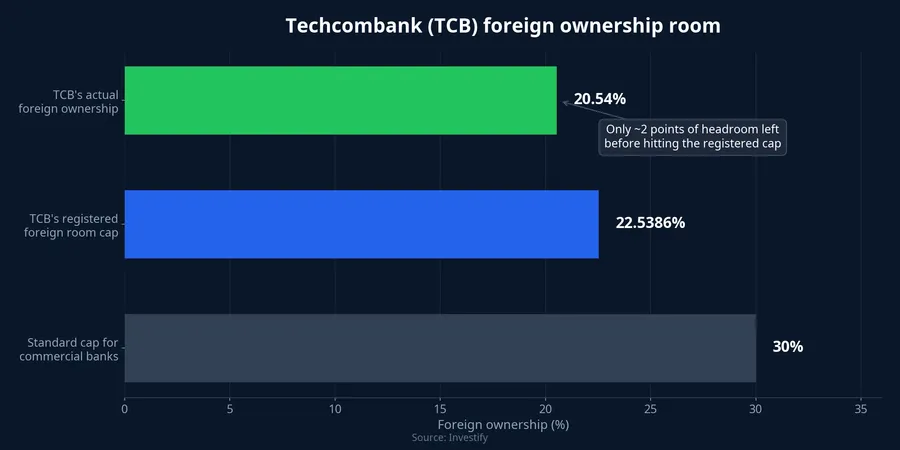
To own 15% of Techcombank, a foreign partner would need roughly 1.06 billion shares, far more than the remaining room even if it were bought out entirely. That's why the structure Reuters described is a transfer of shares currently held by existing foreign shareholders, rather than a new share issuance.
That structural detail gets little attention, but it matters most to retail shareholders. If the deal goes the transfer route, Techcombank raises no new capital at all, and the premium over market price flows to the selling foreign shareholders, not to the bank and not to retail investors holding TCB on the exchange. The "2 times book value" figure is the price for one privately negotiated block of shares, not the price the market would pay for every outstanding TCB share.
The evening of August 27: one of the two names walks away
More than four hours after the market closed, Reuters added BNP Paribas's statement to the original story. The French bank confirmed it has no plan to buy a stake in Techcombank.Người Quan Sát By the end of August 27, the picture looked like this: BNP Paribas denied it outright, KB Kookmin acknowledged screening the bank but not negotiating, and Techcombank itself stayed silent.
Three levels of confirmation every M&A rumor should be read against
The Techcombank episode offers a reading framework that applies to any ticker, not just TCB. The first level is an anonymous tip through a news agency: "two anonymous sources" describes a negotiation in progress, not a final outcome, and the caveats a report flags on itself often get dropped when other outlets pick the story up.
The second level is a response from the parties involved, which narrows the story considerably but doesn't close it: "not at the negotiation stage" is different from "will not buy." The third and highest level is an official disclosure from the listed company itself, an obligation that in this case belongs only to Techcombank, and one it still had not met as of August 27.
For an M&A story that hasn't reached that third level, the common-sense standard is to wait for the mandatory disclosure rather than chase a price that has already run. TCB currently trades 8.9% above its pre-news base, while the confirmed portion of the story amounts to little more than one party saying it's "under review."
What to watch in the August 28 session
August 28 is the first session in which the market trades TCB with full information about both partners' responses, including BNP Paribas's denial. Two signals worth watching: whether Techcombank issues an official statement or stays silent, and whether foreign investors keep net-buying now that BNP Paribas has been ruled out.
If foreign buying pulls back sharply in that first session, most of the past two days' gains would be confirmed as a reaction to the rumor rather than a fundamental shift in the bank's outlook. If flows hold up despite the denial, the rally's momentum more likely comes from something else, such as index-upgrade expectations. The clearest answer will come from how the session actually trades, not from guessing ahead of it.