

On August 26, Vietnamese banks were lending each other overnight funds on the interbank market at an average rate of just 2% a year.Người Quan Sát That same day, ACB posted the highest 12-month online savings rate among 34 banks surveyed, at 7.8% a year.CafeF And Sacombank, on that very same day, rolled out a new rate schedule raising every online tenor from 6 months and up.CafeF
These three numbers do not contradict each other. They describe three different kinds of money sitting on the same interest rate curve, and the gap between them is what will determine how much interest savers actually earn between now and year-end.
What Sacombank raised, and what it didn't
Sacombank's new retail rate schedule, effective August 26, draws a fairly clear line. For online deposits under VND 50 million, tenors from 1 to 5 months stayed flat at 4.5% a year.CafeF But from the 6-month mark onward, everything moved up: the 6-11 month tenor rose from 6.4% to 6.8%, the 12-18 month tenor from 6.6% to 7%, and the 24-36 month tenor from 6.9% to 7.2%.
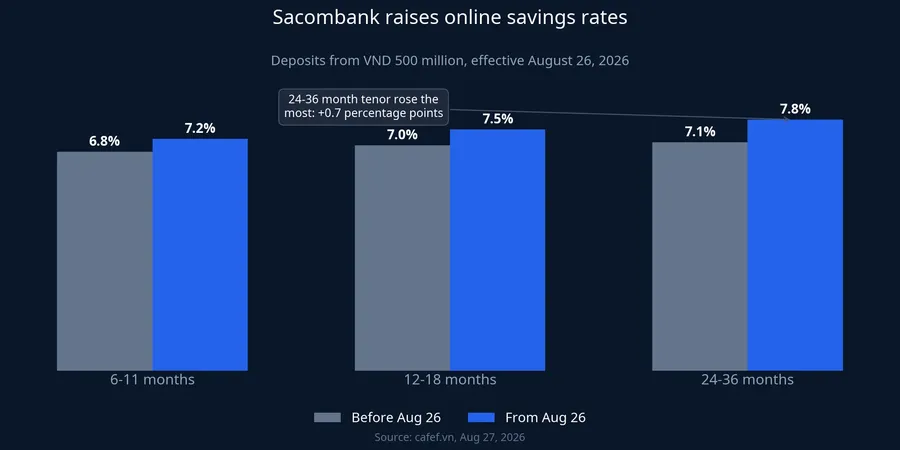
The more money on deposit, the bigger the increase. Deposits between VND 50 million and under VND 500 million got a flat 0.5 percentage point bump across every tenor from 6 months up. Deposits of VND 500 million or more got the biggest boost at the longest tenors, with the 24 and 36-month rates jumping from 7.1% to 7.8%, a full 0.7 percentage point increase in a single adjustment.
Meanwhile, the over-the-counter rate schedule barely moved, topping out at 6.9%. In other words, Sacombank isn't raising rates for every dollar that walks in the door. It's specifically rewarding money that arrives through digital channels, stays long, and comes in large sums.
What the 2% figure actually measures
The overnight rate is the price of the shortest loan that exists on the interbank market. It measures the cash left sitting in banks' settlement accounts at the close of a business day, not the funding a bank can actually lend out over multiple years.
That gap shows up on the very same rate sheet. In the August 26 session, the average VND interbank rate was 2% overnight, 6.3% for one week, 6.4% for two weeks, and 6.9% for one month.Người Quan Sát Simply stretching the loan from overnight to one week adds more than 4 percentage points to the price. Cheap money is only cheap for exactly one night.
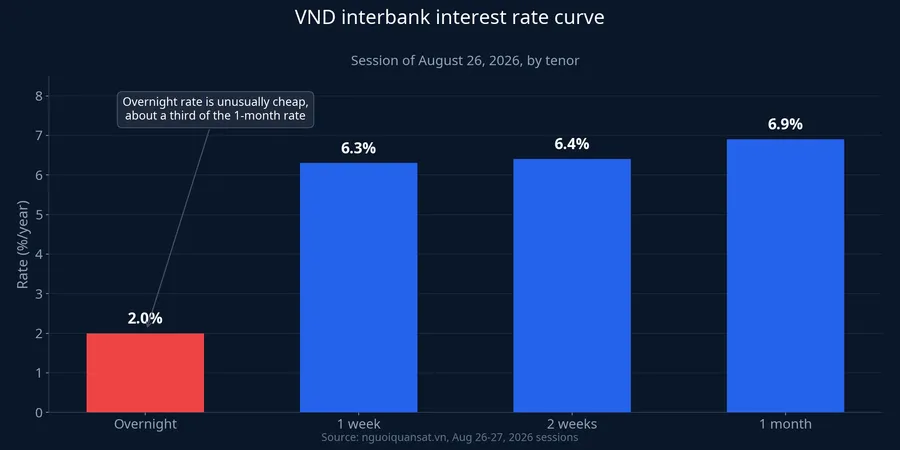
Set against that, the 7.2% Sacombank pays large depositors on 6-11 month terms is only slightly above the 6.9% banks themselves pay each other to borrow for one month. Savings rates aren't anchored to that 2% overnight figure. They're anchored to the steep part of the curve.
The State Bank is also selling term money
In the August 27 session, on the open market's repo channel, the State Bank of Vietnam (SBV) offered four tenors at once: VND 7,477 billion at 14 days, VND 162 billion at 35 days, VND 2,117 billion at 63 days, and VND 3,811 billion at 91 days.Người Quan Sát All VND 13,569 billion was awarded at a 4.5% rate. With VND 3,973 billion maturing that same session, the SBV injected a net VND 9,596 billion, pushing outstanding repo-channel volume to VND 183,455 billion.
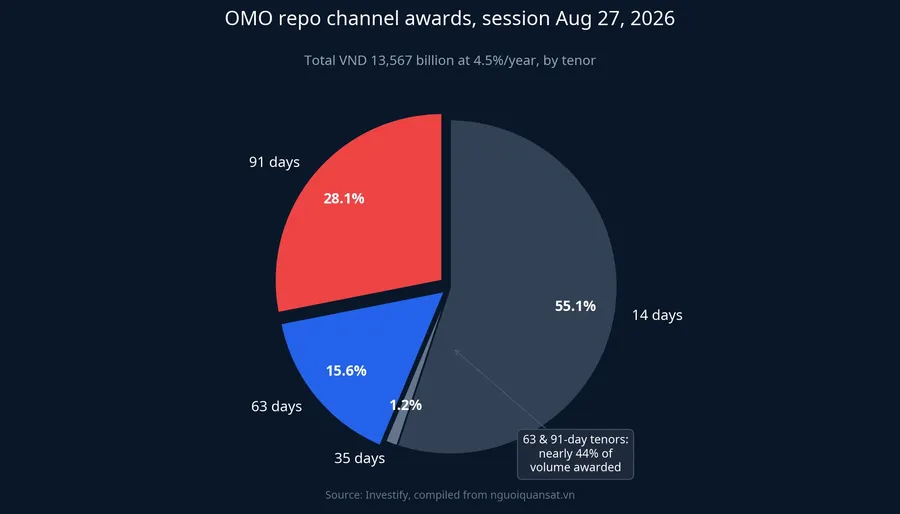
Banks took the entire offered volume, borrowing from the SBV at 63 and 91 days for 4.5%, more than double the 2% they could borrow overnight on the market. But compared to the 6.9% they'd pay to borrow one-month funds from each other, that 4.5% three-month money is actually cheap. The two longest tenors made up nearly 44% of that session's awarded volume, a sign the regulator itself is extending the tenor of the funding it provides to the system.
Why long-term funding stays scarce
The root cause sits in the structure of banks' balance sheets, not in short-term liquidity. Per remarks from Vietcombank leadership at an investor meeting, the system-wide loan-to-deposit ratio (LDR), calculated the conventional way, stood at approximately 102.4% at the end of July, meaning the system is lending out more than it takes in from customer deposits.CafeF Vietcombank also noted that recent policy adjustments, such as counting a larger share of State Treasury deposits toward LDR or loosening the ratio of short-term funds used for medium and long-term loans, are mainly technical support measures that don't replace the real need to raise funds from customers.
The tenor mismatch runs even deeper than the LDR figure suggests. At a meeting of the Government Standing Committee with the business community in mid-July, State Bank of Vietnam Governor Phạm Đức Ấn said short-term funds now make up as much as 80% of the system's funding structure, while medium and long-term funds account for only about 20%, even as businesses' demand for medium and long-term loans remains substantial.CafeF A bank can be flush with overnight cash and still lack the eligible funding to back a ten-year infrastructure loan, because overnight money doesn't count as stable funding.

Rong Viet Securities (VDSC) noted that short-term liquidity pressure has eased considerably, but that doesn't mean savings rates are entering a downtrend, because the real drivers of rates are structural issues within the system's balance sheet.CafeF
Is there another explanation
The structural story isn't the only possible read on Sacombank's move, and a few alternatives deserve a look before drawing conclusions.
The first is distribution-channel strategy. Sacombank's counter rates barely budged while its online tenors rose by as much as 0.7 percentage points, which could simply be a push to shift deposits toward digital channels and cut operating costs, not necessarily a sign of funding stress. The second is seasonality: the National Day holiday running from August 31 to September 2 typically drives up cash demand, so the SBV's large net injection on August 27 could just as easily be holiday preparation as a signal of a longer trend. The third is limited breadth: in the August 26 survey of 34 banks, only 8 posted 12-month rates of 7% or higher, with most of the rest still clustered around 6-6.9%.CafeF
Still, the evidence leans toward the structural explanation, because two large banks, independent of each other, arrived at the same forecast. Vietcombank leadership expects the overall savings rate level to stay firm through the second half of the year given strong credit demand from infrastructure and public investment, coupled with deposit growth lagging lending growth. Alexandre Macaire, Chief Financial Officer of Vietnam Technological and Commercial Joint Stock Bank (Techcombank), went further, saying savings rates will likely keep inching up by about 0.3 percentage points through year-end.CafeF
What savers should take from this curve
First, the gap between banks is wide. Among 12-month online rates on August 26, the highest was 7.8% and the lowest 3.7%, a spread of 4.1 percentage points.CafeF On a VND 1 billion deposit held for 12 months, that spread translates into roughly VND 41 million in interest, enough to warrant careful comparison shopping before picking where to deposit. The four state-owned banks, Agribank, BIDV, Vietcombank and VietinBank, all posted a matching 6.8% for the 12 and 18-month tenors, one point below the market leader but still above most of the system.
Second, the current curve rewards both longer tenors and larger balances. At Sacombank, within the same online deposit-from-VND-500-million bracket, the 6-11 month rate is 7.2% while the 24-36 month rate is 7.8%, a meaningful gap for the same customer.
Third, there is a real cost to locking in the wrong tenor. With savings rates forecast to inch up roughly another 0.3 percentage points by year-end, locking all of one's money into a 36-month term right now is a bet that rates have already peaked. On the other side, early withdrawal typically only earns the non-term deposit rate, effectively wiping out most of the premium a saver waited for. Given an upward-sloping curve and a modest further increase expected, a common approach is to split funds across multiple tenors: keep a portion in the 6-12 month range for a chance to re-deposit sooner, and lock the rest into longer terms. The right split depends on when each saver actually expects to need the money.
The signal worth watching over the coming weeks isn't the overnight rate, which swings sharply with each SBV liquidity operation. The real signal is the one-month interbank rate. As long as that figure stays near 7%, banks still have reason to pay up for long-term household deposits.