

Just two months ago, a joint-stock commercial bank was still willing to pay a fixed 10% a year on six-year bonds. By August, that rate had vanished from every new issuance across the banking sector.Người Quan Sát
Looking at the average alone, this reads like an ordinary "rates are cooling" story. But one detail doesn't fit: borrowing volume through the bond channel didn't shrink alongside the price of money. It rose sharply. The bigger picture sits right there.
The peak of a hot cycle: June through late July
The starting point was late June, when average bank bond rates were still hovering around 8% a year,Dân Trí right as the banking system hit its tightest liquidity of the first half, with overnight interbank rates briefly touching around 13% a year.Dân Trí By July, the funding race hit its peak: Sacombank ran three fixed-rate bond issuances at 10% a year, raising more than VND 3,600 billion,Người Quan Sát while PVcomBank locked in a seven-year tranche at 9.8% a year on July 31.FireAnt The sector-wide average for July reached 8.7% a year, the highest in years.Người Quan Sát

What stands out is that the cost of capital peaked exactly when borrowing volume bottomed out: banks raised only VND 15,350 billion through private bond placements in July, down more than 72% from June and the lowest for any July since 2021.Vietstock Buyers were quoting a high price, and it only bought a much smaller pool of capital.
August 1: a decision that rewrote the liquidity rulebook
The turning point came from policy, not market supply and demand. The State Bank of Vietnam issued Decision 1743/QĐ-NHNN, effective from August 1, 2026 through July 31, 2028, raising the share of the State Treasury's term deposits that count toward commercial banks' total deposits from 20% to 50%.VnEconomy

It sounds technical, but the effect is direct. The loan-to-deposit ratio (LDR) acts as a safety cap: the bigger the denominator, the more room a bank has to lend. Letting banks count more Treasury deposits into that denominator means more lending room without going out to buy expensive capital, because this money was already sitting inside the system, simply uncounted until now.
August: a new floor, and a bigger volume
The result showed up within the month. The sector's average issuance rate slipped to around 8.5% a year, down 0.2 percentage points from July, with no tranche left in the 9.5-10% range.Người Quan Sát The split by group is clear: Vietcombank and BIDV around 7.8-8% a year, private banks mostly at 8.5-9%, and TPBank at the top with 9.1% a year on a three-year tranche.
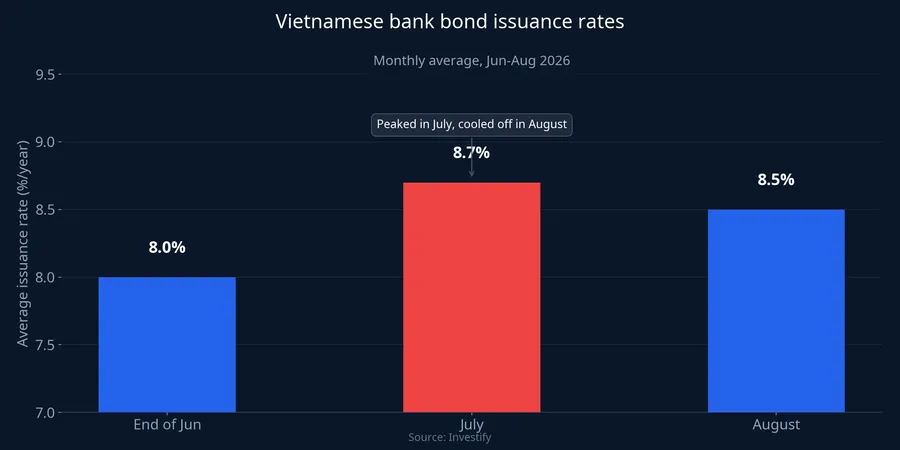
While the price of capital fell, volume moved the opposite way. As of August 25, banks had issued 23 bond tranches worth a combined VND 23,900 billion, out of 28 tranches market-wide.Dân Trí Compared with July's VND 15,350 billion, that's roughly 56% higher with five days still left in August.
How much of that decline is a real rate cut?
The 0.2-point drop is an average, and averages are highly sensitive to who's issuing. August saw a heavier weight of Vietcombank and BIDV tranches in the 7.8-8% range, and that composition alone would drag the sector average down without any single bank actually cutting its own rate.
To find out whether prices actually fell, you have to compare the same issuer at the same tenor. PVcomBank offers exactly that comparison: a seven-year tranche on July 31 paid 9.8% a year, and another seven-year tranche on August 17 paid only 9.6%.FireAnt Same bank, same tenor, 17 days apart, 0.2 points cheaper. So there is a real cut, but its size just matches the average. The sense of "leaving the 10% zone entirely" mostly comes from state-owned banks retaking a larger share of issuance, not the whole market pricing uniformly lower.
What hasn't eased: money is only cheap overnight
This is the detail easiest to miss in a "rates are cooling" headline. Abundant liquidity in August is real, but it's only abundant at the short end of the curve.
In the week of August 17-21, the overnight interbank rate fell from 5.77% to 3.01% a year in just one week, and the State Bank of Vietnam net-drained VND 7,839 billion via open market operations.VietnamFinance But that same week, the one-month rate barely moved at 6.93%, while the three-month rate actually ticked up to 7.56%.
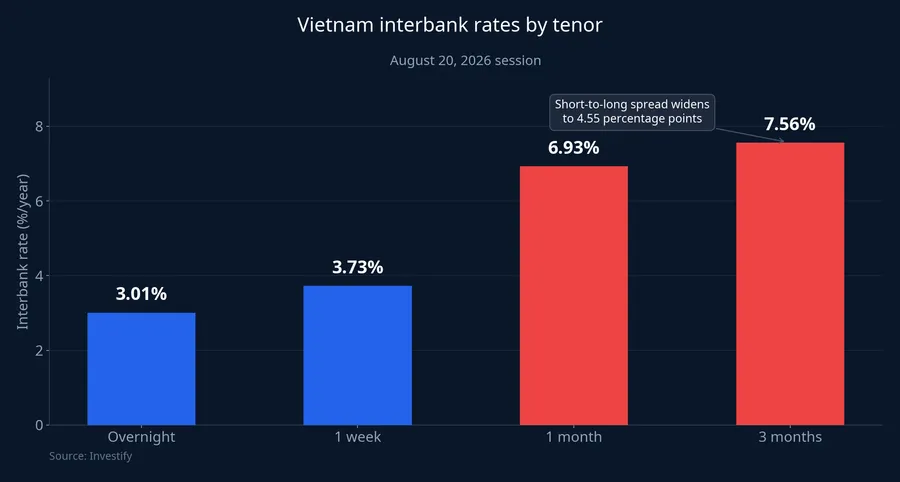
The gap between 3.01% overnight and 7.56% at three months says something specific. Banks have surplus cash to patch daily liquidity, but not surplus cash to fund medium- and long-term lending, exactly the gap bank bonds are issued to cover, often tied to Tier-2 capital targets. That's why TPBank's three-year tranche still pays 9.1% a year, about 2.9 percentage points above the bank's own 12-month deposit rate.
The causal picture has several contributing explanations at once: short-term liquidity improved, the issuer mix tilted toward cheaper state-owned names, and lending room was widened by an administrative decision. The data leans hardest on the latter two, because if abundant liquidity alone were driving this, the interbank curve should have eased evenly across every tenor. FiinRatings analysts accordingly hold a more cautious view than the cooling narrative circulating in the market: bank bond rates show no genuine sign of easing in the second half of the year, given that system-wide credit growth reached 7.41% versus deposit growth of just 5.02% through the end of June.Dân Trí
For individual investors, that 9-10% never opened its doors
Nearly every tranche mentioned above was a private placement, and the buyers were overwhelmingly institutional: securities firms, insurers, investment funds.Người Quan Sát Individuals who want to buy private placements must qualify as professional securities investors, with a portfolio of at least VND 2 billion held continuously for 180 days; face value per tranche typically starts at VND 100 million, and there's almost no resale market. In other words, that 10%-a-year figure which just vanished was never an option for most individual investors to begin with. It was a price banks paid to institutions.

The fixed-rate channels actually open to individuals sit at a much lower level:
- Savings deposits: online 12-month rates as of August 25 were 6.8% a year at BIDV, 6.3% at PVcomBank, 6.2% at TPBank, and 5.9% at Vietcombank, with Saigonbank leading the market at 7.0%. The only channel among these covered by deposit insurance, capped at VND 125 million.
- Certificates of deposit: same bank, but priced above regular savings; Vietcombank lists 7.5% a year for six months and 7.9% for 12 months, versus 6.6% and 6.8% for online savings.Dân Trí
- Open-end bond funds: leading 12-month trailing performance is 7.53% (VinaCapital Bảo Thịnh), 7.14% (DC Bond Fund), and 6.95% (VCBF-FIF), with management fees of 0.8-1.2% a year and no deposit insurance.
- Government bonds: yields as of August 25 were 3.91% a year at one year, 4.18% at five years, and 4.42% at ten years, with credit risk near zero in exchange for the lowest returns in the group.
The highest Big Four 12-month deposit rate is 6.8%, while BIDV itself borrows long-term through bonds at 7.8-8%. That roughly 1.2-point gap is what banks pay extra to secure long, stable capital, and it flows to bond-buying institutions, not to ordinary savers.
How to read this trend
For anyone already holding fixed-rate bonds or certificates of deposit bought near the July peak, the current trend works in their favor: a lower new floor makes the locked-in rate relatively more valuable. The risk for this group isn't today, it's at maturity, when reinvestment rates will likely sit below what they're earning now.
For anyone weighing new capital, the sensible reference is the shape of the whole rate curve, not a single number. Cheap money has only shown up overnight and hasn't spread to the one-to-three-month tenors. The usual priority now is locking in longer tenors at today's rates rather than rolling over short terms repeatedly, and comparing a certificate of deposit against the same bank's own savings rate before comparing across banks.
The signal worth watching in September is straightforward: whether the one-month and three-month interbank rates follow the overnight rate down. If those two tenors break out of the 6.9-7.6% range, retail deposit rates will likely keep falling, and August's cooldown will turn out to have been the start of a longer trend. If they stay put as they did last week, August's 8.5% figure is more likely just a pause in a funding-cost cycle that remains elevated.