
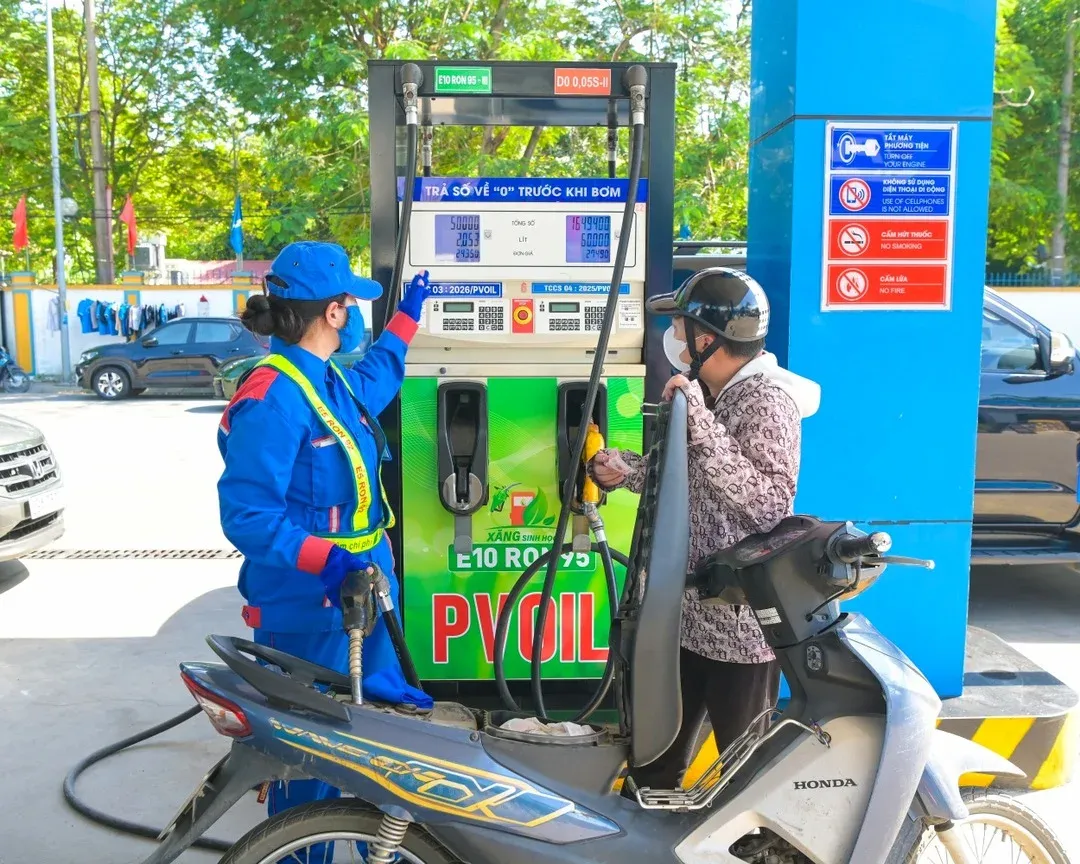

Vietnam's retail diesel price is still frozen at its cap of VND 28,543 per liter, the level set at the August 20 pricing cycle and unchanged since.Tiền Phong Meanwhile Brent crude has fallen for two consecutive sessions, closing on August 25 at $89.00/barrel, down 3.44% from the prior session. Morning coverage on August 25 described global oil as "cooling" while domestic prices "wait for adjustment."VietnamNet
The more useful question is how much the next pricing cycle, due Thursday afternoon August 27 under the country's fixed 7-day schedule, will actually cut.e10.vn The answer doesn't hinge on the single session that fell on August 25. It hinges on a weekly average, and that average, as of now, is still coming in higher than the prior cycle.
Base price is a weekly average, not a closing quote
Under Decree 95/2021 and Decree 80/2023, the base price each cycle is calculated from the average price of refined petroleum products on the Singapore market over the preceding cycle, then loaded with standard costs, standard profit margins, and taxes and fees including import duty, special consumption tax, environmental protection tax, and value-added tax. Put simply, one trading session, no matter how sharply it moves, is only one of seven days feeding that average. It does not by itself set the price for the next cycle.
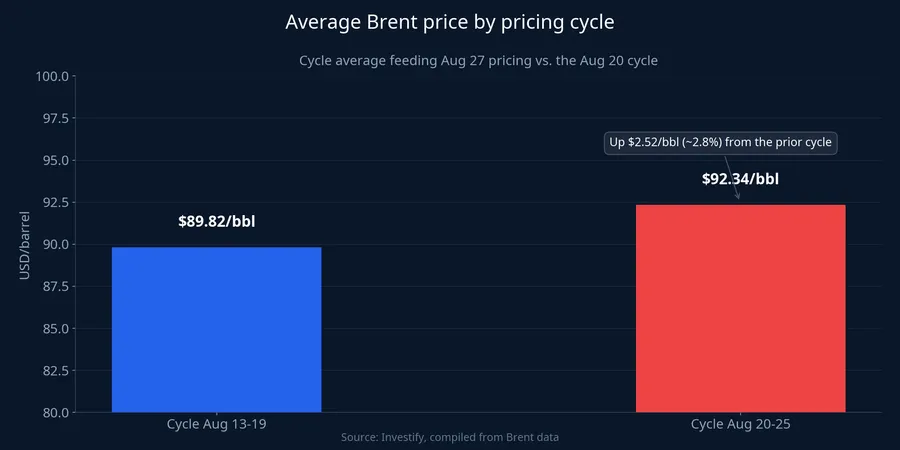
The numbers make this concrete. Applying the same averaging method to the Brent series, the four sessions from August 20 to 25 produce an average of $92.34/barrel, about 2.8% above the $89.82/barrel average of the prior cycle (August 13-19). Even if the August 26 session extends the decline toward $89/barrel, the full cycle average will likely still land above the previous one.
One caveat matters: the official formula uses Singapore refined-product prices, not Brent crude, and the two series move on their own rhythms. Brent here is only a reference indicator. But the mechanism that creates the lag is identical for both series: retail prices respond to a week's average, not to the most recent session.
The buffer many assume is still there
The default explanation when domestic fuel prices fail to track world prices down is that the Price Stabilization Fund is absorbing the gap. 2026 data tells a different story. The industry has barely contributed to the fund all year: only one distributor recorded a contribution, in April 2026, totaling roughly VND 10.5 billion, and no cycle since May 2026 has seen any contribution at all.
Fund balances at distributors' most recent reporting dates have held roughly flat around VND 1,218.7 billion across the August 13 and August 20 cycles. Saigon Petro, the distributor reporting closest to the pricing date, kept its balance unchanged at VND 270.1 billion at the August 20 cycle, with no contribution and no drawdown. That aggregate is each distributor's balance as of its own latest report, not a figure booked on a single date, since reporting cadences differ across distributors. Even so, the trend is clear: the buffer fund is doing almost no intervening in current prices.
That points to a counterintuitive conclusion. World prices are passing through to retail prices nearly intact in magnitude, only delayed in timing. The lag right now is an administrative lag built into the 7-day pricing cycle, not the result of a fund absorbing the difference.
Why the domestic percentage move is always smaller than crude's
A third factor flattens the amplitude: the tax and fee structure. Most taxes and standard costs are calculated per liter or at a fixed rate, so when the world refined-product price moves by one unit, the percentage change on the final retail price comes out smaller. That is why domestic prices rarely move by the same percentage as crude, even when pass-through is complete.
But when a move is large enough and persists through an entire cycle, pass-through can be close to full. In the week ending July 23, Brent rose 19.54% to a peak of $100.69/barrel. At the July 23 pricing cycle itself, diesel 0.05S-II jumped from VND 21,740 to VND 25,760 per liter, an 18.5% increase in a single pricing decision. The mechanism doesn't erase a week's gain, it just compresses that gain into one jump.
An alternative explanation deserves a place on the table too, since the cycle lag isn't the only reason diesel is running high. Since early July, Vietnam's retail diesel price has risen 30.6% (from VND 21,860 to VND 28,540/liter, Zone 1), while Brent has risen 24.4% (from $71.57 to $89.00/barrel). Diesel has outpaced its feedstock, and that gap most likely comes from a widening spread between regional refined-product prices and crude, not from the pricing cycle itself. In other words, the 7-day cycle explains the timing of when prices turn, while the product-crude spread explains most of the current price level.
Who is actually paying for this lag
Diesel is a direct input cost for freight transport. Fuel accounts for roughly 40-45% of road transport costs, so every week prices stay elevated is a week of squeezed margins for logistics firms.SGGP

The hardest-hit group is aviation, where jet fuel accounts for roughly 30-40% of operating costs, while Vietnam Airlines' Q2 2026 gross margin was only 4.4% and Vietjet's was 5.6%. At its 2026 shareholder meeting, Vietnam Airlines assumed a full-year average Jet A1 price of $128.54/barrel, up nearly 48% from 2025.Tuoi Tre The carrier has already trimmed some flights since April 2026 to manage rising fuel costs.Anadolu Agency

In shipping, VOS shows the clearest exposure since it runs dry-bulk vessels on a voyage-charter basis and absorbs fuel costs directly, with a Q2 gross margin of only 11.1%. PVT and HAH are less exposed, since most of their fleets operate on time-charter contracts and their port operations carry thicker margins.
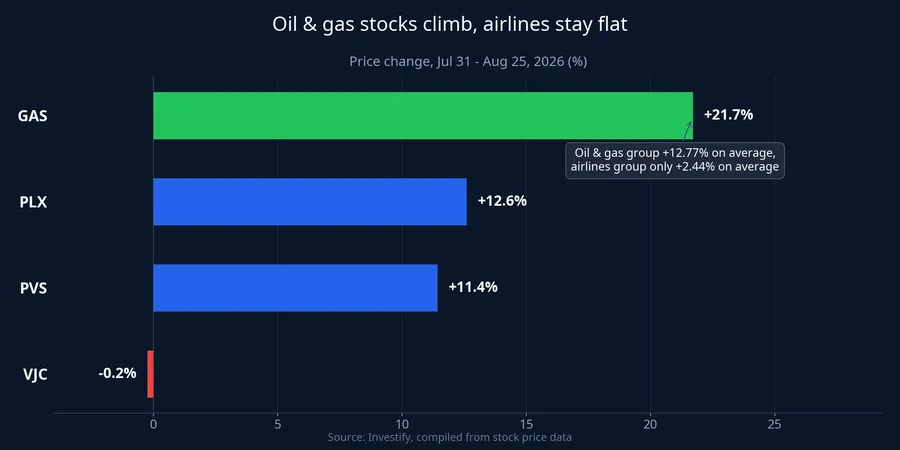
Equity markets have priced this pecking order fairly closely. From July 31 to August 25, GAS rose 21.72%, PLX rose 12.61%, and PVS rose 11.44%, while VJC was the only stock among the ten tracked that declined, down 0.24%. The oil and gas group averaged +12.77%, versus just +2.44% for the airline group.
For investors who'd rather track the underlying variable than trade it through equities, crude oil is traded directly on the Vietnam Commodity Exchange under the Ministry of Industry and Trade. That channel lets investors observe and participate directly in the price chain creating this lag, though it uses margin leverage and carries considerably higher risk than stocks.
What to watch at tomorrow's pricing cycle
With the cycle average still running about 2.8% above the prior cycle, the more likely scenario for the afternoon of August 27 is that diesel holds flat or edges down only slightly, rather than falling in line with crude's two-session decline. A meaningful cut, if it comes, more likely waits for the following cycle, once a full week of lower prices feeds into the average.
That framing cuts both ways. The lag is symmetric: it once kept domestic prices from rising immediately when world prices rose, and now it's keeping prices from falling immediately when world prices fall. For transport operators, the number worth tracking isn't the nightly crude close but the running weekly average of refined-product prices. For oil and gas investors who have ridden a strong August rally, the risk runs the other direction: if a stretch of lower prices persists through a full cycle, the inventory-driven profit boost these companies have enjoyed could reverse faster than it built up. Tomorrow's pricing cycle, and especially the one after it on September 3, will be a direct test of both sides of this scenario.