


On August 25, the Securities Research and Training Center and the State Securities Commission of Vietnam (SSC) co-hosted a conference in Hanoi titled "Smart Investing in the Digital Age: Identifying Investment Opportunities Through Funds." The number that dominated the room was total assets under management (AUM) at Vietnam's fund management companies, which climbed from roughly VND 124 trillion at the end of 2015 to more than VND 846 trillion by end-June 2026 - a 6.8x increase in just over a decade.Thời báo Tài chính Việt Nam
Looking at that figure, the question worth asking isn't whether it's big or small. It's what the number actually measures, and how much of it is a channel an ordinary retail investor can actually enter.

6.8x growth and 6% of GDP: same industry, two very different conclusions
The first yardstick is internal growth, and it reflects an ecosystem that's genuinely more crowded than a decade ago. Vietnam now has 43 active fund management companies running 142 securities investment funds, 106 of them public funds, distributed through 51 agents including securities firms and financial institutions.Thời báo Tài chính Việt NamVietnamFinance
The second yardstick is scale relative to the economy, and it paints a very different picture. Nguyễn Công Minh, Head of the Fund Management Companies and Securities Investment Funds Department at the SSC, said industry-wide AUM equals only about 6% of GDP.Thời báo Tài chính Việt Nam By the same metric, Thailand sits above 31%, Malaysia above 56%, China above 57%, and South Korea around 84% of GDP.Thời báo Tài chính Việt Nam
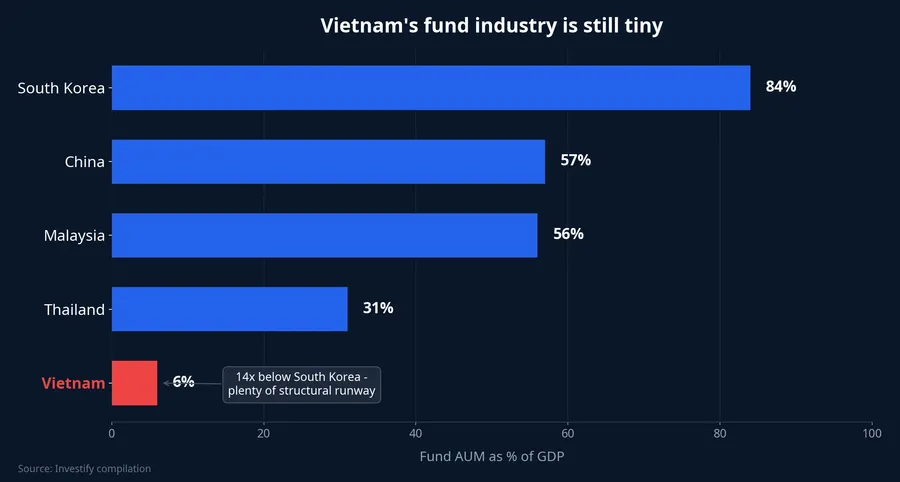
Within Vietnam's own capital markets, the fund industry is also the smallest piece. Stock market capitalization sits at roughly 65% of GDP, and the bond market at around 24-25%.VietnamFinance In other words, Vietnamese household money has already entered capital markets at meaningful scale - it just mostly bypasses funds altogether.
Who actually owns that VND 846 trillion
This is where both yardsticks fall short. A fund management company's AUM combines two very different pools: assets in securities investment funds that the public contributes to, and portfolios under discretionary mandates from large institutional clients. These two pools have entirely different owners, so folding them into one AUM headline risks overstating the size of the channel actually open to individuals.
Per FiinGroup's analysis, the total net asset value (NAV) of securities investment funds stood at approximately VND 247.8 trillion at the end of July 2026, down VND 26.9 trillion from end-June.Thời báo Tài chính Việt Nam Set against the industry's VND 846 trillion in total AUM, the portion actually held inside funds is less than a third. As a share of GDP, that's under 2% - not 6%.

The remainder, roughly VND 598 trillion, sits in discretionary mandates. That money is mostly long-term insurance premiums that life insurers route into investment through fund managers - not capital that individual investors contributed via fund certificates.
Narrow the lens further to the products a new investor is most likely to actually buy, and the numbers shrink again. Total assets of domestic equity open-end funds stood at about VND 26.7 trillion as of June 30, 2026, while HOSE-listed ETFs stood at about VND 23.5 trillion based on closing prices on August 25, 2026. These two figures are snapshots from different dates and exclude nine open-end funds that haven't reported updated data, so they should be read as an order of magnitude - tens of trillions of dong, not hundreds.
The clearest comparison: household savings accounts
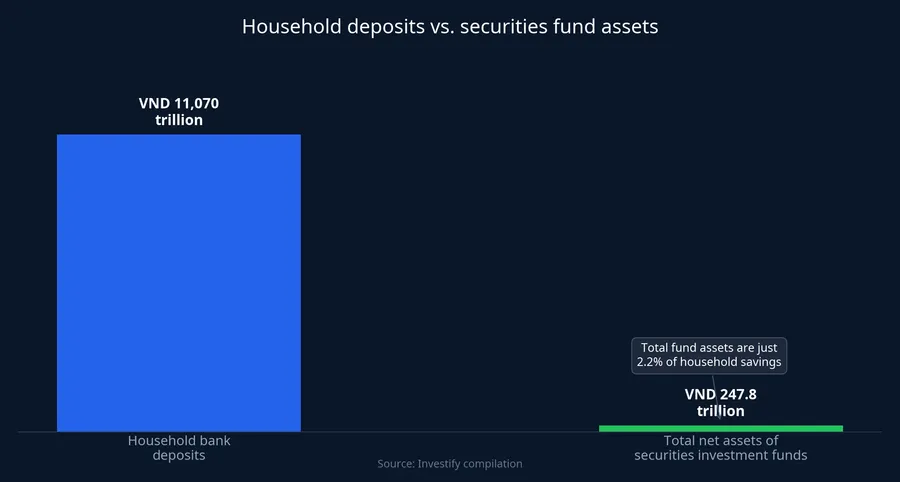
The most intuitive yardstick for a new investor isn't GDP - it's the household savings account. As of end-June 2026, household deposits at Vietnamese banks reached VND 11.07 quadrillion (11.07 triệu tỷ đồng), up 7.1% from end-2025 and a fresh record.Vietstock
The entire net asset base of Vietnam's securities investment funds, about VND 247.8 trillion, equals roughly 2.2% of that deposit pool. For domestic equity open-end funds alone, the ratio is far lower still. When regulators talk about the fund industry's growth runway, this is the gap they mean first - VND 11.07 quadrillion parked in bank deposits versus a few hundred trillion dong managed inside funds - not foreign capital flows.
That's precisely why the Ministry of Finance's 2030 targets under Decision No. 3168/QĐ-BTC, dated September 12, 2025, don't target industry-wide AUM at all. They target the fund segment specifically: total NAV of securities investment funds at 5% of GDP, 500 funds, and 2.5 million investors holding fund certificates, rising to 5 million by 2035.Chinhphu.vn Going from under 2% of GDP to 5% in a little over four years, while GDP itself keeps growing, means the fund segment has to expand several times faster than the economy.
Market upgrade doesn't automatically fill domestic funds
Two capital flows that often get conflated need to be separated. Vietnam's market upgrade and the inclusion of Vietnamese stocks in the FTSE GEIS index directly benefit the stocks in that basket and the foreign index funds tracking it. It does not automatically push money into the domestic open-end funds that Vietnamese retail investors buy.
Three explanations for why the domestic fund segment stays thin each carry some weight. First is habit: savings deposits and self-directed stock picking remain far more familiar to most people with idle cash. Second is recent performance: per FiinGroup, average equity fund returns over the first seven months of 2026 came in at -8.9%, versus +12.2% over the same period in 2025 - a tough stretch to convince a newcomer that delegating to professionals beats doing it yourself.Thời báo Tài chính Việt Nam Third is product range: Decision 3168 devotes most of its solutions to adding new fund types - index funds, money-market funds, infrastructure bond funds - which itself suggests regulators see the current product shelf as too narrow.
The numbers point mainly to the first explanation. The gap between VND 11.07 quadrillion in deposits and a few hundred trillion dong in funds is too large for one year of performance or a thin product lineup to be the dominant cause. The other two factors amplify the gap rather than create it.

How retail investors should read this data set
The VND 846 trillion figure is not a measure of how developed the fund-certificate channel is. When reading fund-industry news going forward, the numbers worth tracking are NAV of securities investment funds and the count of investors holding fund certificates - the two metrics with explicit 2030 targets.
The structural runway here is real and will play out over years, which argues for dollar-cost averaging into this channel with a portion of a portfolio, not rushing in to catch a wave of foreign inflows. For new investors without stock-picking experience, open-end funds and ETFs typically fit the slice of a portfolio meant for the long term - money not needed for several years - while the rest stays in more liquid channels.
Funds also don't eliminate market risk. The first seven months of 2026, with average returns of -8.9%, is a reminder that delegating to professional managers diversifies risk across a portfolio - it doesn't shield an investor from a broad market correction.
The signals worth watching over the coming quarters are the number of newly licensed funds and the growth rate in investors holding fund certificates. Those two numbers will show whether retail capital is actually shifting well before the NAV-to-GDP ratio has time to move.