
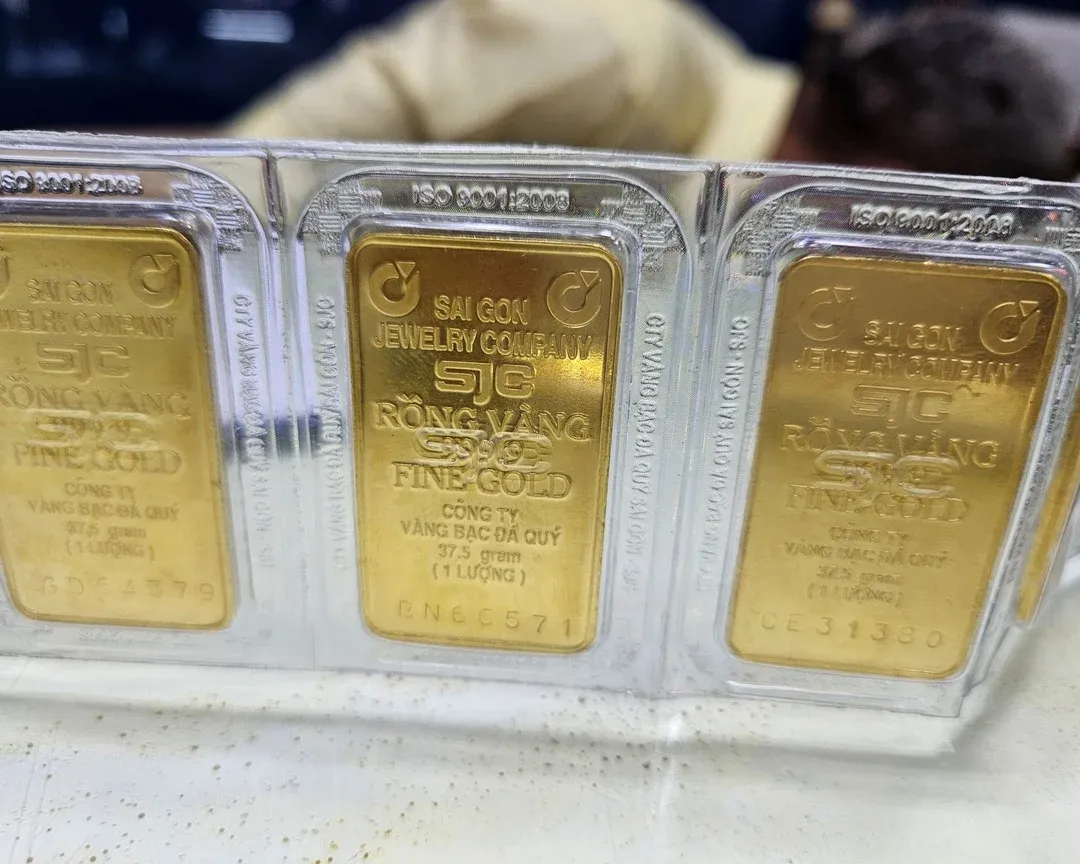

On August 19, a Vietnamese gold shop bought back SJC gold bars at VND 139.7 million per tael.Dân Trí World gold closed that same day at $4,517.78 per troy ounce, with the USD/VND rate at 26,173.5, converting to roughly VND 142.55 million per tael. In other words, anyone selling a tael of gold bar that day received VND 2.85 million less than the converted world price.
If you've followed Vietnam's gold market for years, that number sounds strange. Since Investify began tracking gold bar data in December 2021, SJC's ask price has averaged VND 13.72 million per tael above the converted world price. That premium peaked on March 20, 2026 at VND 33.71 million per tael. Yet just five months later, the gap has nearly vanished. What's really driving this shift, and what does it mean for anyone holding gold?
World gold surges, domestic prices lag behind
The week of August 18-25 was one of the strongest weeks for world gold this year. Prices climbed from $4,334.92 per troy ounce on August 18 to $4,677.04 on the morning of August 25, a 7.9% gain in just five trading sessions.Tuổi Trẻ
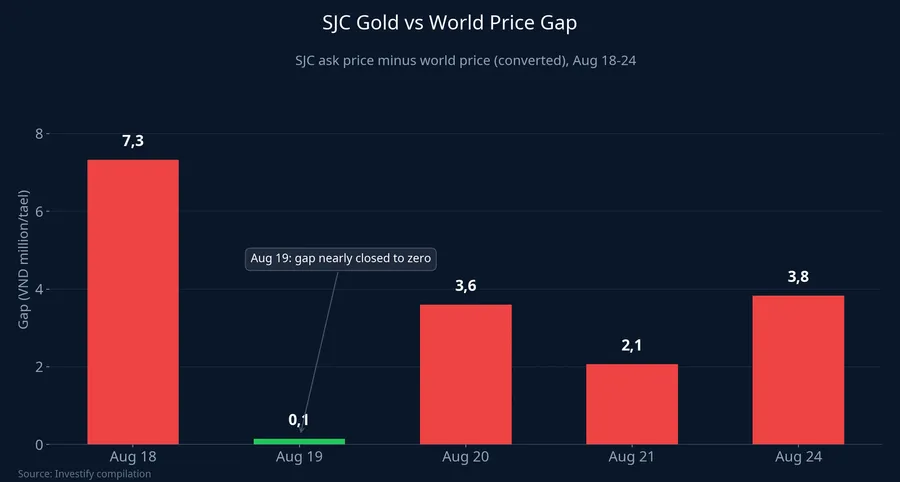
Domestic prices moved far more slowly. SJC's ask price edged up from VND 144.3 million to VND 150 million per tael over the same period, just a 3.9% gain. When one side sprints and the other side walks, the gap between the two price boards compresses fast: it started the week at VND 7.33 million per tael, narrowed to just VND 147,000 by August 19 (essentially zero), then widened back out to VND 3.83 million by August 24, or about 2.6% of the ask price.
Gold rings moved even further. On August 19, the buy price for 99.99 gold rings stood at VND 136.2 million per tael, VND 6.35 million below the converted world price; the sell price of VND 140.7 million was also VND 1.85 million below world levels. Anyone looking to sell gold rings that week got a price that didn't even match the converted world price.
This isn't a one-week story
Looking only at this week, it's tempting to conclude that world gold simply ran ahead of domestic prices. That reading is partly right, but it misses a longer road behind it.
As a percentage, the gap between SJC's ask price and the converted world price fell from 23.7% on March 20 to 9.7% in early August, then to 2.6% by August 24. Most of that compression happened in May, June and July, well before this week's world gold rally began. That rally only pushed the remaining gap down toward zero and briefly flipped it negative; it didn't create the trend.
One technical point worth noting: the converted world price here is spot price times the exchange rate, before import duties, processing fees, and shipping costs. So the current VND 2-3 million gap isn't entirely profit for gold dealers.
Why demand has weakened for two straight quarters
The clearest driver sits on the demand side. Per the World Gold Council, Vietnam's investment demand for gold bars and coins fell 24% year-on-year in Q1 2026 to 9 tonnes. In Q2, that figure dropped further to 6.5 tonnes, down 31% year-on-year. Jewelry demand in Q2 also fell 28% year-on-year to 1.8 tonnes, the steepest decline among the Southeast Asian markets the organization tracks.Tin Nhanh Chứng Khoán
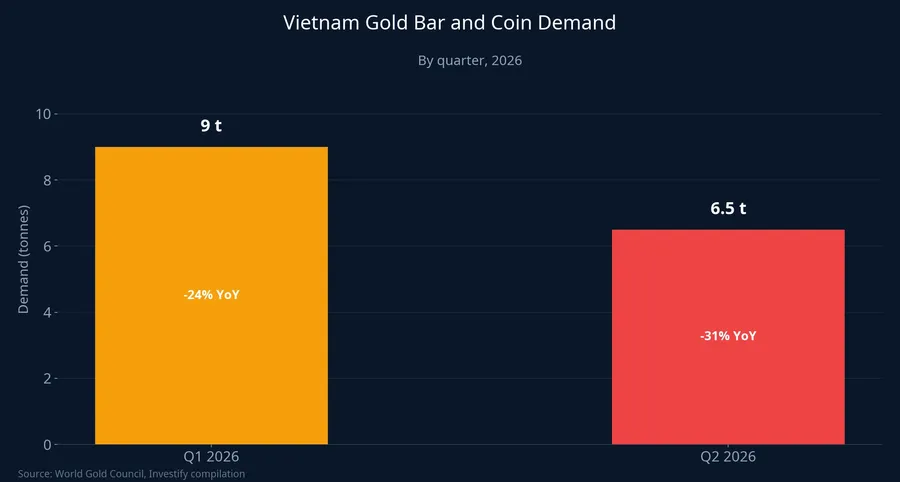
The mechanism is fairly simple: once people stop queuing up to buy at any price, gold dealers lose their reason to bid up buy prices to compete for supply. At the same time, some gold holders take advantage of high prices to sell, adding to the supply available at the counter. Both forces pull domestic listed prices closer to world levels.
Demand has weakened for several compounding reasons: prices are already high relative to income, deposit rates remain attractive enough to keep money in banks, and gold supply has also improved.VietnamNet Put simply, physical gold buyers now have competing options that were largely unavailable during earlier years of scarcity.

The legal framework dropped the scarcity assumption
The second layer of causes is policy. Decree 232/2025/NĐ-CP, issued on August 26, 2025 and effective from October 10, 2025, abolished the state monopoly on gold bar production along with the monopoly on importing raw gold for bar production. Gold bar production became a conditional business line licensed by the State Bank of Vietnam, requiring charter capital of at least VND 50 trillion for commercial banks and VND 1 trillion for enterprises.Báo Chính Phủ

Be careful about crediting this policy alone. As of mid-April 2026, the most recent public update available, the State Bank had received just 11 applications for gold bar production and raw gold import licenses from enterprises and credit institutions, and said it was reviewing them carefully.Dân Trí The official list of licensed producers and the additional gold bar volumes hasn't been fully published. In other words, most of the effect so far comes from the market no longer pricing on the assumption of permanent scarcity, not from a new volume of gold bars actually reaching shop counters.
The real cost of buying gold hasn't gone away
A narrower gap with the world price doesn't mean buying gold now comes nearly free of cost. The biggest expense for physical gold buyers is still the buy-sell spread at the counter, and that spread doesn't shrink along with the world price gap.
On August 24, SJC gold bars were quoted at VND 147 million to buy and VND 150 million to sell per tael. Buy a tael and sell it back the same day, and you lose VND 3 million, or 2% of the purchase price. For 99.99 gold rings, the buy price was VND 143.5 million and the sell price VND 148 million, a gap of VND 4.5 million, or 3% of the purchase price. This cost exists independently of whether the gap with world prices is widening or narrowing.
What has changed for gold holders
For four years, buyers of domestic gold bars paid a large premium to get in, and got that same premium back on the way out, as long as the market stayed scarce. That premium has now disappeared, and the consequences cut both ways.
For new buyers building a long-term position, entry cost is now at its lowest since late 2021: roughly 2-3% above the world price, instead of the 10-20% typical of most of the prior period. But for anyone already holding gold bars, the domestic cushion that once propped up asset value is gone. Gains or losses on a tael of SJC gold now track almost entirely on two variables, the world gold price and the USD/VND exchange rate, instead of being buffered by the domestic premium as before.

This also puts physical gold in more direct comparison with other ways of holding money. With the cushion gone, gold's return is now simply international price movement minus the 2-3% buy-sell cost at the counter. You can weigh that figure against deposit rates or fixed-income products to decide your allocation, rather than defaulting to the assumption that gold always carries its own built-in edge.
Signals worth watching
Today's thin gap isn't a locked-in state. Three signals will determine whether it stays anchored near zero or widens again in the coming weeks.
First is the pace at which the State Bank publishes its list of licensed gold bar producers and raw gold import quotas. This determines whether real supply actually increases the way the market is currently pricing in.
Second is how fast domestic price boards adjust in the coming sessions. If world gold holds around $4,650-4,700 per troy ounce, domestic dealers will likely keep raising listed prices further, and the gap should drift back up toward a few million dong.
Third is whether hoarding demand returns. If a macro shock brings back the queues of buyers seen earlier this year, the mechanism that pushes buy prices up to compete for supply could reappear, and the gap could widen quickly again. In that scenario, buyers chasing the price at elevated levels would be paying back exactly the premium that just disappeared.