


On the morning of August 24, PNJ hit its daily ceiling at VND 42,650, up 6.89%, but only about 493,500 shares changed hands, less than 12% of the previous session's volume. Exactly one month earlier, on July 24, more than 41.5 million PNJ shares traded at the floor price of VND 30,750, the highest volume in the stock's trading history. Sellers had all but vanished by the August 24 session, and investors are now reading that shift through two competing lenses: the stock has been cleared in a diamond-smuggling case, or it's riding a world gold rally hitting record highs.
The two explanations point to very different conclusions about how durable this rally is. Looking at the session-by-session numbers, the two forces leave very different fingerprints on the price chart, and it's worth separating them before drawing conclusions.
Three weeks, more than half the value gone
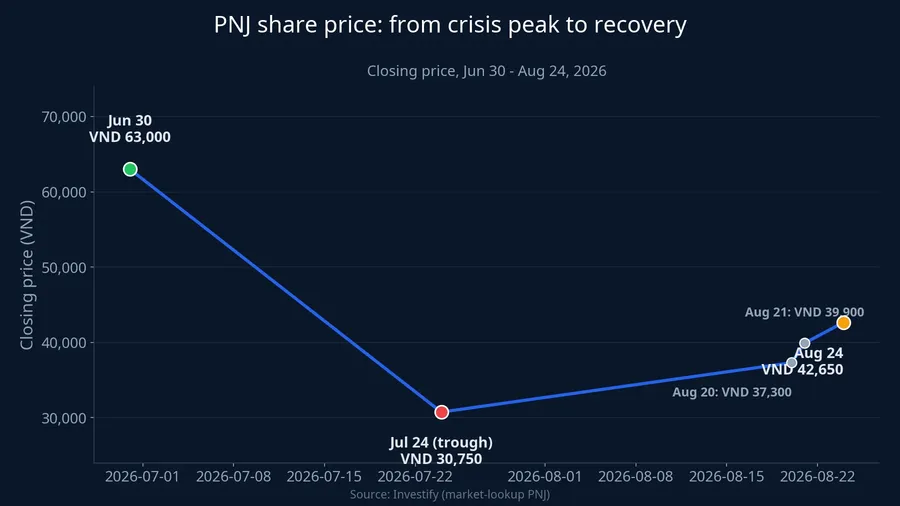
On June 30, PNJ closed at VND 63,000, equivalent to a market cap of VND 21.5 trillion. From the July 3 session, as news of a diamond-smuggling ring spread, the stock entered a string of consecutive floor-price sessions. The immediate trigger was the indictment of Đặng Ngọc Thảo, former Director of PNJ's P-Lab, along with a staff member of that appraisal unit, in a scheme that smuggled more than 28,000 diamonds from Hong Kong into Vietnam.Tuổi Trẻ
Selling pressure intensified in the second half of July, with three consecutive floor-price sessions on July 21, 22 and 23, before the closing low formed on July 24 at VND 30,750, a 51.2% drop in just three and a half weeks. Institutional money exited on the same rhythm: the T. Rowe Price fund group cut its stake below 5% on July 30, the third foreign fund group to exit PNJ's list of major shareholders within three weeks.SGGP Tuổi Trẻ counted 24 funds exiting PNJ within a single month, with most of the sold shares absorbed by domestic investors.Tuổi Trẻ
The damage hit the books, not just the ticker
The shock didn't stop at the share price; it flowed straight into operating results. Between July 1 and 20, PNJ sold only VND 1,588 billion worth of goods but had to spend VND 5,900 billion buying back diamonds, gold and jewelry from customers, nearly 3.7 times revenue. By the end of July 27, total buyback costs had topped VND 7,000 billion.Dân Trí The company was forced to change its payment method starting July 21, spreading buybacks into five installments over 120 days instead of paying in full immediately, while encouraging customers to exchange for other products instead. Within a week, buyback value fell to VND 1,162 billion, with 95% of customers choosing to exchange for other products.
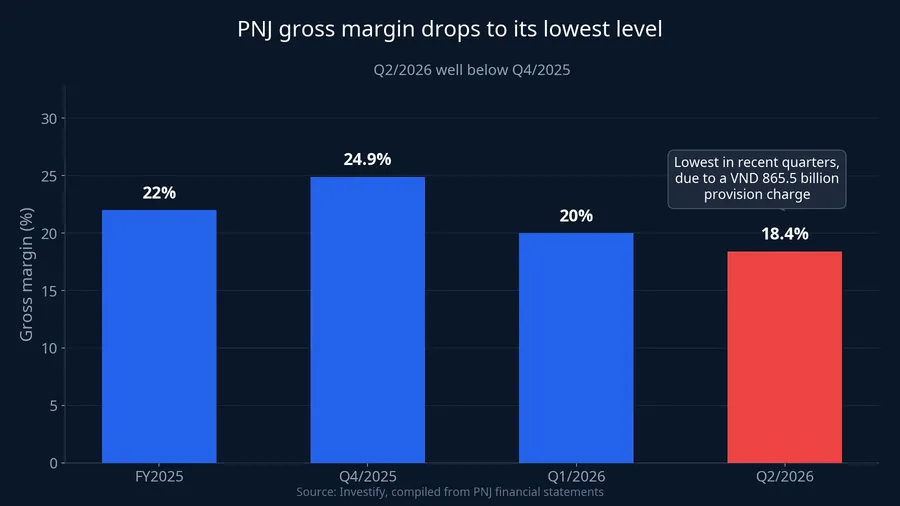
The accounting fallout showed up in Q2 2026: PNJ set aside a VND 865.5 billion provision for buyback obligations, driving a post-tax loss of VND 283.0 billion, versus a VND 437.0 billion profit in the same period of 2025. Net revenue still grew 11.9% to VND 8,483.7 billion, but gross margin fell to 18.4%, well below the 24.9% recorded in Q4 2025. Analysts have described it as an unprecedented crisis of trust in Vietnam's jewelry industry.24h
The August 20 findings unlocked the rally
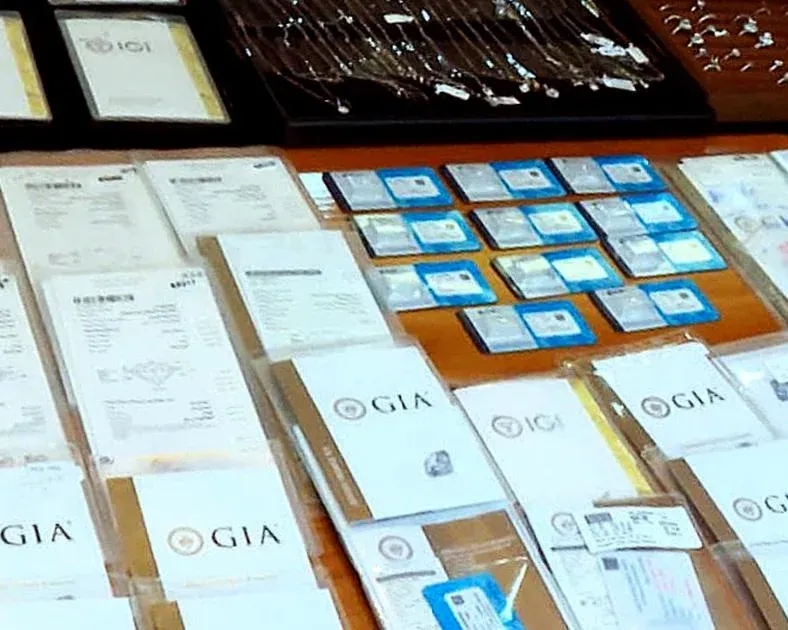
On August 20, the Investigative Police Agency of Thanh Hóa Province released the results of its forensic appraisal and preliminary investigation, finding that PNJ held complete import documentation for its diamonds and that its import and distribution process complied with regulations.CADN All of the smuggled diamonds were sold to outside individual customers, never entering the company's retail chain.Tài chính Doanh nghiệp The offense was determined to be the work of two individuals colluding for personal gain, with Thảo grinding off the GIA serial numbers on smuggled diamonds and issuing new appraisal certificates.VnExpress
That finding was almost identical to what Cao Thị Ngọc Dung, PNJ's Chairwoman, had asserted earlier: that the smuggled diamonds never entered the company's distribution system.Tuổi Trẻ The difference this time was that the confirming voice was the investigative authority, not the company itself. The market reacted immediately: PNJ rose 4.48% to VND 37,300 on August 20, with the highest matched value since early August; by August 21, the stock had hit its daily ceiling at VND 39,900.
Gold played a role, but it isn't the main engine
World gold prices traded at $4,623 an ounce on the morning of August 24, holding above the $4,600 mark after a week of sharp gains.Thời báo Tài chính Việt Nam SJC gold bars sold for VND 147.6 million per tael. That backdrop is clearly favorable for jewelry stocks, but looking session by session, it isn't the main cause of PNJ's rally.
The first piece of evidence comes from July itself. From June 30 to July 24, world gold prices rose just 1.1% (from $4,007.72 to $4,052.00 an ounce), while PNJ lost 51.2% of its value in the same window. The gold rally did nothing to cushion the stock while legal risk still hung over it.
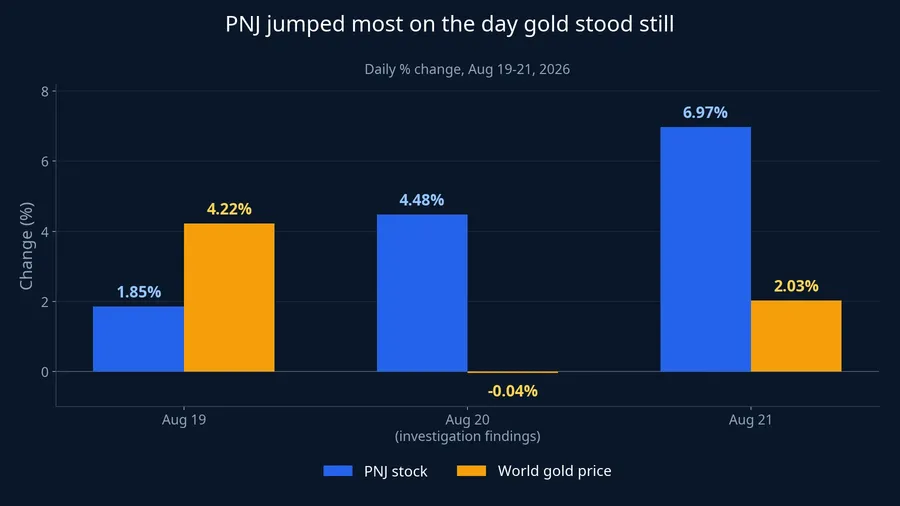
The second piece of evidence comes from last week. On August 19, gold jumped 4.22%, its sharpest one-day gain in August, while PNJ edged up just 1.85%. On August 20, gold was almost flat, down 0.04%, while PNJ rose 4.48% on the exact day the investigation findings were released. On August 21, gold rose 2.03% while PNJ jumped its full daily limit of 6.97%. The stock's price action tracks legal news far more tightly than it tracks gold.
There's another layer that gets less attention: for PNJ, expensive gold doesn't mean fatter profit. Its core earnings come from the margin on crafted jewelry, not from the spread on gold bars. When customers shift from diamonds and jewelry into 24K gold as a defensive move, revenue mix tilts toward thinner-margin products, while high input gold prices push up inventory costs. The 18.4% gross margin in Q2 is the first sign of that shift.
How far from the old peak
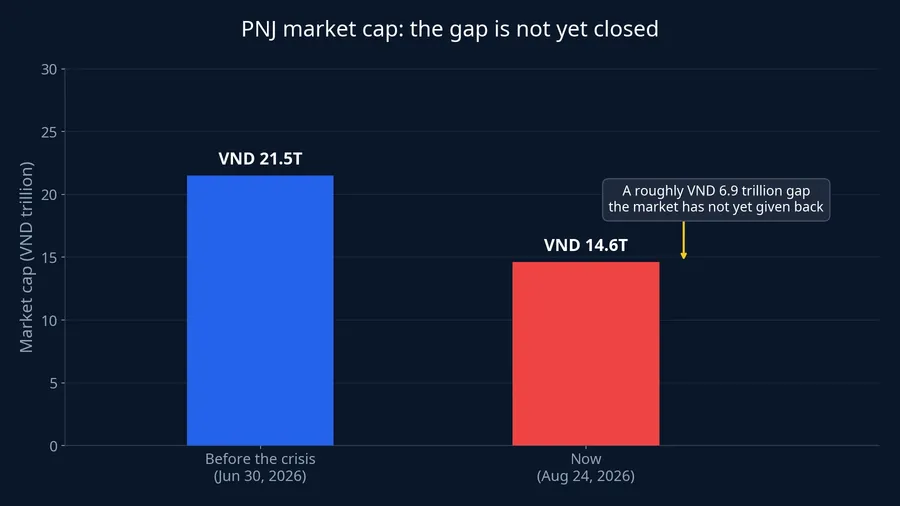
At VND 42,650, PNJ has recovered 38.7% from its July 24 trough but remains 32.3% below the VND 63,000 level of June 30. Market cap now stands at VND 14.6 trillion, versus VND 21.5 trillion before the crisis. That roughly VND 7 trillion gap is the portion the market hasn't given back, and it now reflects operating risk rather than legal risk.
Three signals will answer how durable this rally is. First, Q3 results, the first quarter to fully reflect the crisis's impact on retail revenue and margins, since the VND 865.5 billion provision was already booked in Q2. Second, the extraordinary shareholder meeting: PNJ locks its shareholder list on August 25 and plans to convene in October to adjust its 2026 business plan, and the size of that adjustment will show how deeply management believes the damage runs. Third, how far the case expands: investigators have indicted 31 suspects and estimate the smuggled diamond count may exceed 30,000 pieces. The August 20 findings cleared PNJ as a corporate entity, but the case itself is not closed.
Buying the recovery story, not the legal risk
The session-by-session data is fairly clear: the main driver behind the rally since August 20 has been the removal of legal risk, with gold prices playing only a supporting, favorable role. A recovery that follows the lifting of legal risk typically moves fast and hard in its early stage, then slows as the market shifts to pricing the operating business itself, and for PNJ that repricing has only just begun, with no quarterly data yet to confirm it. Investors buying at current levels are no longer buying legal risk; they're buying an expectation that the company can rebuild brand trust, a process measured in quarters, not sessions. The three signals above, Q3 results, the extraordinary shareholder meeting, and how the case unfolds, are where the answer will show up, not the path of world gold prices.