


There's a common belief in financial markets: when bond yields rise too fast, governments always have a tool to pull them back down. That belief isn't baseless. Between 2009 and 2021, the Federal Reserve bought trillions of dollars of bonds and kept long-term yields near historic lows. Last week, the market got a fresh test of that belief, and the answer was blunt: the most-anticipated tool worked for exactly one trading session.
A week-long test, played out in real time
On August 18, 2026, the yield on the US 30-year Treasury bond broke above 5.33%, its highest level in 19 years.CNBC For an economy borrowing hundreds of billions of dollars every quarter, each additional basis point translates into real interest costs stretched across decades.
A day later, the Treasury Department announced it was doubling the maximum size of its per-session buyback operations for longer-dated debt, from $2 billion to at least $4 billion, covering the 10-to-20-year and 20-to-30-year sectors, effective from the September 9 session.Treasury The market reacted exactly as the textbook would predict: the 10-year yield fell more than 5 basis points to 4.647%, and the 30-year dropped 9 basis points to 5.196%.CNBC

The effect lasted exactly one session. On August 20, yields jumped right back, erasing nearly all the decline the intervention had produced.Yahoo Finance By August 21, the 30-year yield was back around 5.27%, higher than before the intervention week even started. As of August 23, the two longest maturities stood at 4.738% (10-year) and 5.276% (30-year), both near their highest levels of the year.
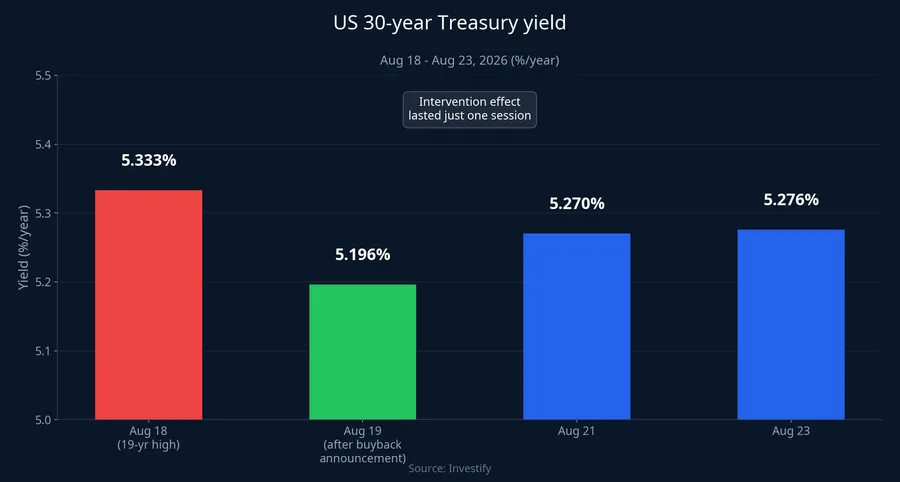
In other words, the tool markets were counting on most got doubled in dosage, and the result was yields settling higher than before the intervention.
Why this tool is fundamentally different from the Fed's
The easiest mistake when reading this news is lumping the Treasury together with the central bank. Both buy the same type of asset, but the money behind each purchase comes from entirely different places. The Fed buys bonds with money it creates itself: its balance sheet expands, the supply of bonds circulating in the market shrinks, and bond prices genuinely rise.
The Treasury has no power to print money. Its buyback program runs as a reverse auction: the Treasury announces in advance which maturities it wants to buy, dealers submit competitive offers, and the Treasury accepts the lowest-yielding bids to pull old bonds out of circulation, per the Q3 2026 buyback schedule the Treasury itself published.US Treasury The catch is that the cash used for those purchases also has to be borrowed, meaning new bonds have to be issued to fund it. Total outstanding debt doesn't fall by a single dollar; only the maturity mix shifts.
Charlie Bilello, Chief Market Strategist at Creative Planning, called it plainly "debt rotation, not debt reduction": the Treasury is still running a large deficit, buying back old bonds, then issuing even more new ones to pay for it.Yahoo Finance For his part, US Treasury Secretary Scott Bessent has framed the program as liquidity support rather than an attempt to push yields down, citing thin summer liquidity in the 30-year sector, and said he's prepared to raise the size beyond $4 billion per session if needed.CNBC
The scale comparison tells the rest of the story
Put two numbers side by side and it's clear why the market didn't change direction. The new buyback size is a minimum of $4 billion per session. Meanwhile, the Treasury's own net borrowing need runs to $739 billion for Q3 2026, $68 billion higher than the May forecast, plus another $628 billion for Q4 2026.US Treasury
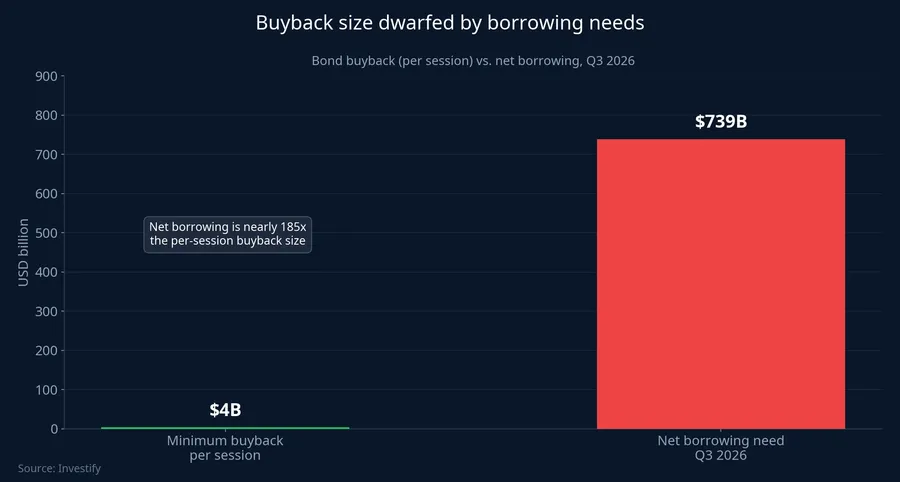
The root of that borrowing need is the budget. The cumulative FY2026 deficit through the end of July had already reached $1,799 billion, exceeding the entire FY2025 deficit with two months still left in the fiscal year.Yahoo Finance July 2026 alone posted a deficit of $432 billion, up 48% year-over-year and the largest monthly deficit since March 2021.Yahoo Finance Interest payments currently run around $24 billion a week.Yahoo Finance A $4 billion-per-session program set against $739 billion of quarterly borrowing simply cannot be the dominant pricing force. It can adjust liquidity depth in a handful of specific securities; it cannot move the overall yield level.
Are there other explanations?
It would be unfair to pin the entire yield rise on a single cause. At least three explanations coexist. The first is inflation expectations: US inflation remains above the Fed's 2% target, and oil prices rising on Middle East tensions make that expectation harder to bring down quickly, so buyers of 30-year debt reasonably demand a higher premium. The second is the technical factor Bessent himself raised: August is typically a thin-trading month, and heavy corporate bond issuance has been pulling demand away from longer maturities. The third is supply pressure from the federal budget.
The data leans toward the third explanation, based on how persistent the trend has been. The 30-year yield broke above 5% back in late May 2026 and has stayed above that level almost continuously since, well before this month's thin trading season began. The technical factor explains the swings within a given month, but a plateau that has held for four months needs a more durable cause. Inflation expectations and supply pressure reinforce each other, but only supply is rising steadily according to a pre-announced issuance calendar.
What this means for Vietnamese investors
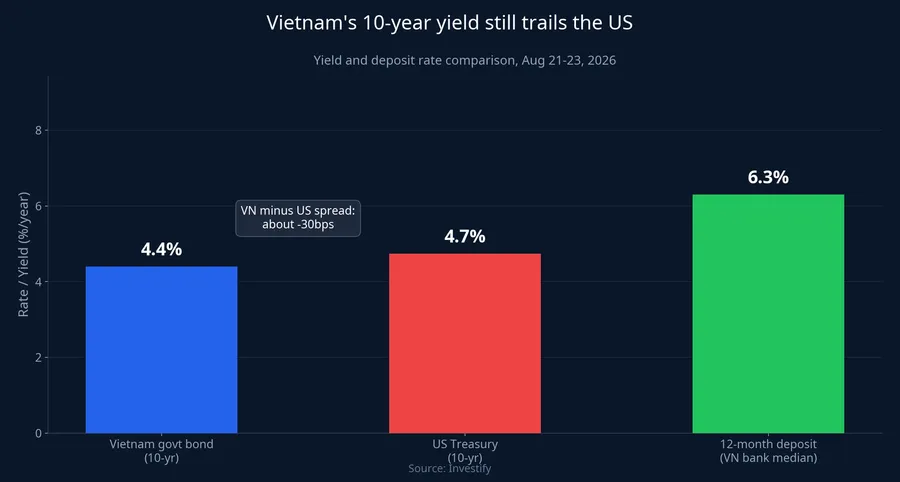
This story reaches domestic portfolios through the yield-spread channel, not yet through the exchange-rate channel. Vietnam's 10-year government bond yield stood at roughly 4.4% on August 21, up about 55 basis points since the start of the year; the equivalent US yield rose 56 basis points over the same period. The two lines have moved almost in parallel, but because the US started from a higher base, the Vietnam-minus-US spread remains negative by roughly 30 basis points. Vietnamese government bonds currently pay less than equivalent-maturity US Treasuries, while foreign investors also have to pay extra for currency hedging.
The consequence is already visible in the stock market, where session-by-session data is public. Over the three months through August 21, foreign investors net sold VND 52,579 billion on the HOSE, with 56 of 67 sessions posting net selling, though the pace has been cooling: June saw VND -19,736 billion, July VND -16,145 billion, and August just VND -5,586 billion so far. The exchange-rate channel, by contrast, has stayed quiet. The USD/VND rate stood at 26,092 on August 21, down 0.25% from the prior session, with the dong still slightly stronger against the dollar year-to-date, while the Dollar Index sat at 98.76 the same day. US yields are high, but the dollar hasn't strengthened to match, so pressure on Vietnam's exchange rate hasn't materialized yet.
From an asset-allocation standpoint, there's a notable observation for domestic individual investors. The median online 12-month deposit rate currently runs around 6.3% a year, typically in the 5.8-6.7% range, clearly above the 10-year government bond yield. In other words, at today's levels, locking up capital for nine extra years doesn't come with a higher yield. That's a normal structure, since bank deposits carry a credit-risk premium, but a gap of nearly two percentage points is worth weighing before committing to a long maturity.
The more accurate picture
The belief that governments can always hold yields down only holds when the intervening agency has the power to create money. The US Treasury doesn't have that power. What it can do is reshape the maturity structure of its debt, push back maturity peaks, and improve liquidity in a handful of securities. The long-term yield level is still set by how many new bonds have to be sold and by inflation expectations, and both are currently rising.
For readers following this story, the practical takeaway is what to watch next. Intervention announcements produce one-to-two-session moves. What shapes the trend over months is the issuance calendar and the monthly deficit figures, both published on a regular, trackable schedule. There's already a concrete checkpoint ahead: the doubled buyback program starts running from the September 9 session. If the 30-year yield is still anchored above 5.2% after the larger program is up and running, that would confirm the tool can't reverse the trend, and the Vietnam-minus-US yield spread will likely stay negative for a while longer.