
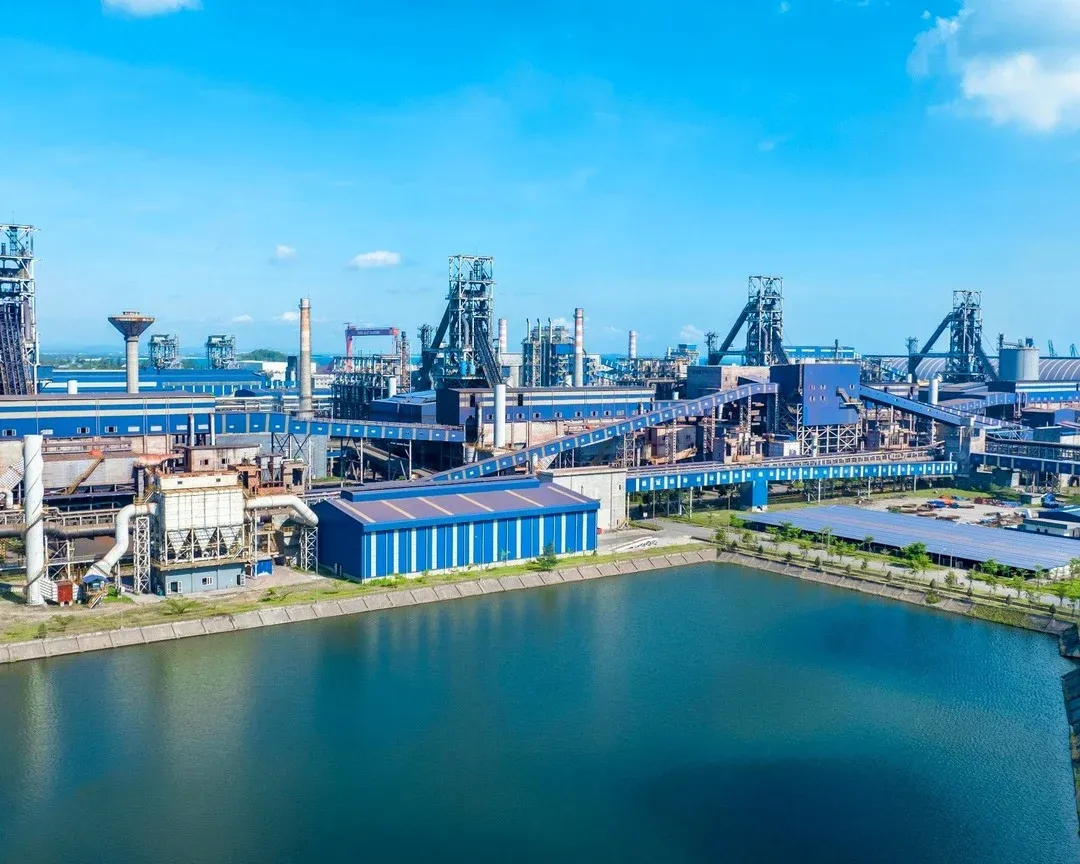

In Q2 2026, Hoa Phat's domestic market share in hot-rolled coil (HRC) steel hit 40.5%, overtaking the combined share of all imported HRC for the first time.Tap Chi Kinh Te Tai Chinh Over the same stretch, the international HRC benchmark most commonly quoted on commodity boards moved the other way, trading around USD 1,180/tonne. On the surface, those two lines seem to contradict each other. Peel back a layer, though, and the contradiction disappears: what's driving Hoa Phat's profit isn't the global steel cycle. It's a domestic tariff wall that was sealed shut twelve days ago.
HPG shares closed August 21 at VND 21,700, up 2.6%, with a market cap of VND 166.6 trillion. That's still nearly 20% below the September 2025 peak of VND 27,096. A stock that hasn't reclaimed its old high sits behind a company that just posted a record quarterly volume. This piece walks through three layers of data to explain why.
Layer one: new capacity is a necessary condition, not a sufficient one
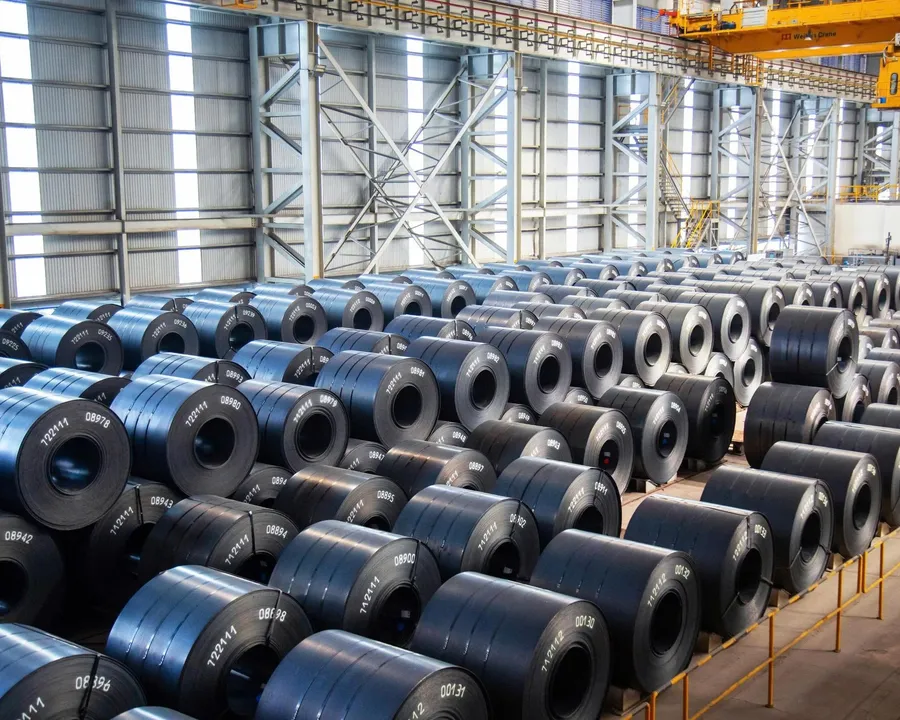
Dung Quat 2 has a designed capacity of 5.6 million tonnes of HRC per year, cost roughly USD 3.3 billion, and ran at full capacity throughout Q2 2026 after its second blast furnace produced first iron.DNSE After this project, the group's total steel capacity reaches roughly 16 million tonnes per year.DNSE
Capacity explains why Hoa Phat could produce several million more tonnes of HRC. It doesn't explain why the company sold all of it. Before 2025, every additional tonne of HRC had to compete directly with Chinese steel offered at Vietnamese ports at a lower price. The sales side of the equation has a different explanation, one found in the second layer.
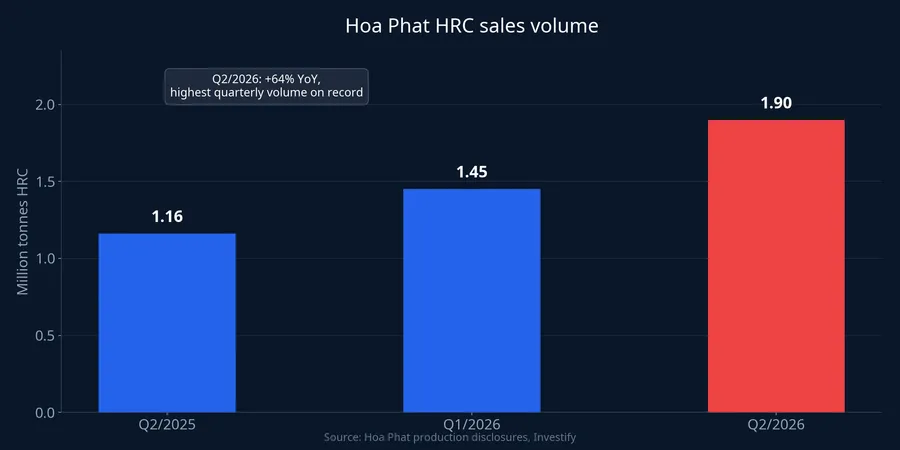
HRC sales volume in Q2 2026 reached 1.9 million tonnes, up 64% year-on-year and the highest quarterly figure on record, with roughly 80% sold domestically.Nguoi Quan Sat This wasn't growth driven by a sudden domestic demand surge. It was growth driven by Hoa Phat reclaiming market share that imports used to hold.
Layer two: a tariff wall built in three steps
Vietnam's Ministry of Industry and Trade opened an anti-dumping investigation into Chinese HRC imports in July 2024, following a petition from Hoa Phat and Formosa Ha Tinh. On July 4, 2025, the ministry issued Decision 1959/QD-BCT, imposing official duties of 23.1% to 27.83% depending on the exporter, effective July 6, 2025 for five years.Dan Tri
The effect showed up almost immediately in customs data: HRC imports from China fell from roughly 4.4 million tonnes in 2024 to 2.8 million tonnes in 2025, a 36% drop.SteelOrbis But the 2025 ruling only covered HRC no wider than 1,880 mm. In the first half of 2025 alone, Vietnam imported nearly 650,000 tonnes of wide-width HRC from China, roughly 15 times the volume in the same period a year earlier.Tuoi Tre This is a classic workaround: roll the steel slightly wider to fall outside the taxed range, then slit it to size once it's in Vietnam.
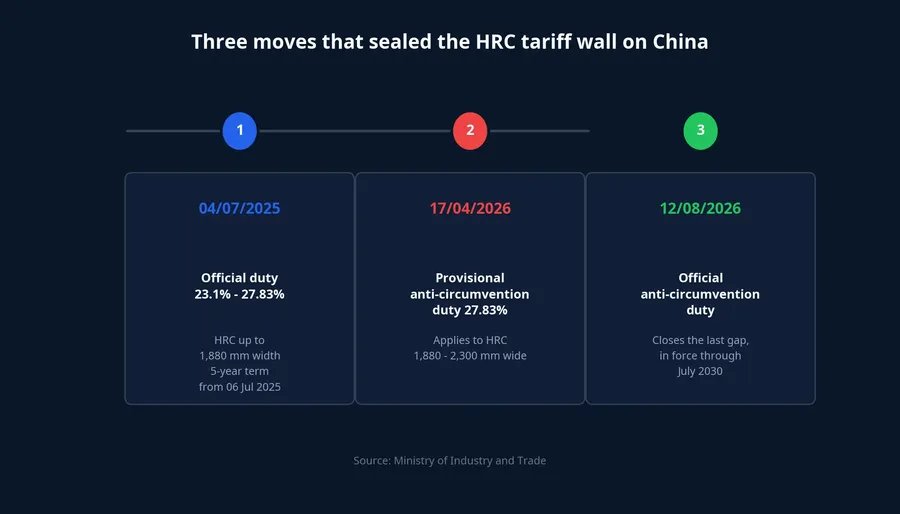
Hoa Phat and Formosa petitioned for an anti-circumvention investigation. The ministry opened one on October 27, 2025, imposing a provisional anti-circumvention duty of 27.83% on HRC between 1,880 mm and 2,300 mm wide, effective April 17, 2026,CafeF then issued Decision 1917/QD-BCT making the same duty official, effective from August 12, 2026 through July 2030.DNSE With this step, every width of Chinese HRC now falls inside the taxed range.
Line the two dates up and the story clicks into place: the provisional anti-circumvention duty took effect April 17, and Q2 2026 was the first full quarter to run entirely under that wall. That same quarter, Hoa Phat's HRC volume hit a record and its market share overtook imports for the first time. This is the point that any analysis anchored only to global steel prices would miss.
Layer three: the wall becomes pricing power
The part that matters most to investors isn't volume. It's price. Through 2026, Hoa Phat's domestic HRC offer price has held roughly 9% to 14% above China's export HRC price, equivalent to USD 45–65 per tonne.
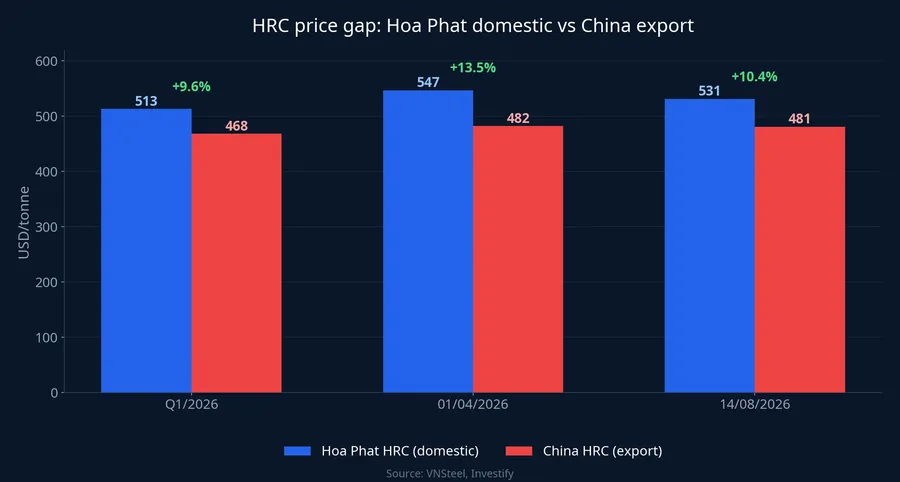
On April 1, 2026, right before the provisional anti-circumvention duty took effect, Hoa Phat raised its HRC offer price by VND 900/kg to VND 14,390–14,420/kg, the highest of the year, pushing the gap over China's price to 13.5%.VNSteel That kind of pricing power is exactly what a producer competing head-on with cheap imports cannot exercise.
The result flows straight into the earnings statement. In Q2 2026, Hoa Phat posted net profit of roughly VND 6,400 billion, up 51% year-on-year, with a gross margin of 18.9%, the highest in eight quarters.Vietstock For the first half of the year, revenue reached VND 108,870 billion and after-tax profit hit VND 15,480 billion, up 103% year-on-year.CafeF That's 70% of the full-year profit target of VND 22,000 billion, reached at the halfway mark.
Why falling world steel prices don't translate to Hoa Phat
The falling international HRC benchmark is the US market reference, around USD 1,180/tonne. Hoa Phat doesn't sell into that market. Its real price competitor is Chinese HRC offered regionally, around USD 481/tonne as of August 14, 2026, with Hoa Phat's offer roughly 10.4% higher at the same date.
In other words, the variable that determines Hoa Phat's margin is the gap between its domestic offer price and Chinese steel plus the tariff, not the international benchmark investors see quoted daily. That's why reading global steel price movements straight through to HPG's stock tends to produce the wrong conclusion.
What could complicate this story
It would be wrong to attribute the entire profit jump to the tariff wall. Three other factors deserve a place alongside it.
Part of the early-year profit didn't come from steel. In Q1 2026, Hoa Phat reported profit of VND 9,056 billion — higher than that quarter's own gross profit, implying a large contribution from non-core income. The 103% first-half growth figure should be read with that detail attached, rather than treated entirely as core manufacturing profit.
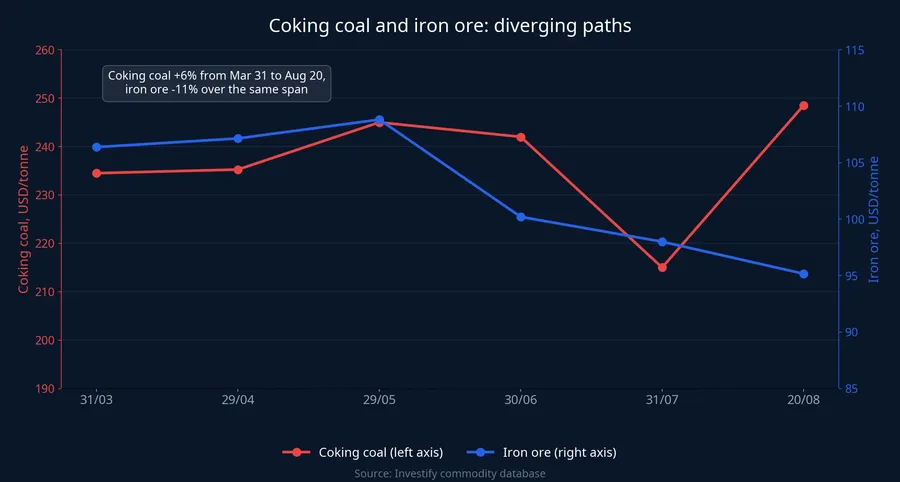
Input costs are diverging, not uniformly working against margins. Commodity price data shows coking coal, the main blast-furnace input, rose roughly 6%, from USD 234.5/tonne at end-March to USD 248.5/tonne on August 20. Iron ore moved the other way, down roughly 11% over the same period to USD 95.16/tonne. That coking coal increase is far smaller than the cost-pressure warnings that circulated earlier, and the iron ore decline offsets a meaningful chunk of it. In short, current input-cost pressure isn't yet large enough to threaten the 18.9% gross margin. It remains worth watching at every price release, though.
The pricing power has already been tested. In early August 2026, Hoa Phat cut its HRC offer price by VND 400/kg, bringing the August delivery price down to roughly VND 13,990–14,020/kg and narrowing the gap over China's price to 10.4%. The tariff wall raises the price floor. It doesn't fix it in place. The gap still flexes with every pricing cycle.
Growth is also concentrated in a single product line. Construction steel and premium coil volume reached just 1.3 million tonnes in Q2, up only 2% year-on-year and down 9% quarter-on-quarter. This year's Hoa Phat story is an HRC story, not a broad-based steel-sector recovery.
Three indicators worth watching instead of the world steel price board
On July 30, 2026, the Ministry of Industry and Trade opened its first review of the HRC anti-dumping measure, at the request of China's Baosteel Group.Nguoi Quan Sat Under Decree 86/2025/ND-CP, any involved party may request an annual review during the first four years of the measure. If the review lowers the duty for cooperating exporters, the price gap domestic steel currently holds would narrow.
The evidence across all three layers points to one conclusion: Hoa Phat's Q2 2026 profit engine sits in the domestic tariff wall, not the global steel cycle. For a stock trading nearly 20% below an 11-month-old peak while first-half profit doubled year-on-year, the more useful monitoring frame isn't the daily international steel price board. It's three indicators tied directly to the mechanism actually generating that profit.
The first is the outcome of the Baosteel-requested review, since it determines where the wall still stands. The second is the gap between domestic and Chinese HRC offer prices at each pricing cycle, since it shows how much pricing power Hoa Phat still holds. The third is the coking coal price, since it determines whether input costs eat into that profit. At present, though, the coal price increase isn't large enough to reverse the profit picture.