


On July 2, 2026, Vinhomes' board approved a co-investment agreement with VinSpeed High-Speed Railway Investment and Development JSC for the Hanoi-Quang Ninh high-speed rail project. The headline that spread fastest across forums kept only half the story: Vinhomes gets a profit share equal to 85% of the project's EBIT. The other half sits in the same resolution, and it changes how that 85% should be read.
From VND 6 trillion in charter capital to the groundbreaking at Tuan Chau
VinSpeed was established on May 6, 2025 with initial charter capital of VND 6 trillion, raised to VND 45 trillion within about six months.VnExpress Ownership is concentrated inside the Vingroup ecosystem: Pham Nhat Vuong, Chairman of Vingroup (VIC), holds 51%, Vietnam Investment Group holds 35%, Vingroup itself holds 10%, and two other individuals hold 1% each.
On April 12, 2026, in Tuan Chau ward, the Quang Ninh provincial government joined Vingroup and the governments of Hanoi, Hai Phong and Bac Ninh to formally break ground on the line.CafeF Total investment is VND 147.37 trillion, equivalent to more than $5.6 billion, not including roughly VND 10.27 trillion in land clearance compensation covered by the state budget.Báo Đầu tư The line runs 120 km at a design speed of 350 km/h, targeting commercial operation in 2028 and cutting the Hanoi-Quang Ninh travel time to about 23 minutes.

One detail rarely mentioned: the starting station, Co Loa, sits inside the Vinhomes Global Gate township in Hanoi. The terminus, Ha Long Station, sits inside Vinhomes Global Gate Ha Long. In other words, this 120-km line connects two land banks belonging to the same listed company.
The July 2 resolution: 85% cuts both ways
Per VnExpress, Vinhomes' board resolution bundles three tightly linked terms.VnExpress Vinhomes will contribute up to 85% of the project's total investment, net of whatever capital VinSpeed raises from third parties. That contribution, at any point in time, cannot exceed 35% of Vinhomes' total assets per its latest financial statements. In return, Vinhomes takes 85% of the project's EBIT, after deducting interest expense and the share owed to other partners.
Put the three terms side by side and the 85% profit share is not a windfall: it is the counterpart to the 85% of capital Vinhomes puts up. Taking the ceiling on total investment, Vinhomes' maximum capital commitment to this single line works out to roughly VND 125.3 trillion, about 43% of VHM's market cap as of the August 21 session and nearly half its VND 274,005 billion in equity at the end of Q2.
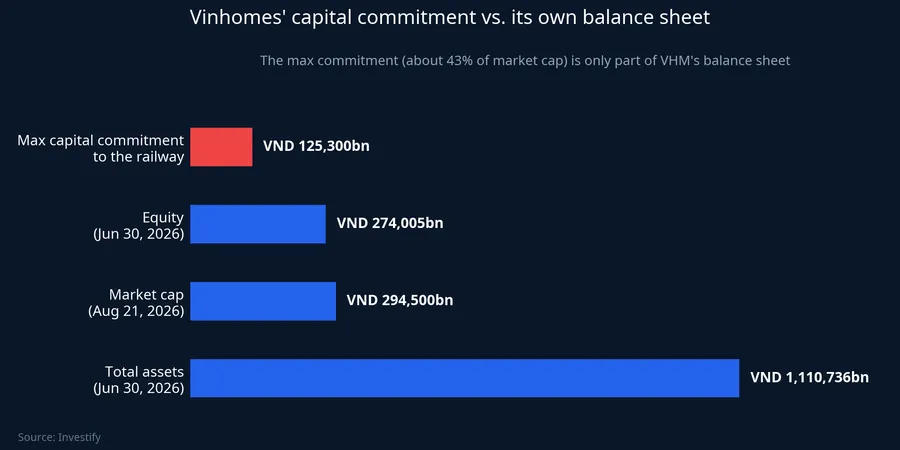
The 35% cap on total assets sounds like a safety valve, but the actual numbers show it barely constrains anything. Vinhomes' consolidated total assets at the end of Q2 2026 stood at VND 1,110,736 billion,CafeF so 35% of that is roughly VND 388,800 billion, more than three times the VND 125.3 trillion ceiling above. What actually limits the size of the capital contribution is the scale of the project itself, not a financial safety clause.
The profit formula also rewards a close read. EBIT is earnings before interest and tax, but the resolution deducts interest expense on top, so what Vinhomes actually collects is closer to 85% of pre-tax profit than 85% of a clean EBIT figure. For an infrastructure project carrying heavy debt and long depreciation schedules, the gap between those two readings is not trivial.
Three roles, one cash flow
In the same July 2 resolution, Vinhomes approved forming a consortium with SGC Investment and Construction JSC to sign design-and-build contracts on two lines: Ben Thanh-Can Gio, valued at roughly VND 43.755 trillion, and Hanoi-Quang Ninh, valued at roughly VND 73.373 trillion, for a combined VND 117.1 trillion. The Hanoi-Quang Ninh construction package alone accounts for nearly half of that line's own total investment.
Vinhomes is therefore simultaneously the largest capital contributor, the largest construction contractor, and the landowner at both ends of the line. For VHM shareholders, that structure cuts two ways: construction revenue and project margin stay inside the group instead of flowing out to an external contractor, and land values at both termini get a lift from the new infrastructure. The side worth watching is concentration risk. If the schedule slips or the cost per kilometer rises, all three roles absorb the hit at the same time. There's no independent piece left to offset the damage.
Why Hoa Phat isn't in this equation yet
Every time a mega rail project appears, the reflex among investors is to reach for steel stocks. Hoa Phat broke ground on its rail and special steel plant in Dung Quat back in December 2025, with total capital of more than VND 10 trillion, designed capacity of 700,000 tonnes a year, and a target of rolling out its first rail product in Q1 2027.Báo Chính phủ
The problem is that the Hanoi-Quang Ninh line's steel demand is unlikely to flow there. Vingroup has set up VinMetal in Ha Tinh with VND 10 trillion in capital and first-phase capacity of about 5 million tonnes a year, explicitly aimed at making the group self-sufficient in steel for its own core businesses.Dân Trí When the investor, the contractor and the steel supplier all belong to the same group, the slice of value that flows outward gets thinner.
That doesn't mean Hoa Phat's rail plant has nowhere to go. Vietnam still has the North-South line, the Hanoi-Hai Phong-Lao Cai line and several urban transit lines ahead, with total rail-steel demand estimated at roughly 4 million tonnes.Người Quan Sát But those are contracts not yet signed, on projects not yet broken ground. Tying HPG's share price to the progress of this one Hanoi-Quang Ninh line specifically is attaching it to the wrong address.
The nearest milestone: over 100 hectares before September 30
As of August 23, 2026, localities in Quang Ninh had handed over just over 50 hectares of land for the line. Seven communes and wards along the route are counting and verifying land-origin records, aiming to complete clearance before September 30, 2026 per the provincial government's directive. The remaining area still to be recovered exceeds 100 hectares. VOV calls this September deadline a "hard line."VOV
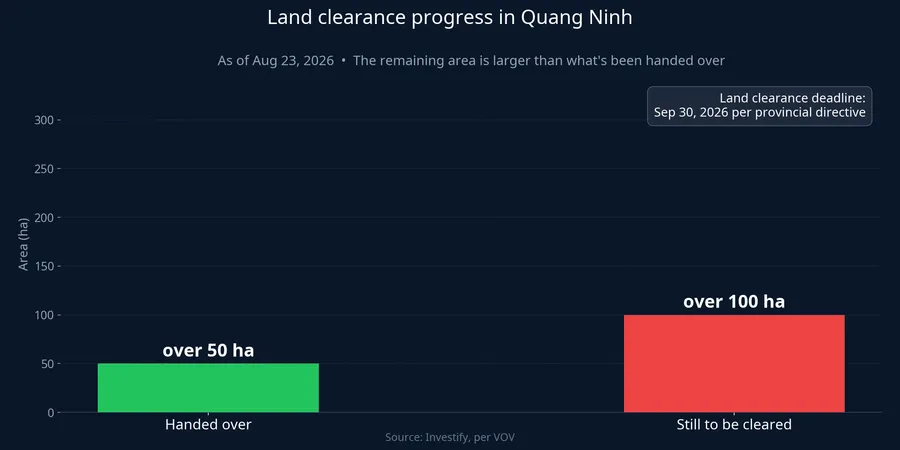
The biggest snag cited by the province is verifying land-origin records, since the paperwork was created across multiple administrative periods. To clear it, the provincial government is holding daily and weekly coordination meetings, dispatching specialist staff from various departments for direct support, and setting up mobile task forces to review records. This is the clearest signal to watch over the coming weeks: the line targets 2028 operation, leaving only about two construction seasons. A slow handover won't immediately derail the schedule, but it pushes construction volume toward the back end. For a consortium holding a VND 73.373 trillion contract, that pileup flows straight into cost.
How much of this is already priced in
VHM shares closed the August 21 session at VND 71,700, up 3.17%, with a market cap of roughly VND 294,500 billion. Since the first session after its 100% stock dividend on August 6, VHM has fallen 7.0%, while the VN-Index has been essentially flat, moving from 1,764.78 to 1,768.12 points.
That decline shouldn't be read purely as a reaction to the rail project. Several explanations coexist: the extra shares from the 100% stock dividend increased the float available for selling, profit-taking followed Vinhomes' record first-half profit of VND 52,092 billion, and the market has started factoring in the sheer amount of capital this rail line requires. The available data isn't enough to isolate which factor dominates. What can be said with confidence is that the market has not priced the 85% EBIT clause as free money.
For investors tracking this stock, the reasonable framework right now is to treat the railway as a long-term capital commitment from VHM, not an unusual income item about to hit the books. The concentration risk from holding all three roles is worth monitoring, but it doesn't overturn this framework unless disbursement or land-clearance progress diverges sharply from plan. Two concrete signals to watch before the end of Q3: whether the remaining 100-plus hectares in Quang Ninh get handed over before September 30, and Vinhomes' next disclosure on how much capital has actually been disbursed into the project. The real disbursement figure will show how far the 85% commitment has actually gone. Everything circulating today is still just a ceiling written into a resolution.