


Every year around late August, the same story resurfaces on investor forums: Vietnamese stocks tend to rally ahead of the September 2 National Day holiday. The data backs it up. Over the VN-Index's last eight closing years, the 5 sessions before the holiday rose in 6 of 8 years, averaging a 1.08% gain. Yuanta Vietnam Securities found a similar pattern, with the VN-Index averaging roughly 1% gains over 3 days and 1.4% over 5 days before the holiday.DNSE
What rarely gets mentioned is that this is only half the dataset. The other half, measured by consistency, is actually more reliable.
The other half of the same table
Using the same VN-Index closing data from 2018-2025, if you measure the 5 sessions right after the market reopens, the picture nearly flips. The pre-holiday leg rose in 6 of 8 years, averaging +1.08%. The post-holiday leg fell in 7 of 8 years, averaging -1.23%. The only year that broke the pattern was 2021, when the market was still riding the strong uptrend of the pandemic-era liquidity wave.
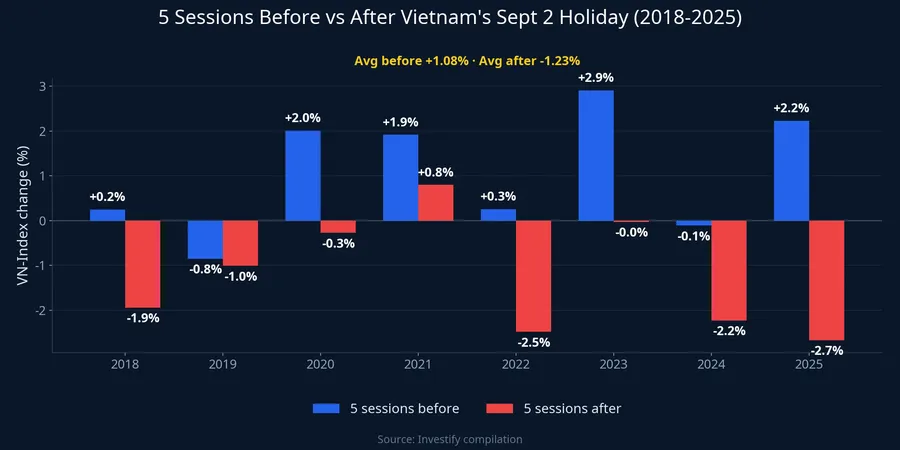
In other words, the half investors keep repeating is actually the weaker one in terms of repeatability. The more consistent half runs in the opposite direction, and almost nobody talks about it.
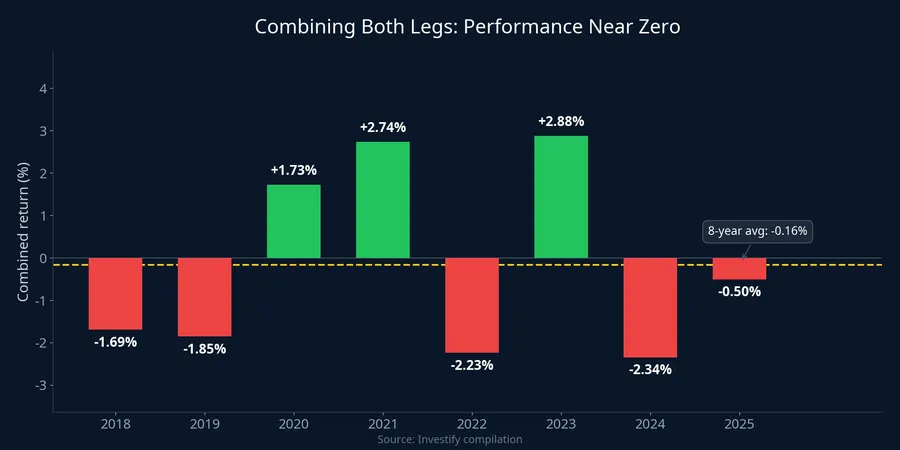
Combine both legs and you get the most telling number of all. An investor who buys before the holiday and sells 5 sessions after reopening would have booked gains in 4 years and losses in 4 years, with an average 8-year return of just -0.16%. Nearly all of the pre-holiday gain, on average, gets handed back in the days right after.
Why the pattern repeats
A few mechanisms explain both directions, and they are not mutually exclusive. The pre-holiday rise comes from a controlled form of risk aversion: a long holiday makes sellers pull back their orders, liquidity thins out, and the same modest amount of buying demand is enough to push prices up.
The post-holiday decline comes from two other forces. First, profit-taking demand that piled up during the days when trading was closed. Second, the broader seasonal pattern of September itself, when retail cash flow typically weakens and funds rebalance portfolios, adding fresh supply to the market.DNSE
The limits of this dataset are worth stating plainly. Eight observations is a small sample, not enough to call a hard rule. Holiday length also varies year to year: 2018-2020 saw just a single day off, 2021 onward saw two or more days, and this year the market is closed for three working days. Each year also carries its own context strong enough to override seasonality, such as the global rate-hike cycle in 2022 or the cheap-money wave of 2021. Seasonality, in other words, is a thin layer of probability sitting on top of the broader context, not a decisive factor on its own.
This year, the average lands right at resistance
On August 21, the VN-Index closed at 1,768.12 points, up 33.88 points or 1.95%, with 245 advancers versus 68 decliners and 18 stocks hitting the ceiling. Matched volume topped 777 million shares, clearly above the average of recent sessions. This was a broad-based rally, not one driven by a handful of large-cap names.

Apply the pre-holiday leg's average gain of 1.08% to the 1,768.12 base and the index would land around 1,787 points. That figure falls almost exactly on the 50-session moving average, currently at 1,787.1 points, right inside the resistance zone that several brokerages have just flagged. This is the detail worth pausing on: even the best-case seasonal scenario this week does not take the market into new territory. It takes the market straight into the nearest technical wall.
The medium-term structure is not fully supportive either. The index is trading above its 20-session moving average, at 1,745.5 points, but still below the 50-session (1,787.1 points), 100-session (1,810.1 points) and 200-session (1,777.3 points) averages. The current rally, in that sense, reads as a short-term bounce inside a medium-term trend that remains weak.
Brokerages: bullish on direction, cautious on entry price
What's notable is that analysts themselves are treating these as two separate questions. Per a roundup by Người Quan Sát on August 23, brokerages are broadly positive on the short-term outlook, but their trading recommendations converge on nearly the same point: don't chase the rally.Người Quan Sát
TPS Securities views the August 21 session as confirmation that buying demand has returned, while setting a further condition: only a decisive break above 1,785 points would confirm the downtrend structure formed since May has been broken. Vietcombank Securities sets its nearest target at 1,790-1,800 points, cautioning against chasing prices as they approach resistance, and favoring entries on pullbacks in the securities, banking and real estate groups.
Asean Securities advises short-term investors to hold moderate exposure, trading around the 1,760-1,770 point support zone. Bao Viet Securities and Kafi Securities both flag the 1,780-1,800 point zone as a likely area for volatility, with support around 1,720-1,750 points. Read closely, this isn't a contradiction. Trend and entry price are two different questions. The short-term trend genuinely is improving, but the current 1,768 level already sits close to a zone these same firms consider hard to clear right away.
What the seasonal statistic actually says
For individual investors, the takeaway from this dataset is not a buy signal.
The week of August 24-28 has 5 trading sessions, and August 28 is the last session before the market closes for three consecutive working days on August 31, September 1 and September 2, reopening on September 3. August 22 is a designated makeup workday, but no trading takes place that day.Báo Mới That means any position opened after August 28 sits untouched for five straight days, with no way to react if adverse news breaks during the holiday.
Put together, the seasonal statistic isn't a reason to add exposure. It's a reason to plan an exit date in advance. With the index moving into the 1,780-1,800 point zone that multiple brokerages already treat as resistance, avoiding chasing the rally and holding moderate exposure is standard defensive positioning, consistent with what's already being recommended.
Two levels are worth watching this week. If the VN-Index closes decisively above the 1,785-1,787 point zone with sustained volume, the technical signal changes character and the bullish seasonal case gains more support. Conversely, if the index loses the 1,745-1,750 point zone, its 20-session moving average, the recovery from the July 28 low would effectively have failed, and the seasonal story would no longer carry much weight as a reference point.