
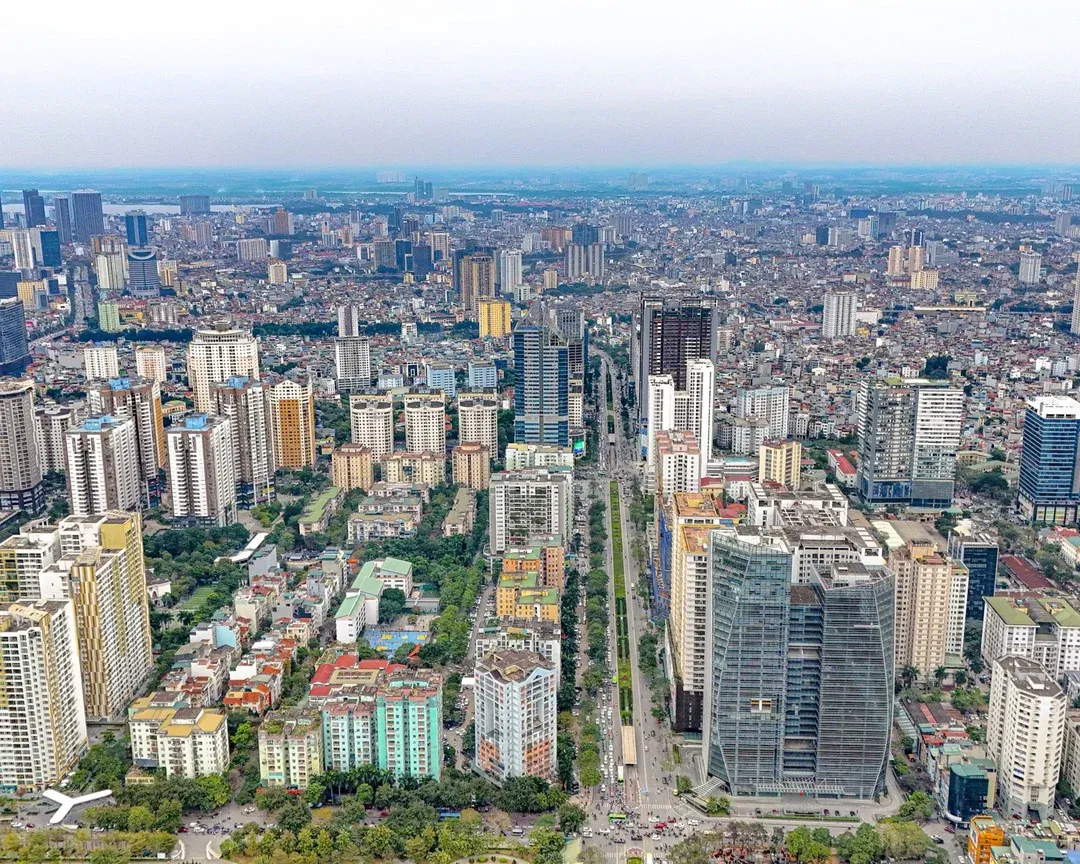

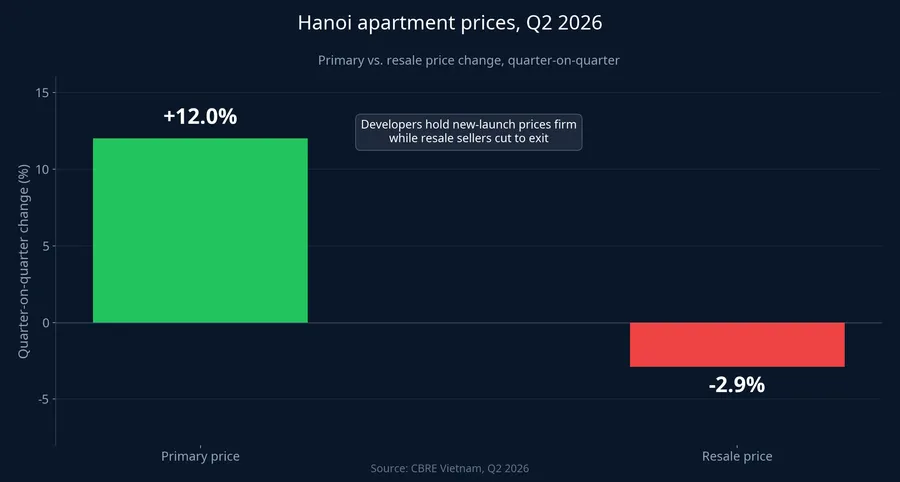
Q2 2026 left Hanoi's apartment market with two numbers that are hard to reconcile at first glance. Primary prices, meaning what developers charge for newly launched units, rose roughly 12% quarter-on-quarter and 21% year-on-year.Thời báo Tài chính Việt Nam In the very same quarter, resale prices on the secondary market fell nearly 3% quarter-on-quarter, the first decline since late 2022.Thời báo Tài chính Việt Nam
This isn't a paradox. It's two different baskets of units being measured at the same time.
Supply really did surge
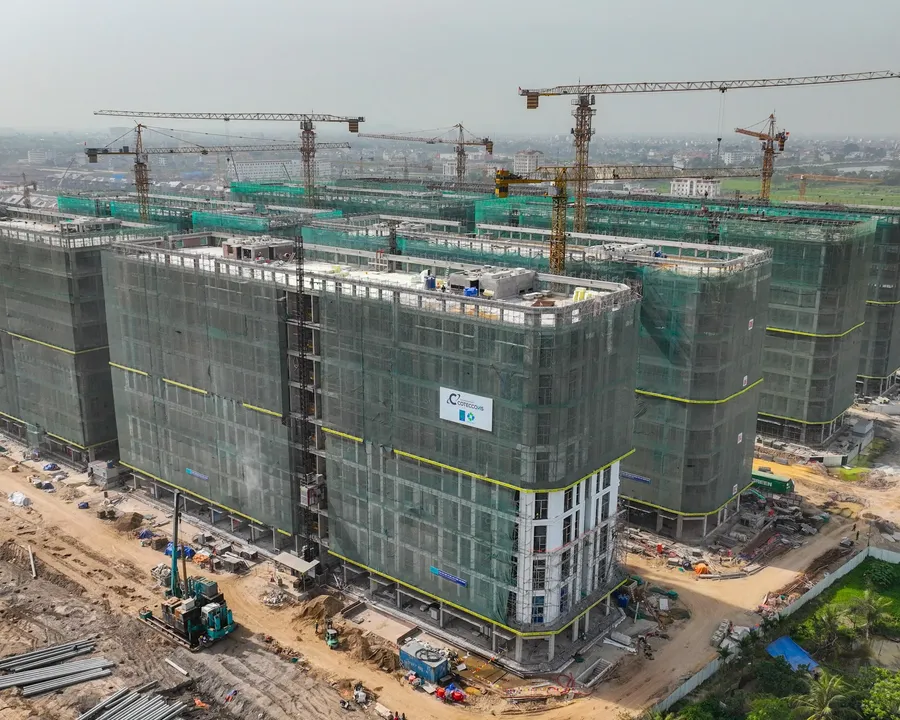
Supply is no longer the bottleneck it was a few years ago. Per the Ministry of Construction, Q2 2026 saw 113 new commercial housing projects licensed nationwide, covering more than 103,200 units, of which nearly 69,600 are apartments, nearly double Q1 and more than triple the same period last year.Dân Trí
In Hanoi alone, H1 2026 recorded 16,600 newly launched units, the highest first-half figure since 2020.Thời báo Tài chính Việt Nam CBRE Vietnam forecasts the full-year 2026 figure could reach nearly 39,000 units, surpassing the old peak of over 37,000 set in 2019. That's exactly the condition homebuyers have waited years for, since more supply should, in theory, mean lower prices.
Demand fell to half its normal pace
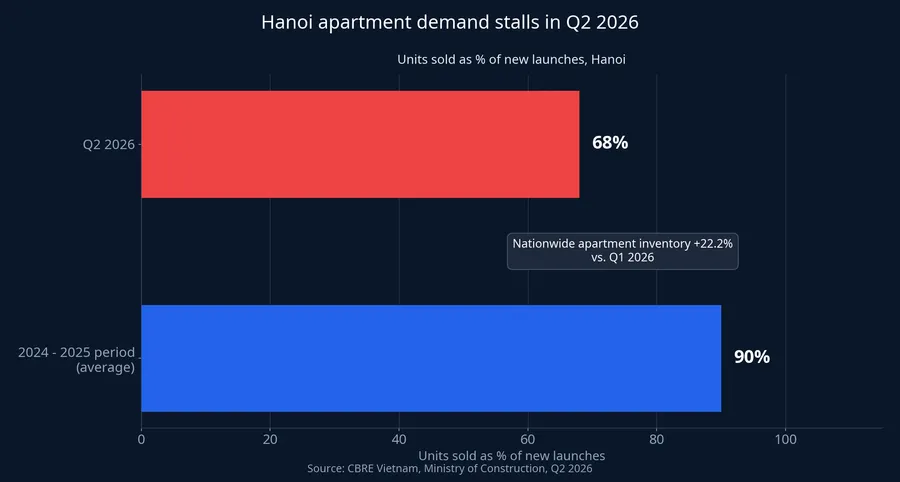
The other half of the equation moved the opposite way. Hanoi sold just over 5,800 units in Q2 2026, only 68% of new launches in the period. That matches Q1 but falls far below the 2024-2025 stretch, when the sell-through ratio routinely topped 90%.Thời báo Tài chính Việt Nam
Nationwide figures paint an even sharper picture: over 100,000 successful real estate transactions in Q2, just 71.5% of Q1's total and 63.7% of the same quarter in 2025.Dân Trí Unsold units flow into inventory: across the 25 of 34 localities that reported data, unsold apartments totaled roughly 12,823 units, up 22.2% from Q1. That figure excludes Hanoi and eight other localities that did not report.Dân Trí
Supply was surging, demand was sinking, and inventory was swelling. The conditions for a price decline were all in place. Yet the average apartment price in Hanoi still stood at roughly VND 123 million/m² per the Ministry of Construction, versus about VND 108 million/m² in Ho Chi Minh City and VND 69 million/m² in Hưng Yên.Dân Trí
The new supply isn't for buyers who are waiting
The answer lies in where the new supply landed: almost none of it falls in the price range buyers are actually waiting for. Q2 2026 marked the second straight quarter with no new Hanoi units priced below VND 60 million/m², while the two largest segments were VND 80-110 million/m² at 30% and above VND 120 million/m² at 35%, the latter alone accounting for over 3,000 units across four projects in Thanh Xuân, Tây Hồ and Đông Anh.Thời báo Tài chính Việt Nam
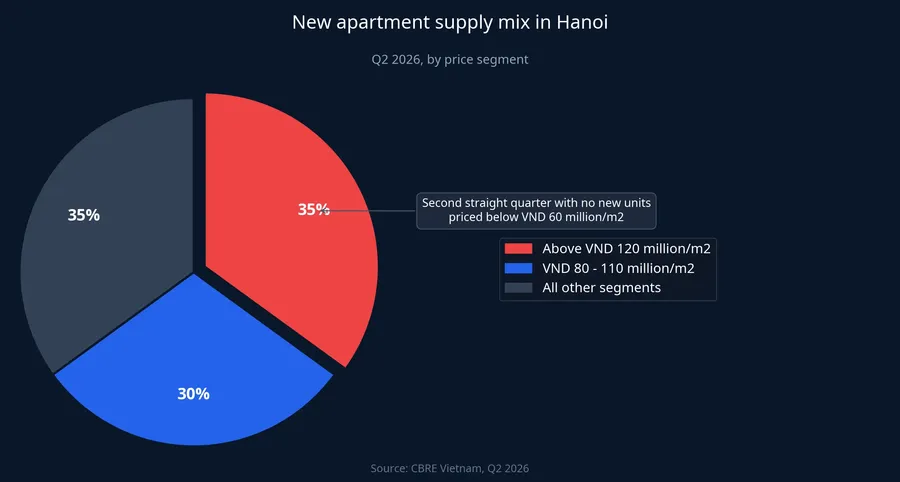
In other words, the market added tens of thousands of new units, but most of them are pricier than the existing stock. Someone shopping for a VND 3 billion apartment still has no new options, even though total supply is running at a six-year high.
Primary prices rose because the mix shifted, not because demand strengthened
A 12% quarterly jump in primary prices is easy to misread as a sign of surging demand, but there are at least three explanations. The first is a shift in product mix: CBRE points directly to a significant share of Q2 supply sitting in inner-city districts, which pulled the average primary price higher. The average moved because the basket being measured changed, not because individual projects raised prices across the board.Thời báo Tài chính Việt Nam The second is input costs: clean land is scarce and project approvals remain slow, forcing developers to price high from launch.
The third is that developers hold listed prices firm while quietly discounting. According to One Mount Group, several Q2 2026 projects officially launched below their previously announced expected prices, while also offering extended payment schedules and interest incentives running up to 5 years.CafeF That means what buyers actually pay is lower than the sticker price.
The evidence leans toward the first explanation, since the sell-through ratio fell rather than rose. If demand were genuinely strong, that ratio wouldn't have dropped from over 90% to 68%. The other two factors add to the picture but don't drive it.
The secondary market is where the truth shows up
Primary prices are set by developers and shaped by product mix. Resale prices work differently: they reflect what a seller will accept and a buyer will pay, with no sales team pricing on anyone's behalf. And that number just turned. The average Hanoi apartment resale price closed Q2 2026 at VND 60 million/m², down nearly 3% quarter-on-quarter, the first decline in Hanoi's secondary market since late 2022, while the year-on-year growth rate narrowed to 13%, roughly half the 24-26% peak of 2024-2025.Thời báo Tài chính Việt Nam Nationwide, the Ministry of Construction reported secondary apartment prices falling from Q1, with declines commonly running 3-6% at some projects, especially high-value units or those facing selling pressure.Dân Trí
Talking about the same Hanoi apartment market in the same quarter, the three figures — VND 123 million, VND 95 million and VND 60 million per square meter — diverge only because they measure different baskets. The Ministry of Construction's VND 123 million/m² skews toward newly launched units, CBRE's VND 95 million/m² is the market-wide primary average, and VND 60 million/m² is what already-delivered units are reselling for. Anyone reading housing-price headlines should ask which basket a figure is drawn from before comparing it to the unit they're actually looking at.
Mortgage rates are squeezing demand directly
The Ministry of Construction points to one specific cause of the slowdown: mortgage rates commonly run 12-14% a year, with many loans reverting to a floating 13-15% after the promotional period ends, and as high as 15-16% at some banks.Dân Trí The ministry assesses that high rates, low loan limits and income-verification requirements continue to constrain purchasing power, especially for buyers with limited financial capacity.
On a VND 2 billion loan at 13% a year, the interest alone in the first month runs roughly VND 21.7 million, before any principal repayment. That's an illustrative calculation using a reference rate rather than a figure pulled directly from a source, but it's enough to show why buyers have shifted from quick decisions to careful deliberation, a pattern CBRE also observed among Hanoi buyers this quarter.

Listed developers show the same split
Q2 2026 earnings across listed residential developers reveal a wide gap. Vinhomes posted a gross margin of 65.9%, up from 22.1% a year earlier on the back of a large handover quarter, while Bluemarq Group's net margin shrank from 36.6% to just 4.4%, reflecting rising costs and margin compression. On the exchange, VHM closed the August 21 session at VND 71,700/share, DXG at VND 11,550/share and NLG at VND 24,000/share, all three up on the final trading day of the week. That reflects stock-market flows, though, not confirmation that the housing market has warmed up. The margin gap between these companies stems mainly from uneven handover cycles, not from underlying sales strength that quarter.
How to read this market
Direct real estate investment in Vietnam requires minimum capital of roughly VND 1.5-3 billion, an exit timeline of typically 1-3 months, and a 2% transfer tax. In an environment of 12-16% mortgage rates and a sell-through ratio of just 68%, the prudent default is to lower leveraged exposure and lengthen the expected holding period, rather than planning around a resale within a year. For buyers purchasing to live in, resale prices are adjusting and developers are loosening payment terms, so buyers' negotiating position is stronger than it was two years ago.
The signal worth watching for the second half of the year is fairly clear. Hanoi is expected to add roughly 17,000-23,000 more apartments in H2 2026.CafeF If that supply lands while the sell-through ratio stays around 68%, inventory keeps building and downward price pressure will gradually shift from the resale market into primary price lists themselves. Conversely, if developers manage to bring units back below VND 80 million/m², the absorption rate could recover even as the average price keeps falling, simply because the basket changes direction.
Those two scenarios diverge on a single variable: the price mix of the supply about to launch. That's the number worth tracking more closely than the average price being quoted everywhere else.