

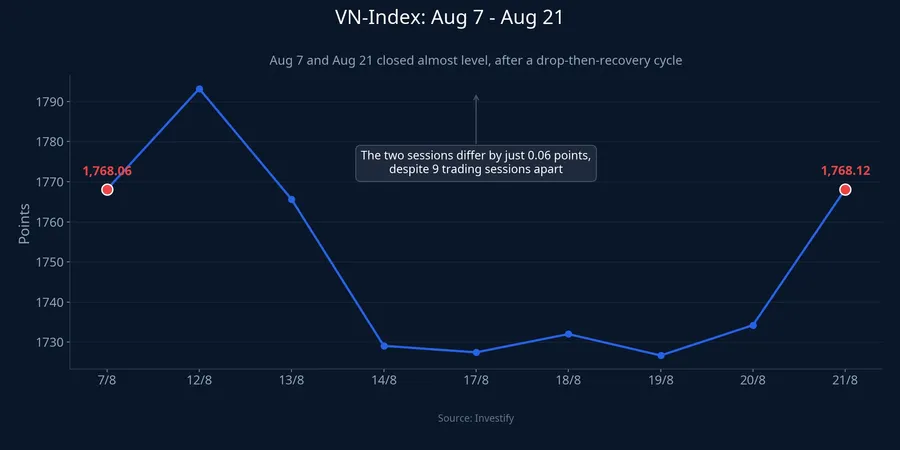
VN-Index closed August 21 at 1,768.12 points, up 33.88 points or 1.95% from the prior session. That figure is just 0.06 points above the 1,768.06 close on August 7. After a sharp drop and an equally sharp recovery packed into two weeks, the index landed almost exactly back where it started.
But look at the trading data from those two weeks: what changed isn't where VN-Index stands, but who's holding the shares.
Only one session in the week actually moved the needle
In the week of August 17-21, VN-Index gained 39.04 points from the August 14 close of 1,729.08. Nearly 87% of that gain came from a single session: Friday.
The first four sessions of the week were nearly frozen, closing at 1,727.46, 1,732.02, 1,726.69 and 1,734.24 points in sequence, adding up to just 5.16 points combined. Vietstock described this stretch as sideways trading around the 1,730 level on thin liquidity, reflecting a market waiting for a confirming signal on demand.Vietstock
Then the August 21 session made up for all of it at once. Matched volume on HOSE hit 777.6 million shares, with 245 gainers against 68 losers. Market-wide trading value that day reached VND 16,897 billion, more than one and a half times the prior session.
The seller was foreign investors, and they sold evenly
Per Vietstock's weekly wrap, foreign investors sold a net VND 2.66 trillion across both exchanges, with more than VND 2.6 trillion of that coming from HOSE, while HNX saw a small net buy of VND 35 billion.Vietstock
The selling pressure wasn't concentrated in one spike session. It was spread out: right at the opening bell on August 17, foreigners already net-sold nearly VND 600 billion, and the three mid-week sessions continued at a similar scale.Thoi Bao Tai Chinh Viet Nam
By ticker, VIC was the most heavily sold name of the week at VND 640.0 billion, roughly a sixth of the week's total net selling, followed by VPB (VND 376.8 billion), VCB (VND 282.1 billion), GMD (VND 261.5 billion), STB (VND 240.7 billion) and VHM (VND 203.9 billion). The selling concentrated in banking and real estate, the two largest-weighted sectors on the index.
By the final session, the foreign flow reversed. CafeF recorded a net market-wide buy of VND 61 billion on August 21, led by SHB at nearly VND 138 billion, followed by SSI (VND 72 billion), MSN (VND 51 billion) and PNJ (VND 43 billion).CafeF
This is the easiest place to misread the data. A single VND 61 billion net-buy session equals only about 2.3% of the week's total net selling. At that pace, foreign investors would need more than forty sessions to return the shares they sold in the past five. One reversal session is one reversal session, not yet a trend.
Proprietary desks bought for real, but not enough to carry the market
Securities firms' proprietary trading desks net-bought VND 646.9 billion on HOSE during the week, plus VND 15.4 billion on HNX. CafeF also noted the group kept up its net buying in the hundreds of billions during the final session.CafeF
The daily pattern was uneven: a net buy of VND 234.5 billion on August 17, a net sell of VND 429.6 billion on August 18, then net buys of VND 91.1 billion, VND 589.0 billion and VND 161.9 billion over the remaining three sessions. The heaviest buying day was August 20, not the day the index jumped.
The subtraction here matters more than the raw numbers. Foreign investors pulled more than VND 2,600 billion out of HOSE; proprietary desks offset only VND 646.9 billion, about a quarter of that. The remaining roughly VND 2,000 billion had to be absorbed by someone else, and that someone is domestic investors more broadly, both retail and other local institutions. Daily disclosure data doesn't break out these groups separately, so there's no precise figure for retail alone, but most of the shares foreigners sold this week clearly ended up in domestic hands.
Looking at proprietary trading alone inflates the picture: it's the most organized, most visible buyer, but not the biggest one.
Two institutional camps facing off on the same few tickers
The notable pattern is that proprietary desks bought exactly the tickers foreign investors were selling.
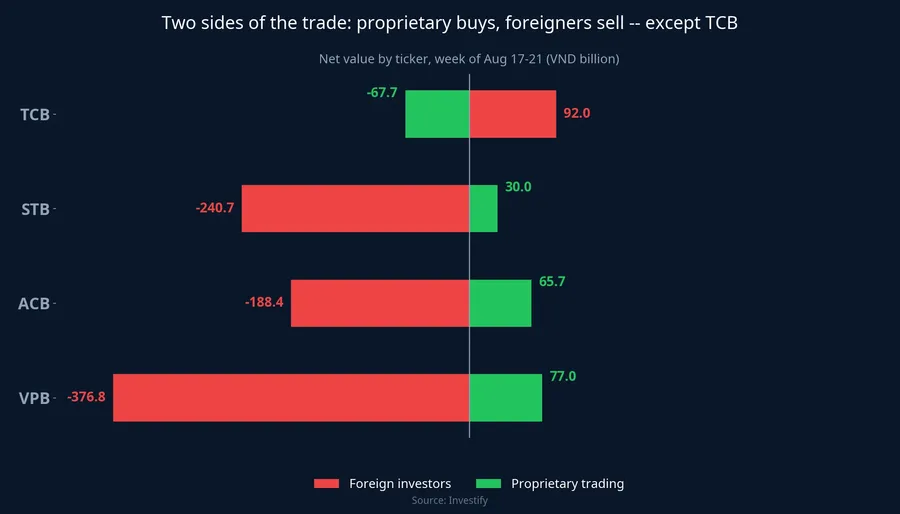
Banking is the clearest example. Proprietary desks net-bought VPB (VND 77.0 billion), ACB (VND 65.7 billion), LPB (VND 61.2 billion), HDB (VND 60.4 billion), MBB (VND 49.8 billion) and STB (VND 30.0 billion), more than VND 344 billion combined. That same week, foreign investors net-sold VPB (VND 376.8 billion), STB (VND 240.7 billion) and ACB (VND 188.4 billion). On these three tickers, the two institutional camps stood on opposite sides of the trade.
The ticker proprietary desks bought most aggressively was FPT, at VND 115.5 billion. Foreigners also net-bought it, at VND 83.3 billion. The two camps agreed on tech, but clashed on banks.
TCB went against both patterns. Proprietary desks net-sold TCB at VND 67.7 billion, their heaviest sell of the week, while foreign investors net-bought it at VND 92.0 billion: a bank stock sold by domestic institutions and bought by foreigners, the reverse of the sector's broader trend that week.
Why August 21 rallied: more than one explanation
Crediting the entire 33.88-point jump to proprietary buying alone would be a hasty conclusion. That session, proprietary desks net-bought just VND 161.9 billion, while matched trading value on HOSE reached nearly VND 15,500 billion.CafeF One percent of trading value isn't enough to explain a rally spreading across 245 tickers.
At least three explanations were present at once. The first is FTSE anticipation. August 21 was exactly the date FTSE Russell announced the results of its semi-annual review, a milestone the market had been watching all week.Thoi Bao Tai Chinh Viet Nam The results confirmed 27 Vietnamese stocks entering the FTSE All-Cap index, with the upgrade taking effect from September 21.Dan Tri
The second is technical positioning. The index had traded sideways below the 1,730 level for four sessions after a sharp two-day drop on August 13-14, when VN-Index lost 27.55 and 36.55 points respectively. A bounce after a compressed range is a common setup.
The third is domestic institutional flow: proprietary desks bought, foreign selling paused, and both eased the pressure on the board during a session that already had positive sentiment.
The data leans most heavily toward the first explanation, since the timing was already anticipated by the market and the rally landed exactly on the announcement date. The other two factors likely amplified the move rather than driving it.
Liquidity is still thin, and that's the thing to watch
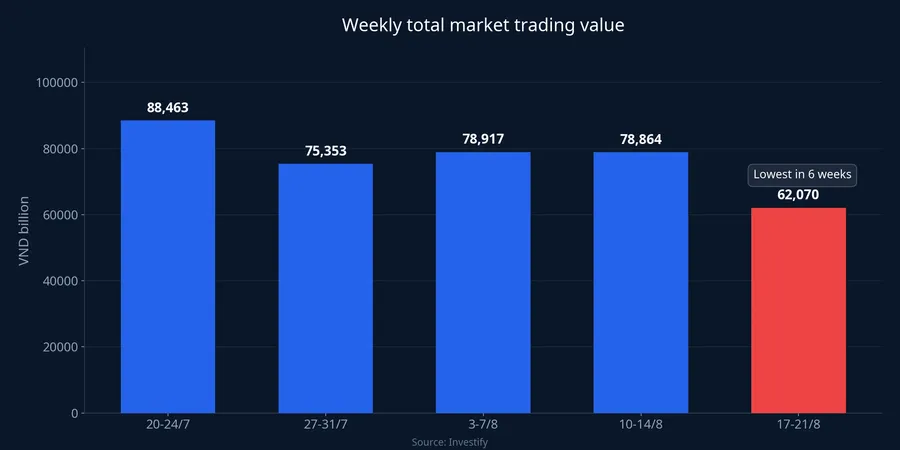
August 21 was busy, but the week as a whole wasn't. Total market trading value for the week of August 17-21 reached VND 62,070 billion, averaging VND 12,414 billion per session, the lowest in six weeks.
The gap against the four preceding weeks is clear: the week of July 20-24 hit VND 88,463 billion, July 27-31 hit VND 75,353 billion, August 3-7 hit VND 78,917 billion, and August 10-14 hit VND 78,864 billion. Last week came in 21.3% below the week before it.
An index recovering on a shrinking liquidity base is an incomplete signal: it shows selling pressure has eased, but not that fresh capital has arrived. Only if trading value holds at August 21's level across several consecutive sessions does the 1,768 level have real ground to stand on.
Three signals to watch in the week of August 24-28
First is foreign flow. The question isn't whether foreigners post one more net-buy session, but whether the selling streak has actually stopped. A week where foreign net flow returns close to balanced would carry far more weight than a single VND 61 billion buy session.
Second is liquidity. VND 12,414 billion per session on average is a low base. If next week's average returns to the VND 15,000-16,000 billion range seen in the four prior weeks, the recovery gains more support.
Third is the upgrade capital calendar. FTSE Russell is phasing Vietnamese stocks into its global indices in stages, starting this September and completing by September 2027.Dan Tri Passive capital will arrive in phases rather than all at once, so expecting an immediate market-cap jump doesn't fit how this allocation actually works.
Given the still-thin liquidity base and unconfirmed foreign reversal, holding a higher-than-usual cash allocation remains a reasonable defensive stance for an equity portfolio, favoring names bought net by both domestic and foreign flows over ones facing one-sided selling pressure. The 1,768 level isn't a resistance the market set for itself; it's simply the number the market passed through two weeks ago and has just returned to. These three signals will answer whether real capital is standing behind it this time.