
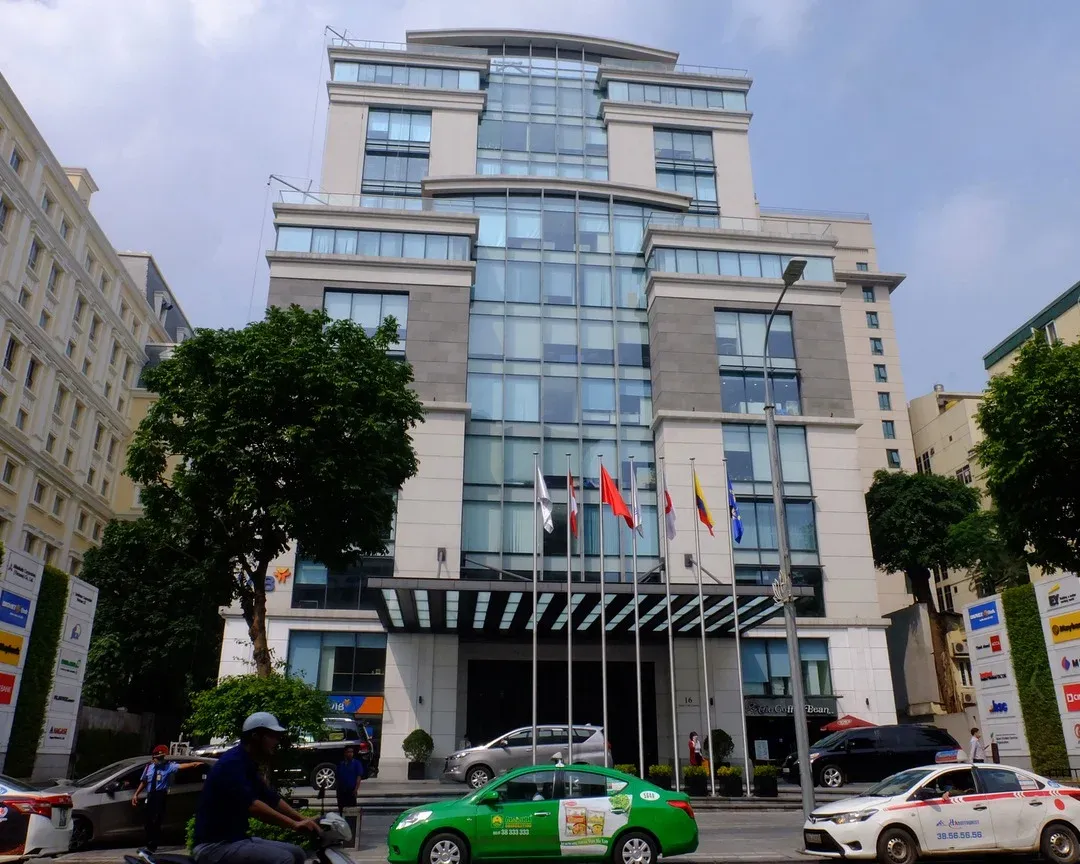

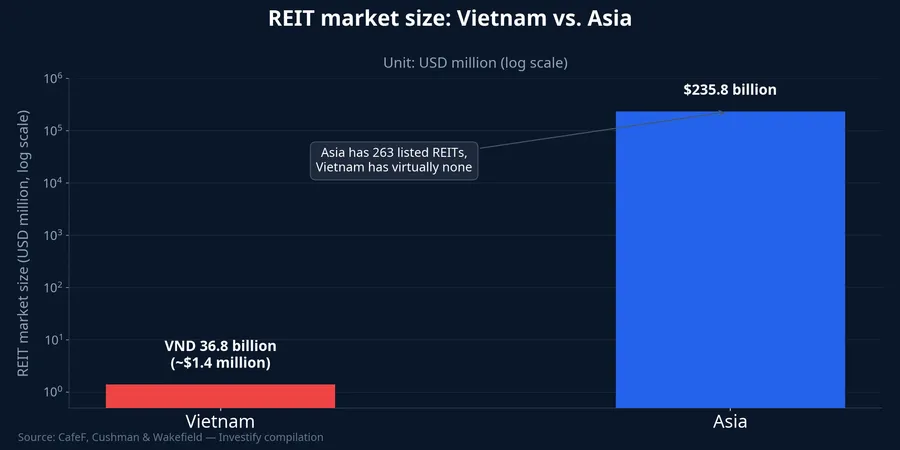
Vietnam's legal framework for real estate investment funds has been in force since January 15, 2021, under Circular 98/2020/TT-BTC. More than five years later, the closest thing to a REIT listed on HOSE is FUCVREIT, managed by Techcom Capital, with a market cap of roughly VND 36.8 billion as of early August 2026.CafeF
Set that number next to the region and the gap becomes obvious. Per Cushman & Wakefield, Asia had 263 active REITs with a combined market cap of roughly $235.8 billion by the end of 2024, while Vietnam still has no internationally standard REIT in operation.Tin nhanh chứng khoán Japan and Singapore are the region's two largest hubs, while China and Thailand are growing fast as capital returns to infrastructure, logistics, and industrial assets.
What a REIT actually is
A REIT securitizes income-generating real estate: office towers, warehouses, industrial parks, shopping malls. Investors buy listed fund units, and most of the rental profit is distributed back on a regular schedule. The model's value comes from steady, long-term cash distribution, not land-price appreciation. That is what sets it apart from developer stocks, whose prices track stock-market cycles and project timelines.
Bottleneck one: the fund has no legal personhood
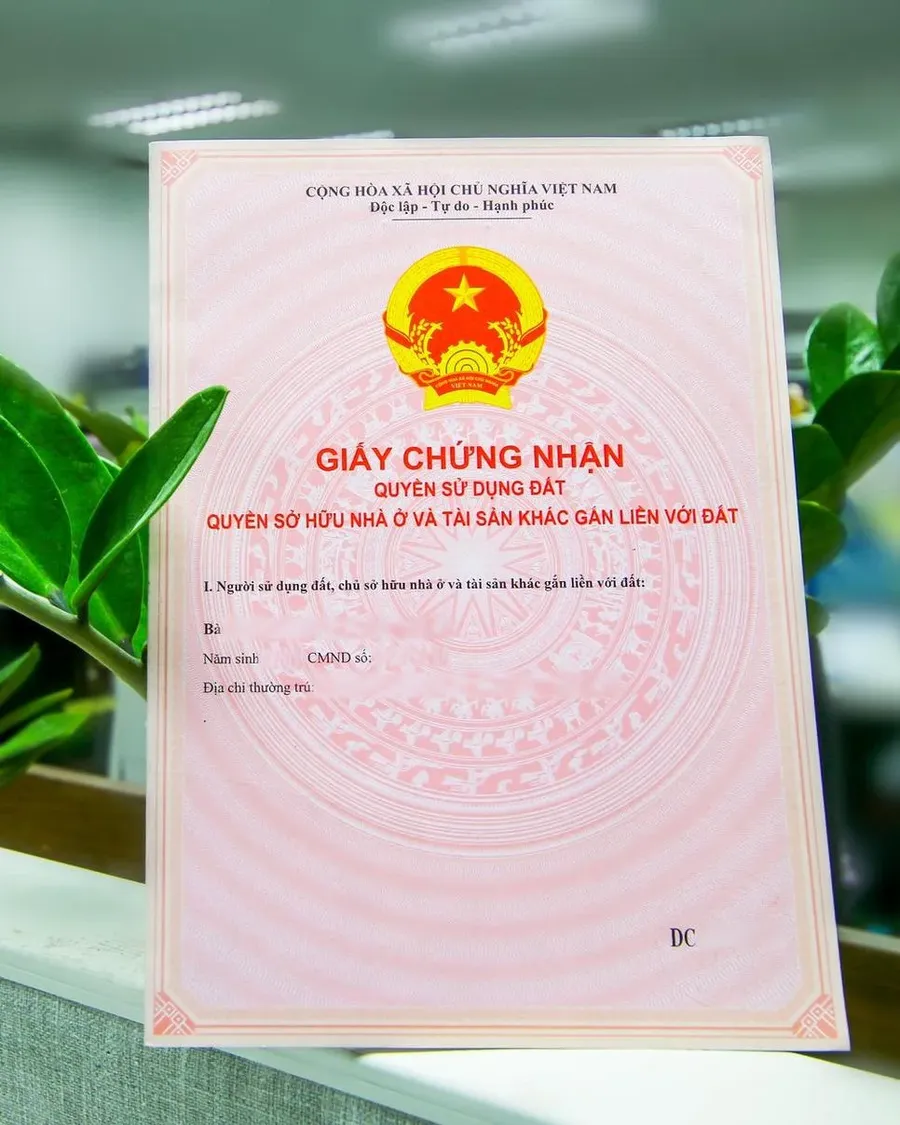
Under the 2019 Securities Law, securities investment funds, including real estate funds, are not legal entities. A fund is simply a pool of investor capital run by a fund management company under a trust-like arrangement. Real estate, by contrast, always needs a legal entity to hold title on the land-use rights certificate, so the asset ends up registered under the fund manager's name, raising questions about asset segregation and investor protection when disputes arise.
Nguyễn Anh Vũ, Director of Investment at PVI Asset Management (PVI AM), calls this one of the biggest obstacles to REIT development in Vietnam today. Markets that got there first solved this two different ways. Japan uses an investment-corporation structure, so the fund itself holds title. Singapore uses a business-trust structure: the fund still isn't a legal entity, but the trustee holds the assets under a mature trust-law framework that keeps them clearly segregated.
Bottleneck two: taxed at two layers
In the US, Singapore, and Japan, REITs are built on tax transparency. A fund only has to distribute most of its profit to investors, and in exchange that distribution is largely shielded from tax at the fund level, so the income is taxed once. In Vietnam, the same real estate profit can be taxed at both the fund level and the investor level when dividends or distributions are received, which makes REITs hard to compete against bank deposits, bonds, or direct property ownership.
Part of that gap has just narrowed. Decree 253/2026/NĐ-CP, which guides the Personal Income Tax Law and took effect on July 1, 2026, cuts personal income tax by 50% on distributions from securities investment funds and real estate investment funds, for five years through June 30, 2031.ACAC The same decree exempts gains from transferring open-end fund units if investors have held them for at least two years.
Read the fine print, though: the relief sits only at the investor level. The tax layer at the fund level — the one that determines whether the model is economical for an asset owner who wants to contribute a building to the fund — still has no transparency mechanism comparable to regional markets.
Bottleneck three: not enough assets that qualify
Even if both legal bottlenecks were cleared, one economic condition would still need to be met. Vietnam's problem isn't a shortage of real estate; it's a shortage of assets that qualify: clean legal title, verifiable cash flow, a long enough operating track record, transparent lease contracts, and a reasonable valuation.
China's experience shows how specific those standards get. Assets entering a REIT there typically must maintain occupancy of 90-100%, have at least 66% of leasable area under contracts of three years or longer, and a stable cash-flow track record of at least three years. In return, China's real estate REITs sustain payout ratios of roughly 4-6% a year, while infrastructure-concession REITs reach 8-14%. The market grew from the first batch of 9 listed REITs in June 2021 to 29 by the end of 2023, with total issuance of RMB 95.5 billion.Tin nhanh chứng khoán
In Vietnam, many assets are still priced mainly on price-appreciation expectations rather than actual cash-flow performance. An owner who wants to sell at a high valuation leaves too little yield for the fund; an owner willing to price low enough for the fund to work long-term may not want to sell at all. That's why the gap between "having the regulation" and "having the product" stays wide.
FUCVREIT: a portrait of a product standing still
FUCVREIT was licensed for public offering in 2016 and began trading on HOSE on February 27, 2017, with 5 million fund units at a total par value of VND 50 billion, at a reference price of VND 10,000 per unit.Thời báo Tài chính Việt Nam By early August 2026, its price had fallen to VND 7,350, putting market cap at roughly VND 36.8 billion, below its original charter capital.CafeF That size means liquidity is extremely thin, and individual investors who want to look closer need to read Techcom Capital's semi-annual reports or updated prospectus directly.
FUCVREIT should not be confused with TCRES, an open-end real estate equity fund also managed by Techcom Capital, with a NAV of VND 12,076 per unit and roughly 30% of NAV in real estate stocks. Same manager, different nature entirely: one invests in leased assets, the other in developer stocks.
What individual investors are actually using
While waiting for a genuine REIT, Vietnamese retail investors are tapping rental cash flow through two indirect channels.
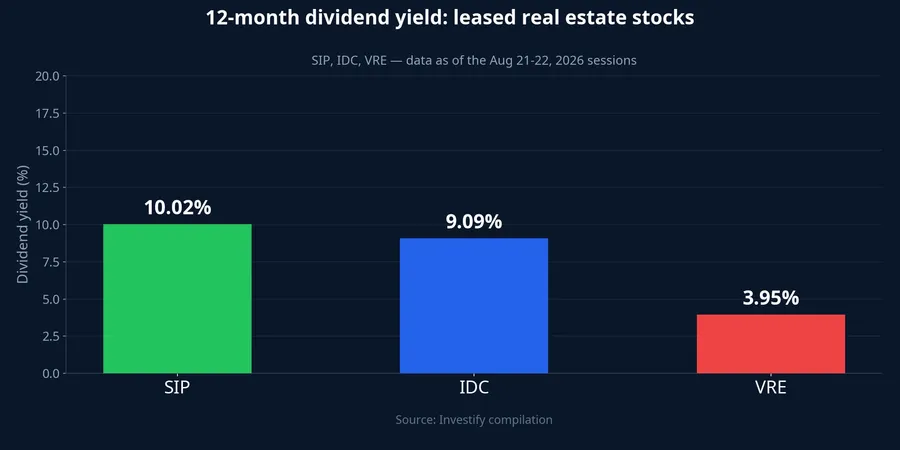
The first is landlord stocks. Industrial land lessors pay the most consistent cash dividends: SIP has a 12-month dividend yield of 10.02% with nine consecutive years of payouts, IDC sits at 9.09% with five years. As of the August 21-22 sessions, SIP closed around VND 49,900 and IDC around VND 33,000. VRE is the purest shopping-mall landlord and comes closest to REIT in nature, but its dividend yield is only 3.95% because most of its cash flow is reinvested into network expansion. The common thread across this channel: share prices still move with stock-market cycles and corporate leverage, not just rental income.
The second channel is open-end funds with high real estate weightings. There's still no purely real-estate open-end fund; the highest-weighted funds, such as VCAMDF (49.7% of NAV) and VNDAF (40.7% of NAV), are equity funds. Most Vietnamese open-end funds reinvest rather than pay cash distributions, making them portfolio diversification tools rather than income sources. The real estate names open-end funds hold the most are VIC, VHM, KDH, NLG, and KBC; pure landlords like VRE, IDC, and SIP make up a much smaller share. In other words, buying a "real estate" open-end fund in Vietnam mostly means buying developers, not rental cash flow.
What to watch
Several foreign-backed funds that once operated in Vietnam, such as VinaCapital's VNL, Dragon Capital's VPF, or Saigon Asset Management's VPH, also invested mainly in real estate stocks rather than owning cash-generating assets directly. That points to a structural obstacle, not a shortage of capital or professional managers.
Two signals will determine whether a genuine REIT model actually takes shape in Vietnam: a legal mechanism that lets a fund, or an intermediary legal entity, hold segregated title to real estate, and an extension of tax transparency down to the fund level for distributed profit. Decree 253/2026 has only addressed half of the second piece, at the investor level; the fund-level layer remains open.
For individual investors today, the practical framework is to separate the goal before picking the channel. For steady cash flow, industrial landlord stocks yielding 9-10% are the most direct route available, in exchange for accepting the sector's cyclicality. For diversification without picking individual names, open-end funds fit better, but investors need to read the holdings carefully to know whether they're buying developers or landlords. As for owning a slice of a leased building for a few million dong, the way investors in Japan or Singapore already can, that channel still doesn't exist in Vietnam.