

During the week of August 17-21, most coverage of US-Iran tensions led with the Brent crude price. That's the easiest number to track, but it isn't the number eating into Vietnamese transport companies' margins. The bigger picture sits in a corner few are watching: the diesel crack spread, the refining margin a plant earns on every barrel it processes. That spread just broke into triple digits for the first time in history, and it, not Brent, is what's setting the fuel bill for every truck run.
Brent closed at $93.93 a barrel on August 21, up 6.1% from $88.52 on August 14, though still below the $100.69 peak Brent itself set on July 23.Al Jazeera Meanwhile, a liter of 0.05S-II diesel sold in Vietnam has gotten VND 6,680 more expensive since the late-June pricing period, rising from VND 21,860 to VND 28,540 per liter. That's a 30.6% jump in eight weeks, while global crude still hasn't reclaimed its old high.
The chain of events that moved oil this week
The starting point was August 17, when the ceasefire memorandum between the US and Iran lapsed without either side renewing it.VnExpress Brent jumped 2.65% that same session. On August 19, US President Donald Trump announced an "economic war" campaign against Iran, warning of sanctions against any country whose banks, companies, or airports helped Tehran breathe.VnExpress
On August 20, US Treasury Secretary Scott Bessent said Washington would impose unprecedented sanctions and called on China, the largest buyer of Iranian oil exports, to cooperate.Al Jazeera Details of the package are expected on August 24. Brent added another 2.36% that session. By August 21, Iranian President Masoud Pezeshkian said it was time to end the war while Tehran still held the upper hand.Dân Trí Brent barely moved, up just 0.16%, and the market read that statement as an opening for negotiations.
The record is being set at the refining stage
What crude prices don't fully capture is happening at the refining level. The gap between diesel and crude prices hit $102.20 a barrel in the August 17 session in the US market, the first time the spread has ever crossed into triple digits.Yahoo Finance The previous record, around $97-98 a barrel, was set in mid-March 2026. The equivalent gasoline spread has stayed roughly flat, which tells you this is a diesel-specific shock, not a broad oil shock.
The mechanism is fairly direct. The Strait of Hormuz doesn't just carry crude; it's also the route refined products take from Gulf plants to Europe and Asia. Per Lloyd's List Intelligence, only 73 vessel transits crossed the strait in the week of August 10-16, down from 91 the week before and far below the pre-conflict pace of over a hundred transits a day.Lloyd's List Intelligence The same briefing noted US Central Command diverted 55 cargo vessels, disabled 3, and inspected 2 more as part of its blockade of Iranian ports.

When the flow of refined products gets choked, diesel prices decouple from crude. But Hormuz isn't the only cause here. US distillate inventories stood at just 107.1 million barrels as of August 7, the lowest level for this time of year since 1996, according to the US Energy Information Administration.Yahoo Finance Drone strikes on Russian refineries have also cut global diesel supply, and Northern Hemisphere harvest season is currently peak consumption. Hormuz was the final push on a market that was already stretched thin, not the whole story.
A selective shock arriving in Vietnam
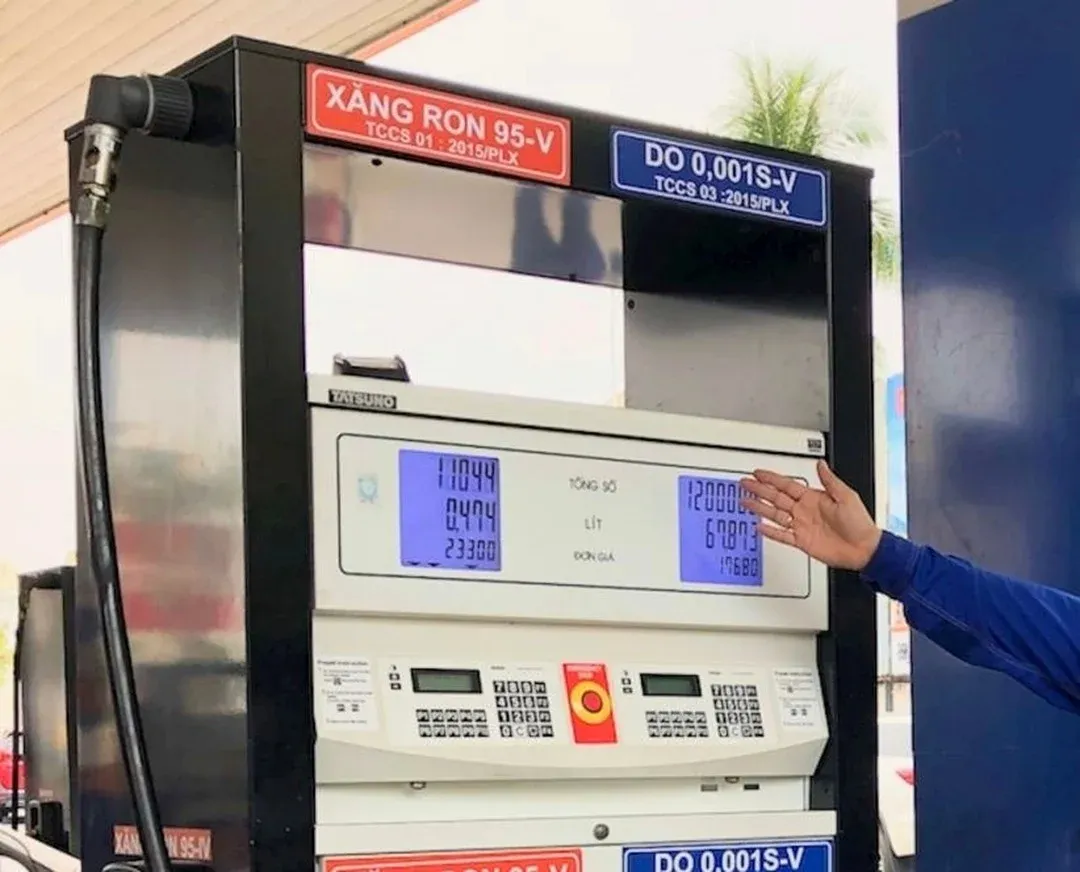
Vietnam imports a significant share of its fuel as finished product, so it absorbs the shock at the refining stage rather than the crude stage. Domestic retail prices are adjusted on roughly a 7-day cycle, tracking the previous period's average world price. At the 3pm pricing update on August 20, diesel rose VND 1,310 per liter, while E5 RON92 gasoline gained only VND 598 per liter and E10 RON95-III gained VND 549 per liter.Petrotimes
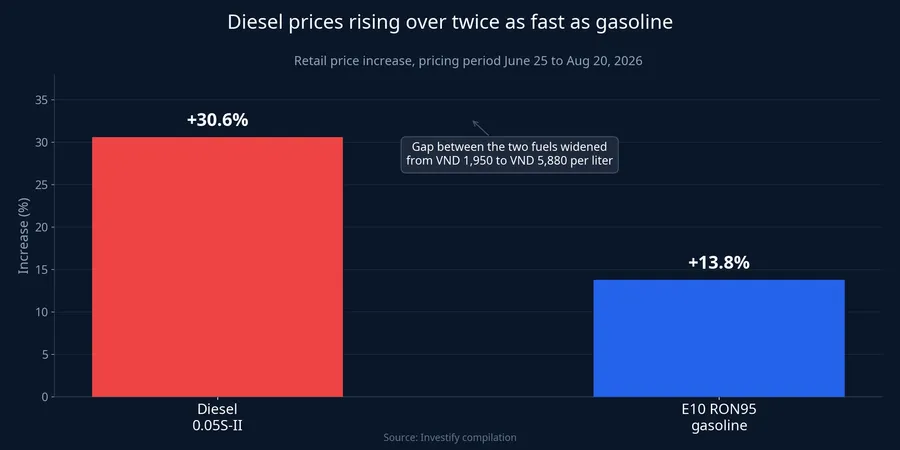
The pricing bulletin noted the average world diesel price for this period rose 6.1% to $160.3 a barrel, and the two ministries neither drew down nor contributed to the Price Stabilization Fund. That means the global shock passed straight through to the pump, with no cushion in between. From the June 25 to August 20 pricing periods, 0.05S-II diesel rose from VND 21,860 to VND 28,540 per liter (+30.6%), while E10 RON95 gasoline rose only from VND 19,910 to VND 22,660 per liter (+13.8%). The gap between the two fuels widened from VND 1,950 to VND 5,880 per liter, nearly tripling in just eight weeks.
Motorbike and car drivers feel the lighter side of this. The heavier burden falls on diesel users: long-haul trucks, container fleets, fishing boats, farm machinery, and industrial generators. Fuel typically makes up 30-40% of total operating costs for freight transport companies, so an increase of this size is enough to push freight rates and feed through into goods prices.

Two paths ahead
There are two scenarios worth watching next week, and the variable that decides between them is the diesel crack spread, not the Brent price.
Cooling scenario: this plays out if the August 24 sanctions package turns out narrower than feared, without secondary sanctions on buyers of Iranian oil, and if Pezeshkian's August 21 remarks are followed by a real round of negotiations. In that case, the risk of a distillate supply disruption eases, ships return to Hormuz, and the diesel crack spread exits triple digits. Watch for: transit counts through the strait climbing back above 91 next week, and the August 27 pricing period bringing a diesel price cut.
Escalation scenario: this plays out if the August 24 package hits Iranian oil buyers and shippers directly, pushing more vessels to avoid the region. In that case, Gulf refining capacity and export flows keep shrinking while US inventories sit at a 30-year low, pushing the crack spread even higher. Watch for: transit counts falling below 73 next week, US distillate inventories breaking below 107.1 million barrels in the next weekly report, and the August 27 pricing period pushing diesel above VND 30,000 per liter.
What both scenarios share: Brent could sit flat around $93 a barrel while Vietnam's domestic diesel price keeps climbing, exactly as it has for the past eight weeks.
Oil and gas stocks react by their position in the chain
This is a cycle where the gains aren't shared evenly across oil and gas names. Refiners benefit most directly when the crack spread widens: BSR, which operates the Dung Quat refinery, posted Q2 2026 profit up 781.2% year-on-year, with shares closing August 21 at VND 26,850, up 16.5% over one month. Distribution benefits indirectly through the absolute margin earned per liter sold, with PLX at VND 37,950 and profit up 113.8% year-on-year. Oil and gas shipper PVT closed at VND 20,450, up 25.5% over one month.
On the other side, drilling services are recovering more slowly than the price cycle: PVD fell 43.2% over three months and sits at VND 18,600, while OIL trades at VND 13,500 with a net loss in the most recent quarter.
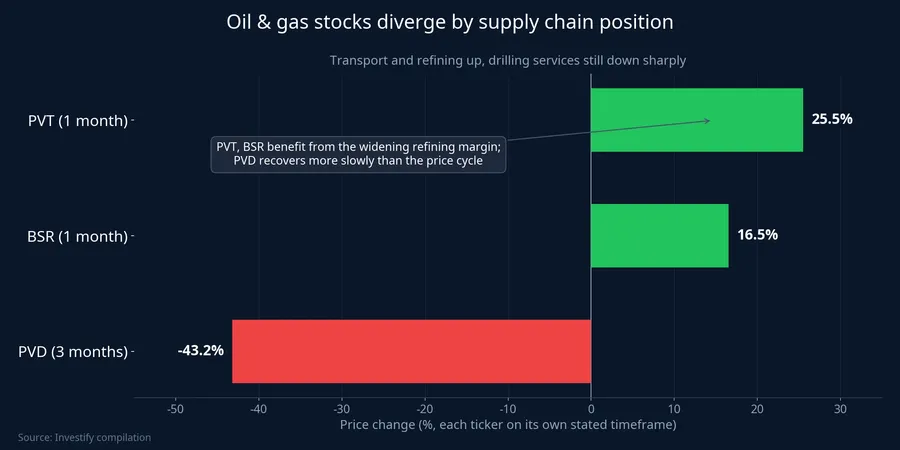
The usual playbook during a widening crack-spread phase favors refining and shipping over technical services, since the latter group only benefits once oil prices stay high long enough to trigger new exploration capex. The biggest risk to this whole thesis is the crack spread cooling on its own: levels above $100 a barrel are unusually high by historical standards and partly seasonal. If distillate supply gets replenished, both retail diesel prices and refiners' margins could come down together.

What to watch next week
The key dates land close together: the US sanctions package on August 24, the EIA's weekly inventory report, and Vietnam's next pricing period on August 27. The number worth reading next week isn't the Brent price, it's the gap between diesel and crude. That's what actually decides the fuel bill for every truck run, every fishing trip, and refiners' margins this quarter.