


Corporation 36 (ticker G36, UPCoM) just approved a VND 252 billion loan contract with Nguyễn Đăng Hùng, brother of chairman Nguyễn Đăng Giáp.Người quan sát The headline number isn't the most notable part. Three attached terms are what investors should read closely: a 9.4% annual interest rate, no collateral, and a term of exactly one month.
For a construction company, a one-month loan can hardly fund a project. Infrastructure and real estate developments run on a scale of years, not weeks. Money that comes in and goes out within 30 days is usually serving a different purpose: plugging a short-term cash gap, covering a maturing obligation, or maintaining a balance for some commitment. This is the detail new investors tend to skip, because the headline figure always looks more striking than the term.

The new loan is bigger than all existing debt owed to the same lender
Hùng is no stranger to G36's balance sheet. As of the end of Q2 2026, the company still owed him VND 55 billion in short-term debt and VND 127 billion in long-term debt, totaling VND 182 billion.Người quan sát In other words, the newly approved VND 252 billion contract is larger than the entire amount the company currently owes this one person. Against G36's total loans and finance lease liabilities of approximately VND 924 billion as of June 30, 2026, a single contract now equals more than a quarter of the company's total borrowing.
The maturity structure also shows where the pressure sits. At the end of 2025, G36's outstanding debt reached nearly VND 999.9 billion, of which VND 672.8 billion was short-term, or 67.3%. By mid-2026, the short-term share had fallen to 55.2% as the company shifted part of its debt to longer terms. Reducing the short-term ratio is a genuine improvement, but it doesn't erase the fact that the company still has to roll over each maturing obligation with fresh borrowing. The newly approved VND 252 billion contract is the latest example.
Interest is eating up the entire profit
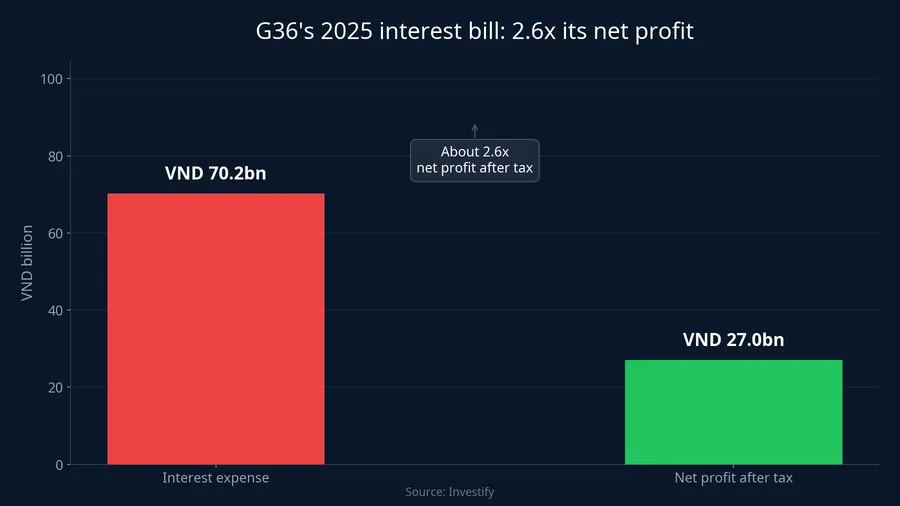
This is the number that matters most. In 2025, G36's interest expense was VND 70.25 billion, while full-year net profit after tax was only VND 27.03 billion.Nhà đầu tư Interest paid ran about 2.6 times the profit retained. With debt hovering around VND 900 billion to VND 1,000 billion, every percentage point change in interest rates flows straight into the bottom line.
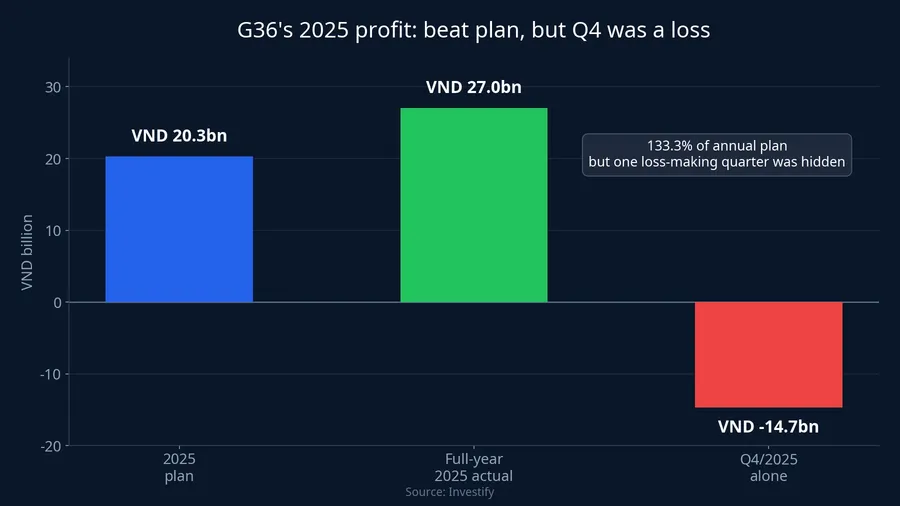
The VND 27.03 billion profit figure for 2025 was described in financial media as 133.3% of the annual plan, and new investors easily stop at that flattering ratio. But the plan the company set for itself for 2025 was only VND 20.27 billion in net profit after tax, on a charter capital base of VND 1,037.45 billion.Nhà đầu tư Beating a low bar isn't the same as the business improving.
A detail that got less attention sits in the final quarter: Q4 2025 alone posted a net loss of VND 14.72 billion despite quarterly revenue of VND 751.46 billion, due to a profit decline at subsidiary BOT 36.71.Nhà đầu tư The full year stayed positive only because the first three quarters carried it. A flattering annual total can mask a loss-making quarter right before an investor makes a decision.
In the first half of 2026, G36 posted VND 441 billion in net revenue and net profit after tax of nearly VND 19 billion, not even a quarter of the VND 1,948.97 billion in revenue for full-year 2025.Người quan sát Looking further back, G36's revenue in 2015 was around VND 3,800 billion, meaning the company has shrunk by more than half over a decade.
The one-month loan's hourglass

What the financial statements don't yet say is where this VND 252 billion goes over the next 30 days. If it's repaid on schedule as the contract states, that's a sign G36's cash flow can right itself after a short stumble. If it's rolled over, or replaced with a similar new contract, that's a sign the company is becoming dependent on family capital to maintain liquidity, no longer a one-off situational fix.
The chairman's family is tied to G36 on both sides: ownership and lending. Chairman Nguyễn Đăng Giáp holds 17,886,131 shares, equivalent to 17.24% of capital, making him the largest individual shareholder and second only to the Ministry of National Defense's 18.38% stake. Hùng holds 1.58%. Combined, members of Giáp's family own more than 27.1 million G36 shares, worth roughly VND 240 billion at market price.Người quan sát
Two funding channels, two different levels of trust
Relying on a leader's personal assets isn't new for this company. In August 2022, G36 disclosed pledging 12.54 million shares owned by Giáp to secure a bank loan.Tin nhanh chứng khoán In October 2023, the company pledged another 5 million of Giáp's shares to BIDV's Hoàn Kiếm branch.Tin nhanh chứng khoán
Placing these two funding channels side by side reveals the most telling point: when borrowing from a bank, G36 has to put the chairman's personal shares up as collateral; when borrowing from family, the company needs no collateral at all. That gap in terms shows which side is pricing G36's risk more tightly.
How the market is pricing G36
G36 shares closed the August 21 session at VND 8,900, valuing the company at roughly VND 923 billion, meaning the market is pricing the entire business at close to the amount it currently owes in debt. The price has fallen about 30% from around VND 12,800 in early February 2026, bottoming at VND 8,500 on July 22 before trading sideways.
More notable than the price is liquidity: average trading volume over the last 20 sessions is just 43,740 shares a day, about a quarter of the six-month average of 173,013 shares. With a free float of only about 0.60 and zero foreign ownership, a sell order of a few hundred thousand shares is enough to move the price.
On valuation, G36's P/B sits around 0.97x, trading close to its book value of VND 10,559 per share. P/E is nearly unusable: Q2 2026 EPS was only VND 27.89, pushing the ratio to 365.7x. When profit is thin and erratic, P/E loses its meaning and P/B is the more reliable gauge in this case.
Four questions to ask about any related-party loan
Borrowing from someone connected to leadership isn't itself a violation. Law permits it, and in many cases it's a faster, cheaper source of capital than a bank. The issue is reading what the transaction actually reveals, through four questions that apply to any listed company with a similar deal.
First, how long is the term: a long term tied to a specific project usually signals real investment capital, while a one-to-three-month term is almost always a cash-flow patch. Second, is there collateral, and how does that differ from a bank loan of the same period. The gap between the two channels shows how the bank views the company's credit profile. Third, does the transaction repeat: a single instance is situational support, while repeated deals over several years with rising balances signal the company has grown accustomed to this funding source instead of generating its own cash flow. Fourth, how does interest expense compare with profit: when interest paid runs several times net profit after tax, most of the value the business creates is flowing to creditors, and shareholders only get what's left.
Signals to watch
Given the current profile, G36's discount to book value isn't automatically a buying opportunity. Among thinly traded small-cap names on UPCoM, a P/B below 1x more often reflects liquidity risk and earnings risk than genuine cheapness. A cautious approach to a profile like this is to place the stock in the high-risk bucket of a portfolio rather than the value bucket, until more data arrives.
Three upcoming data points will answer the question better than any guess right now: the Q3 2026 financial report will show whether the VND 252 billion loan was repaid within the month as contracted or rolled over; the related-party transaction disclosure will show whether the balance owed to Hùng keeps rising or comes down; and cumulative interest expense will show whether the financial burden has eased from the VND 70.25 billion recorded in 2025. These three figures, not short-term share price moves, are the real basis for reassessing G36's risk profile.