
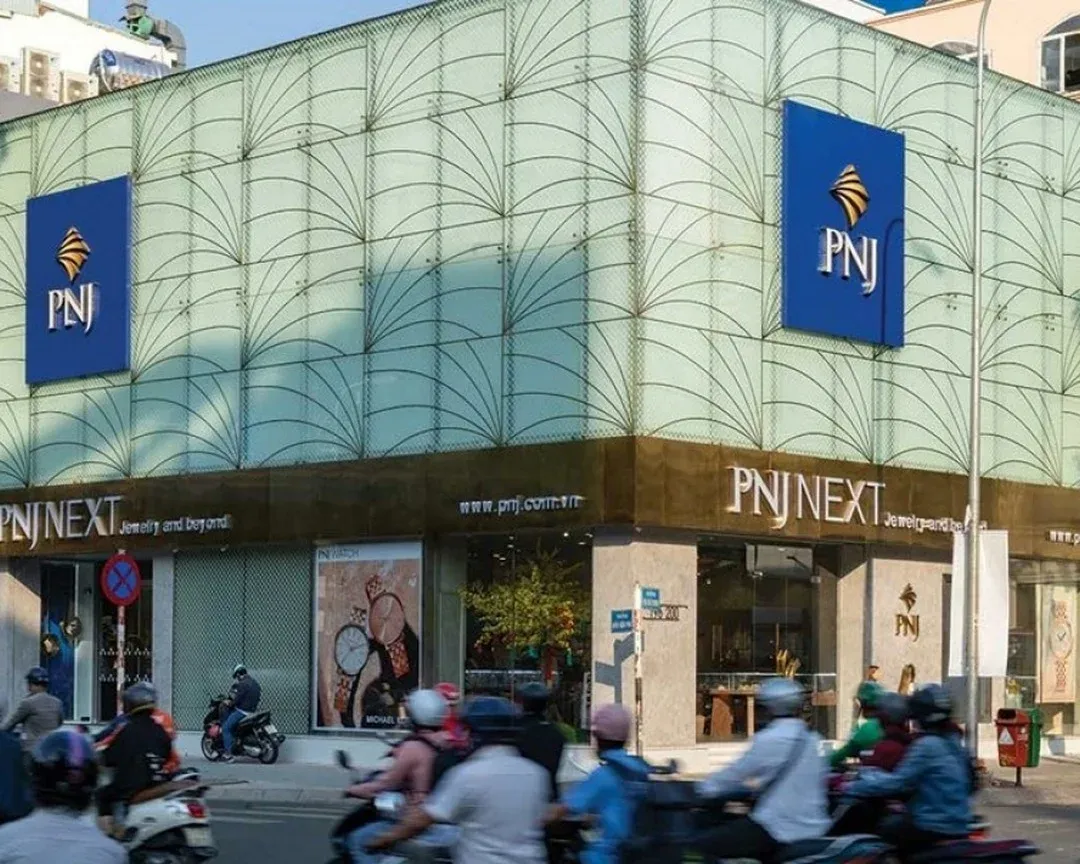

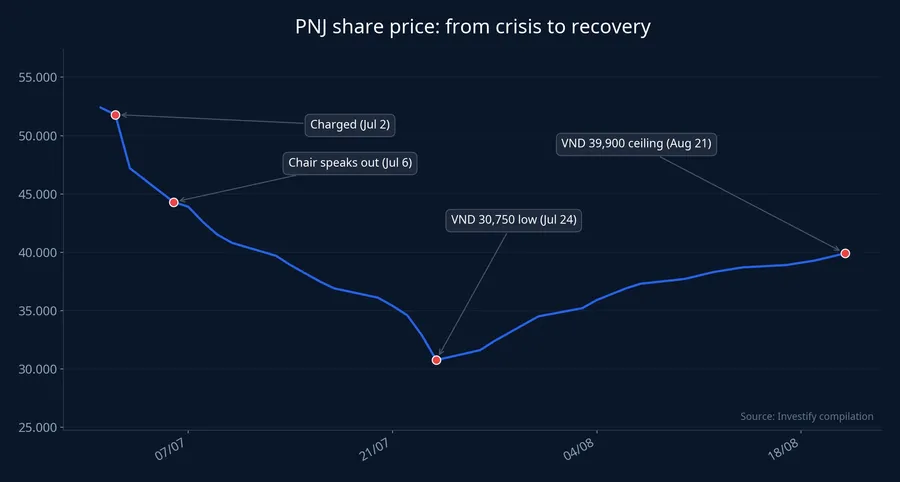
On July 6, Cao Thi Ngoc Dung, Chairwoman of Phu Nhuan Jewelry (PNJ), told investors that the diamonds tied to a smuggling ring never entered the company's system. PNJ still hit its daily floor that same session, closing at VND 54,600.VnExpress On August 20, Thanh Hoa provincial police issued a statement with almost identical content. At the open on August 21, PNJ hit its daily ceiling at VND 39,900, its highest level in over a month.Mekong Asean
Seven weeks separate those two reactions. The content barely changed; only the source did. That gap is worth sitting with, because it says something uncomfortable about how markets price legal risk: not by what is said, but by who is saying it.
One name on a list of 22 defendants
On the night of July 2, Thanh Hoa police announced they had broken up a cross-border diamond smuggling ring, charging 22 defendants and seizing 1,100 diamonds, with total revenue from diamonds already sold estimated at around VND 280 billion.Tuoi Tre On that list was Dang Ngoc Thao, then director of PNJ Gemological Laboratory (commonly known as PNJ-LAB or P-Lab), a unit under PNJ.
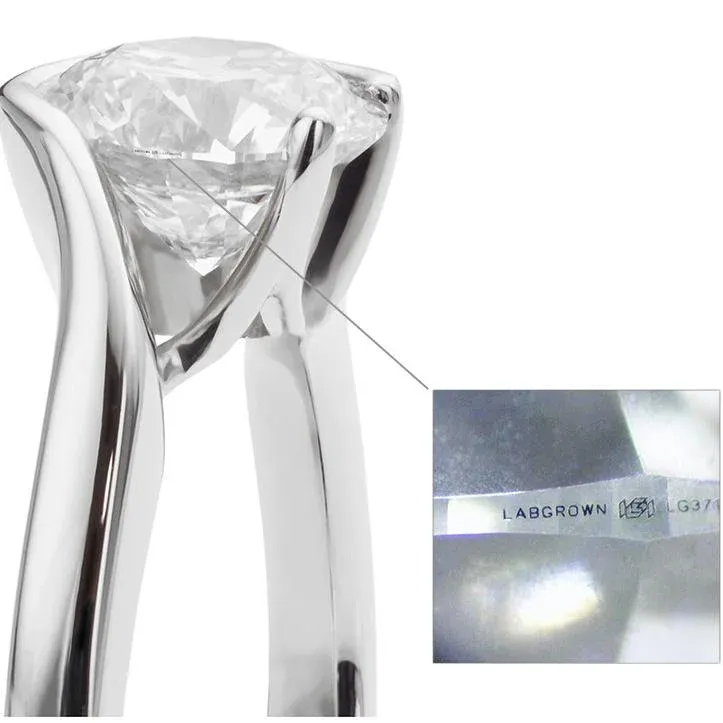
The allegation hit the jewelry industry's most sensitive nerve. Investigators say Thao used his professional expertise to grind off the original GIA serial numbers laser-inscribed on diamonds, re-engrave them with PNJ-LAB codes, then issue new grading certificates before selling the stones to customers. For a diamond, the grading certificate accounts for most of its commercial value. Once the very lab that issues those certificates comes under suspicion, the question stops being about one individual and spreads to every product carrying that brand.
What a financial statement or a corporate press release couldn't answer in that moment was whether the certificate itself could still be trusted. The market reacted exactly as an unanswered question would predict. PNJ closed July 2 at VND 63,100, then hit its floor for two straight sessions, down to VND 58,700 and then VND 54,600.
The company spoke. The stock didn't listen.
On the morning of July 6, PNJ management met with investors. Dung stated that all of PNJ's diamond imports went through official channels, mainly from suppliers in Thailand and Hong Kong, and said P-Lab had no trading function of its own, purely a certification service unit. The only relationship between parent and subsidiary was a service contract, not a buy-sell arrangement.VnExpress
That statement turned out to match, almost word for word, what investigators would confirm seven weeks later. But on July 6, buyers of the stock had no way to verify it, and sellers had a simple reason not to wait: the party making the claim was also the party that stood to lose the most if the claim was wrong. A listed company cannot serve as referee in a case involving itself, no matter how accurate its statement turns out to be. Trading volume on July 6 was thin, just 635,300 shares, and the price stayed pinned at the floor.
A conflicting finding in the same investigation
What turned selling pressure into a rout came from the same case, but at a different company. On July 22, Thanh Hoa police said they had charged four more defendants with smuggling and seized another 354 diamonds worth roughly VND 68.8 billion. Preliminary findings showed that from 2022 to 2024, the ring funneled more than 3,400 smuggled diamonds, valued at over VND 500 billion, into the retail system of Saigon Jewelry Company (SJC).Ministry of Public Security

For anyone holding PNJ, this was close to the worst possible headline. It showed that "smuggled goods reaching a retail network" wasn't a hypothetical risk on paper; investigators had already established it at another jeweler in the very same case. That risk stopped being speculation and became precedent. From July 21 to 24, PNJ hit its daily floor for four consecutive sessions, falling from VND 41,000 to VND 30,750, a 25% drop. On July 24 alone, 41.6 million shares changed hands.
Risk leaves the stock price and lands in the financials
By the end of July, the damage moved from the share price to the balance sheet. PNJ reported a net loss of nearly VND 283 billion for the second quarter of 2026, even as net revenue rose almost 12% to VND 8,484 billion, after the company set aside a VND 865.5 billion provision to cover diamond buyback obligations.VietnamNet
The path a confidence crisis takes into a company's books isn't falling revenue; it's buyback obligations on goods already sold. When customers rush to return products en masse, a company has to pay cash out and take inventory back in. That's the real, unrecoverable cost of a trust crisis, unlike a stock price swing that can reverse in a single session. PNJ said that starting July 21 it shifted its buyback process to staged payments spread over up to 120 days, and that roughly 95% of customers subsequently chose to exchange for other products rather than take a refund.VietnamNet
Institutional money moved before the conclusion did
Before investigators released anything, two groups of institutional investors had already acted. A group of four funds tied to T. Rowe Price Associates bought 525,300 shares on August 13, lifting their combined stake to 5.07%. A group of five funds managed by Sprucegrove Investment Management bought roughly 1.63 million shares on August 14, raising their stake from 4.72% to 5.04% and crossing into major-shareholder status.Mekong Asean
Over the same stretch, Phan Quoc Cong, Board Member and CEO of PNJ, completed the purchase of 1 million shares between July 31 and August 14, raising his direct stake from zero to 0.2% of the company at a cost of roughly VND 36 billion at market price.Vietstock It's worth noting that these trades happened before the investigation's conclusion was public. Neither the foreign funds nor the company insider had privileged access to that conclusion; they were betting on their own read of the odds, not on inside information. Still, that flow of capital is a signal worth noting for retail investors, not one worth blindly copying.
A third party finally weighs in
On August 20, after commissioning the Ministry of Public Security's Institute of Criminal Science to examine the evidence, Thanh Hoa police said they had a full forensic conclusion on all the stones seized in the case, identifying the evidence as a mix of natural and lab-grown diamonds.
Two details in that statement were exactly what the market had been waiting seven weeks for. First, investigators determined that the smuggled diamonds Thao sold went to individual customers, not into PNJ's retail system, and that Thao personally profited from the proceeds. Second, specific to PNJ itself, investigators reviewed the company's diamond import records and found it held complete import documentation, with import and distribution processes that were tightly controlled and compliant with the law.Nhan Dan
None of this was new information: it was almost exactly what Dung had said on July 6. What changed was who was saying it, and that turned out to be the only variable that mattered across those seven weeks.
The August 21 session, and what's still open
At the open on August 21, PNJ was bid straight up to its daily ceiling of VND 39,900, up 6.97% from the reference price and its highest level in over a month. From its July 24 low of VND 30,750, the stock has now recovered nearly 30%.
The investigation's conclusion wasn't the only factor behind that rally. The recovery had already begun: PNJ rose 4.48% on August 20, before the police statement was released, and institutional buying alongside the CEO's own purchases had been building since mid-August. The price base had also been deeply discounted after losing 25% in just four sessions. But the fact that the stock shot straight to its ceiling at the open, in the very session right after the announcement, suggests most of that day's buying pressure came from the conclusion itself, with the other factors serving as a floor underneath it.
Three things remain unresolved. Thanh Hoa's Investigation Police Agency says it is still expanding the probe, reviewing related individuals and tracking down more smuggled diamonds, so further findings remain an open question. The VND 865.5 billion provision booked in the second quarter is a real cost that no announcement can reverse. And August 25 is the record date for shareholders to be eligible for an extraordinary general meeting expected in October, where management will present a revised 2026 business plan against the original targets of VND 48,660 billion in revenue and VND 3,409 billion in after-tax profit.Vietstock
In other words, the corporate-level legal risk has just been substantially narrowed by investigators, but the business risk has not. With the stock still down 36.8% from the VND 63,100 close on July 2, the next data point worth watching isn't the daily trading band. It's the revised numbers PNJ presents at October's shareholder meeting, the first time the company will have to put a figure on exactly how much these seven weeks cost 2026.