


The number everyone quoted after Vietnamese banks' mid-year earnings season was the rise in bad debt: group 3-5 bad debt across 27 listed banks reached VND 310 trillion by June 30, 2026, up nearly VND 48 trillion from the end of 2025.Vietbao
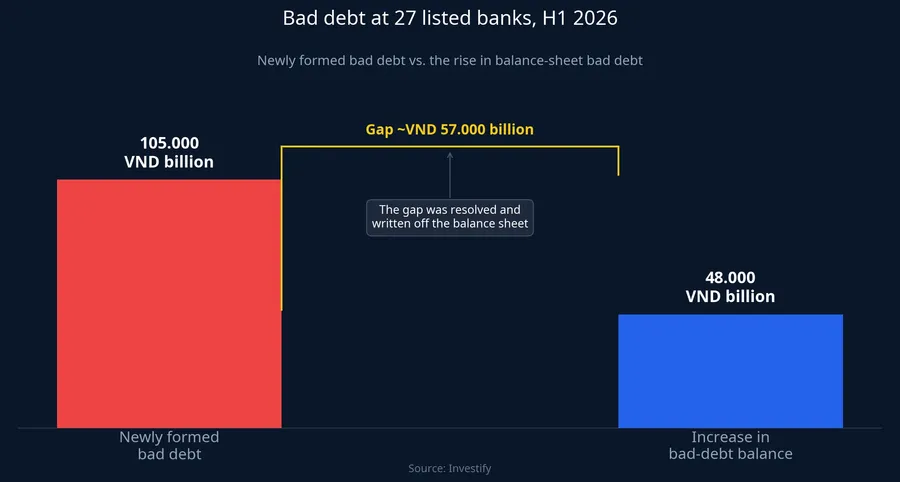
Looking at that figure alone, it's easy to assume bad debt only crept up by VND 48 trillion in six months. It didn't. That VND 48 trillion is just the net change between two balance-sheet snapshots; the bad debt actually generated during the period was far larger, over VND 105 trillion in newly formed bad debt, equivalent to roughly 0.68% of total credit outstanding.Doanhnhanvn The nearly VND 57 trillion gap between the two figures is the bad debt that was already written off the balance sheet during the period. The bad-debt conveyor belt is running at more than twice the pace the period-end balance suggests. Understanding this two-way mechanism is the key to a bigger question: why did the industry's average coverage ratio fall even as most banks raised their provisions?
Provisions get used up as fast as they're built
Loan-loss provisions aren't a reserve that only grows. They're topped up by quarterly provisioning expense and drawn down every time a bank uses that same reserve to write off a bad loan and move it off the balance sheet.
State Bank of Vietnam (SBV) data shows the scale of the drawdown side: in the first half of 2026, the banking system resolved VND 141.4 trillion in bad debt, down 17.5% year-on-year, of which VND 88.02 trillion, or 62.2%, was resolved using loan-loss provisions.Vietbao

Two details here explain almost the entire thin-buffer story. Nearly two-thirds of resolved bad debt was covered by provisions rather than by borrowers actually repaying or banks recovering collateral, so the period-end provision balance grew far more slowly than the expense banks booked. At the same time, total resolution volume fell versus a year earlier: inflow accelerated while outflow slowed, and the gap piled up on the balance sheet as a rising bad-debt balance.
More provisioning still couldn't hold the coverage ratio
This is the easiest place to misread this earnings season. A thinner buffer doesn't mean banks stopped provisioning. In H1, Vietcombank's provision balance grew 20% to VND 29,984 billion, MB grew 26.7% to VND 16,663 billion, VPBank grew 22.7% to VND 21,395 billion, OCB grew 27.6% to VND 4,562 billion, and HDBank grew 26% to VND 9,197 billion.Vietbao
The problem is the denominator: bad debt outgrew provisioning at most banks. ABBank's bad debt grew 62%, TPBank 59%, HDBank 38%, BIDV 31%, and MB 27%, all in six months.Vietbao As a result, the coverage ratio, provisions divided by bad debt, fell at most banks in the survey: VietinBank from 159% to 134%, BIDV from 100% to 76%, TPBank from 92% to 67%. Industry-wide, the average ratio slipped from roughly 83% at the end of 2025 to roughly 79% by the end of Q2 2026, according to Wigroup data.Vietnambiz
For newer investors, the simplest way to read a 79% coverage ratio: for every VND 100 of bad debt on the books, the bank has only set aside VND 79 to absorb losses. If the remaining VND 21 is actually lost, it comes straight out of future quarters' profit.
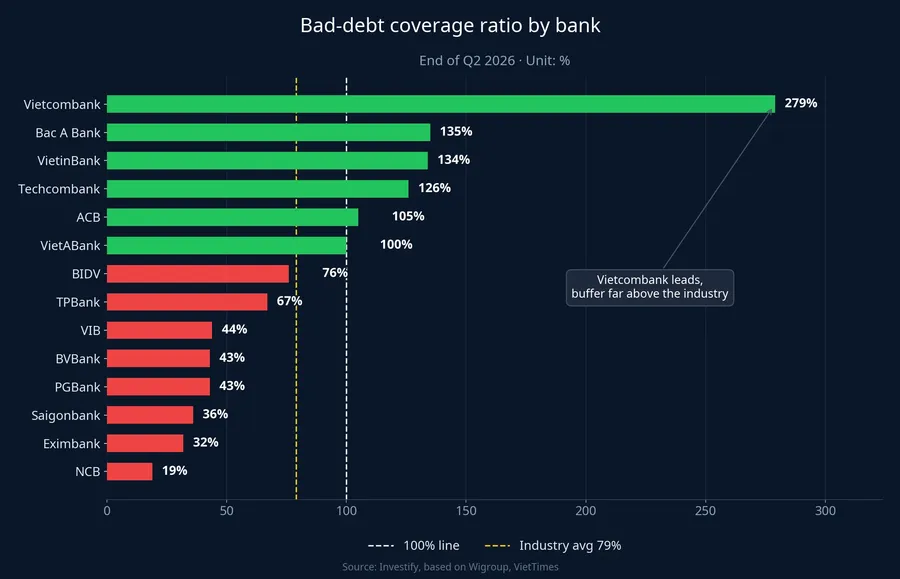
The spread between banks on this metric is wide. Only six names still hold a coverage ratio of 100% or above: Vietcombank at 279%, Bac A Bank at 135%, VietinBank at 134%, Techcombank at 126%, ACB at 105%, and VietABank at 100%. At the other end, VIB sits at 44%, PGBank and BVBank both at 43%, Saigonbank at 36%, Eximbank at 32%, and NCB at 19%.
Where the risk is concentrating
New bad debt isn't spreading evenly. Per SBV data released August 14, real-estate bad debt rose 10.5% from the end of 2025 through the end of June 2026, while real-estate credit outstanding reached VND 5,146 trillion, up 8.3% and accounting for 25.5% of total system-wide credit.VnEconomy Bad debt growing faster than the loan book means the real-estate portfolio's underlying quality is deteriorating, not just expanding in scale.

Retail lending is the second source: a new, higher floor for lending rates is straining borrowers' repayment capacity, especially in the retail segment.Doanhnhanvn Dr. Chau Dinh Linh, a lecturer at Ho Chi Minh City Banking University, points to two parallel causes: bad debt rising naturally alongside credit expansion, and pre-existing hidden bad debt gradually surfacing.Vietbao The first explanation has some merit, since system-wide credit outstanding reached VND 20.26 quadrillion by July 31, 2026, up 8.98%. But it doesn't explain everything: the survey group's average bad-debt ratio still rose from 1.85% to 2.01%, meaning bad debt is outrunning credit growth rather than tracking it, on top of a 17.5% slowdown in debt resolution.
Why this story doesn't end at mid-year
A thinner buffer creates a very concrete constraint for the next two quarters: writing off debt to clean up the balance sheet requires matching provisions, building provisions requires provisioning expense, and provisioning expense comes straight out of pre-tax profit. Analysts at Rong Viet Securities expect provisioning pressure to intensify in H2 2026, becoming the single biggest risk to sector profit growth, particularly for banks with coverage ratios below 60%.Vietbao
Notably, bank stock prices this year haven't tracked banks' static bad-debt ratios. Sacombank has the highest bad-debt ratio in the survey group, at 7.54%, and the largest absolute bad-debt balance in the system at VND 47,957 billion, yet STB shares are up 28.97% year-to-date through the August 19 session. SHB, by contrast, has a bad-debt ratio of just 2.07% with bad debt up only 5% over six months, yet its shares are down 28.64% over the same period, while the VN-Index fell roughly 3.24%.
A more useful read: the market is pricing the trajectory of asset quality, not the absolute level at a single point in time. Sacombank has built its provisions up to VND 27,177 billion, equivalent to 4.27% of gross loans, the thickest buffer among large banks, and its bad debt has already fully surfaced on the books and is being worked down. For banks with coverage below 60% where new bad debt is still climbing, the hardest part may still lie ahead.
Asset quality isn't the only factor driving bank share prices this year. Starting valuations, individual stock liquidity, and company-specific stories like capital raises or divestments all play a role. But when two stocks in the same sector diverge by nearly 58 percentage points over eight months, asset quality is one of the few variables powerful enough to produce a gap that size. In the August 20 session, the VN-Index rose 0.44%, with bank stocks recovering fairly broadly, but that short-term bounce says nothing about asset quality. Q3 earnings season is the next real test.
What to watch in Q3 earnings
For investors already holding bank stocks, the most practical framework isn't comparing profit figures. It's comparing the pace of the two sides of the bad-debt machine.
Start with the quarterly trend in coverage ratio: direction matters more than the absolute level. A bank moving from 76% to 85% is getting healthier; one moving from 105% to 90% is getting weaker, even though the latter number is still higher. Next is the pace of group-2 debt formation, the "special mention" category that feeds bad debt two to three quarters out. A less-discussed metric is the relationship between loan growth and provision growth: if loans grow at a double-digit pace while provisions stay flat, the buffer is thinning in relative terms even before the bad-debt ratio itself worsens. Finally, watch the recovery rate on debt already moved off-balance-sheet, income that flows straight to other income and offsets provisioning costs without touching core profit.
A conservative allocation framework right now favors banks with a coverage ratio above 100% and provisions growing at least as fast as loans, while trimming exposure to banks with coverage below 60% until Q3 results confirm a reversal. The specific weighting depends on each investor's risk appetite and portfolio structure.