

Retail investors tend to hold an almost default belief: a company that's thriving, with profit multiplying, gets rewarded with a higher price once it lists. That belief isn't wrong in principle. Over the long run, share prices do track earnings. But the newly listed cohort of the past year is telling a different story, and the loudest counter-example comes from the very group with the cleanest financial statements.
31 new listings, and the gap between the two ends is too wide to ignore
Between August 2025 and August 2026, Vietnam's stock market welcomed 31 new listings with combined market capitalization of over VND 450 trillion: 8 on HOSE and 23 on UPCoM.Thuong Truong As of August 13, 2026, among the 29 stocks that have started trading, 19 sit above their listing reference price and 10 sit below. A 19-to-10 split sounds comfortable, but the real issue is the gap between the two ends, not the headcount.
The biggest gainer is RGG on UPCoM, up roughly 278% from its first-day reference, nearly 3.8x its starting point.Thuong Truong F88 gained 173.8%. At the other end, VBT of Van Tai Bao Thang lost about 69% of its value, CCS dropped over 40%, and GDH lost nearly 40%. If earnings quality were the deciding variable, the most profitable companies should sit at the top of that range. In practice, the opposite is true. That's worth unpacking.
The three biggest newcomers all posted strong profits, and all have the worst prices
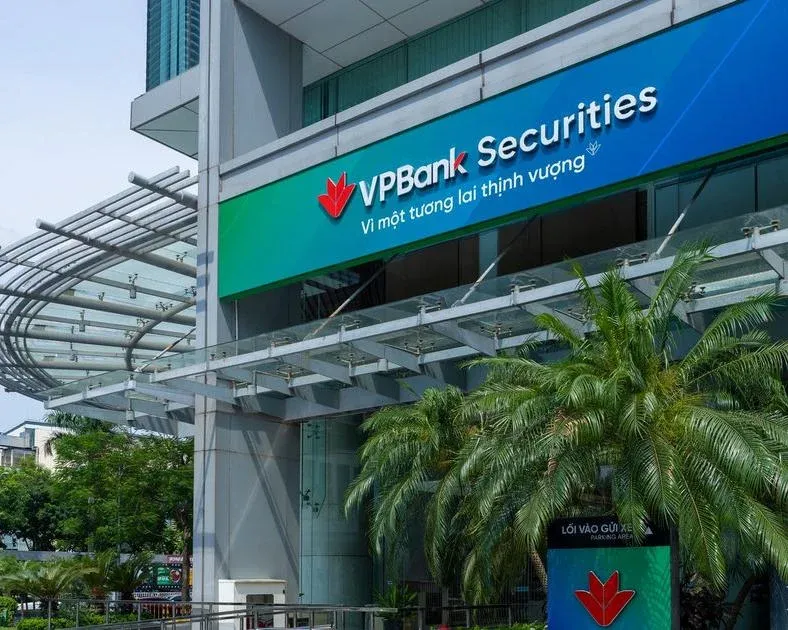
Among the four largest-cap newcomers, three are brokerages: TCBS (ticker TCX), VPS (ticker VCK) and VPBankS (ticker VPX), all of which began trading in the final months of 2025.Thuong Truong Their operating results rank among the strongest in the market. VPBankS posted Q2 2026 pre-tax profit of VND 2,159 billion, 4x year-on-year, bringing first-half profit to nearly VND 2,700 billion. VPS booked VND 2,925 billion in six-month pre-tax profit, up 63%. TCBS reported VND 3,555 billion, up 17%.
Yet as of August 13, 2026, share prices tell the opposite story: VCK is more than 21% below its first-day reference, VPX is down over 25%, and TCX is up just under 4%. What the financial statements don't say out loud: quadrupled year-on-year profit and a price a quarter below the opening day can both be true at the same time.
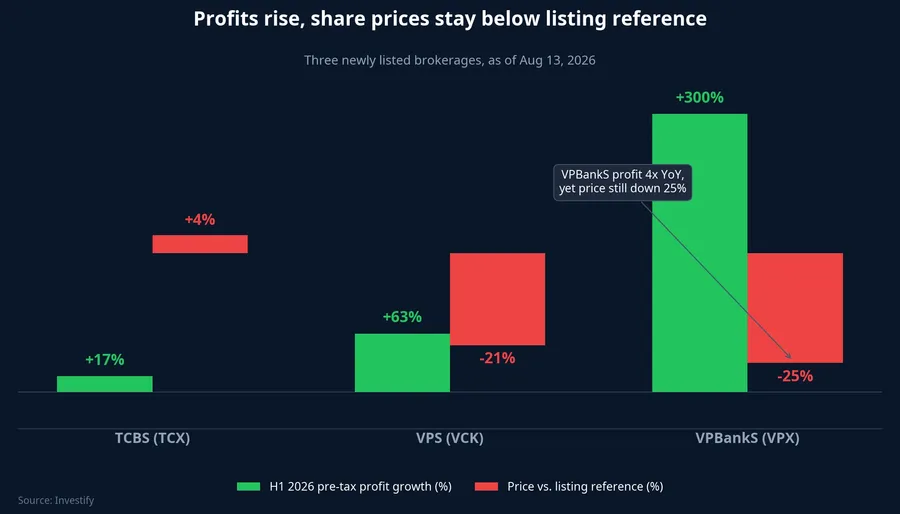
By mid-morning on August 19, TCX was trading at VND 39,400, VCK at VND 29,200 and VPX at VND 24,550 (Investify internal data). VPX in particular listed on December 11, 2025 at a reference price of VND 33,900 and closed its first day at VND 30,800, a 9.14% drop on debut day itself.Bao Dau Tu
It's not the broader market dragging them down
The easiest explanation is that the broader market fell and newcomers fell with it. The index data doesn't support that reading. On October 21, 2025, when TCX listed, the VN-Index closed at 1,663.43 points. On December 11, 2025, when VPX listed, the index stood at 1,698.90 points. On December 16, 2025, when VCK listed, the index was at 1,679.18 points. By mid-morning on August 19, 2026, the VN-Index was trading around 1,722 points, down a modest 0.55% intraday (Investify internal data).
In other words, the index today sits above all three listing-day levels. A broader market that hasn't fallen cannot explain a 21-27% loss in three specific stocks. The real risk sits closer to these names themselves, not in VN-Index volatility.
Listing prices already priced in the growth
The first explanation starts with the opening price itself. TCX listed on October 21, 2025 at a reference price of VND 46,800, valuing the company at over VND 108 trillion on day one, with the offering oversubscribed 2.5 times.VnEconomy A price set in that kind of atmosphere already carries the growth story of the years ahead. When actual profit lands exactly as expected, the price has no reason to move further, because that move was already paid for in advance.
This is the core difference between a freshly listed stock and one that has traded for years. With an established stock, the market has had years to find a fair price. With a new listing, the opening price is proposed by the seller and its advisors, typically at the exact moment the company's story is being told in its most persuasive version.
The group's core revenue is shrinking
The second explanation cuts sharper, and it applies specifically to the brokerage group. A brokerage's brokerage-fee income and margin lending book depend directly on the market's daily trading value. That figure is falling visibly.
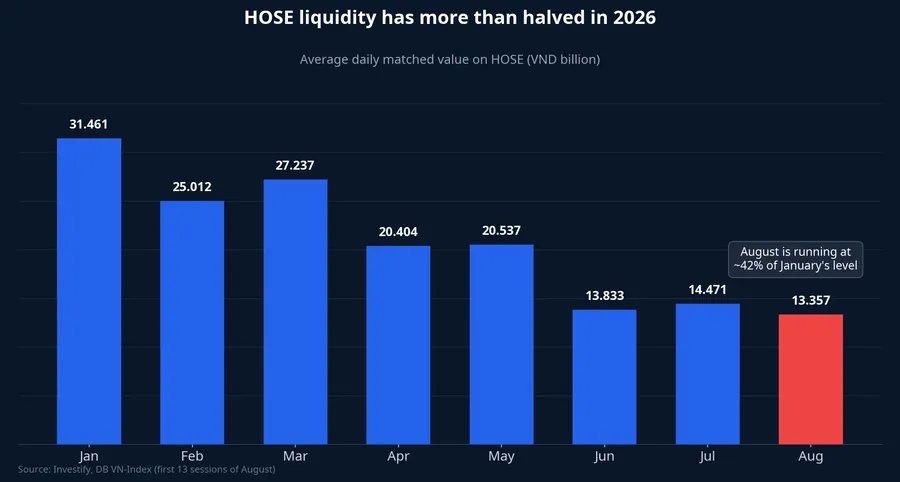
Average daily matched value on HOSE reached VND 31,461 billion in January 2026; over the first 13 sessions of August 2026 it averaged just VND 13,357 billion (Investify internal data), less than half. The Q3 peak was July, at VND 14,471 billion per session, and August is running about 7.7% below that.
There's a timing mismatch new investors easily miss: profit looks backward, while share price looks forward. Brokerages' first-half 2026 profits were generated while liquidity was still at a high plateau. Today's share price, by contrast, is discounting the liquidity plateau of the quarters ahead. When those two planes diverge, a clean earnings report and a falling share price can coexist without any contradiction.
One more factor deserves to be named rather than skipped: the supply of new shares. A steady stream of new listings hitting the market while capital inflows shrink adds further pressure on valuations. Brokerages themselves are among the most active issuers right now. These causes act together; none of them alone explains the full picture.
The multi-bagger group isn't playing on the same field as TCX or VPX
So what about RGG or F88, the multi-baggers? The honest answer is that they don't share the same conditions as the large-cap newcomers. Most of the biggest gainers sit in small-cap UPCoM names, where many companies carry market caps of just tens to a few hundred billion dong, free float is thin, and daily trading bands are wider than on HOSE. At that scale, a modest amount of money is enough to multiply the price. A stock worth over VND 100 trillion needs capital inflows several orders of magnitude larger just to nudge a few percentage points. Comparing returns across these two groups and drawing conclusions about business quality is comparing the wrong units.
Even on HOSE itself, the picture is far more modest than multi-bagger expectations suggest. HPA of Hoa Phat Agriculture Development listed in February 2026 at an adjusted reference price of VND 39,610; by mid-morning on August 19 it traded at VND 27,400, down about 30.8% (Investify internal data). GEL of GELEX Infrastructure once climbed to VND 34,550 on its first day and now trades around VND 29,100, nearly back to its starting point (Investify internal data). Dien May Xanh listed on August 6 at VND 80,000, touched VND 88,500 on August 17, and pulled back to VND 81,100 by mid-morning on August 19 (Investify internal data), despite reporting first-half pre-tax profit of VND 6,094 billion, up 72%.
A reading frame for LPS and Kafi
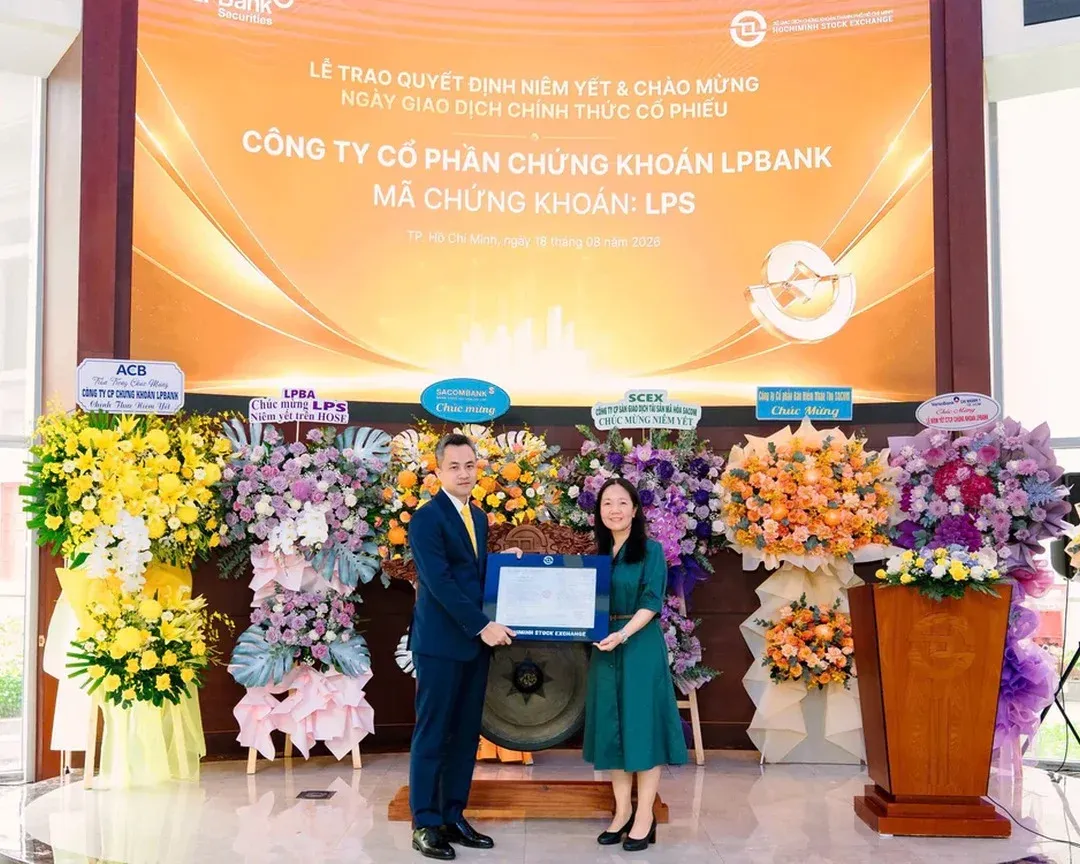
This story isn't finished, because new supply keeps arriving. On August 18, over 1.4 billion shares of LPS from LPBank Securities began trading on HOSE at a reference price of VND 30,000, valuing the company at an estimated VND 42 trillion-plus.Dan Viet The stock closed its debut session at VND 31,800, up 6% and without hitting the daily limit.Bao Moi The company posted nearly VND 575 billion in after-tax profit for the first half, 2.3x year-on-year, having completed about 42% of its full-year profit plan.
Kafi Securities is also preparing to offer 125 million shares to the public at a minimum price of VND 15,000, aiming to raise at least VND 1,875 billion, of which about VND 1,312 billion is earmarked for margin lending.Tin Nhanh Chung Khoan What both deals share is that most of the capital raised flows into margin lending, and margin lending capacity expands or contracts with the market's own trading value. In other words, investors buying these stocks aren't just buying first-half results. They're betting on where HOSE liquidity settles over the coming quarters.
For a freshly listed stock, profit growth is a necessary condition, not a sufficient one. The rest of the outcome hinges on two questions: how much of that growth the listing price already paid for, and whether the company's core revenue depends on a variable that's currently shrinking. The evidence so far isn't enough to say which of the two trajectories seen in TCX, VCK and VPX will apply to LPS or Kafi. A reasonable level of caution is to wait for at least one earnings cycle after listing, checking actual profit against the new liquidity plateau, rather than buying into the atmosphere of debut day.
The specific signal worth watching this quarter: whether HOSE's average daily matched value climbs back above VND 20 trillion, or keeps hovering around VND 13 trillion as it is now.