


On the balance sheet of Công ty Cổ phần S.P.M (SPM), a pharmaceutical company listed on Vietnam's HoSE, as of June 30, 2026, two line items stand out. The first is cash and equivalents: under VND400 million, less than the price of a small apartment.Nguoi Quan Sat The second is undistributed after-tax profit: VND456 billion, plus VND211 billion in share premium, roughly VND670 billion accumulated over years that the company has never paid out to shareholders.Nguoi Quan Sat
Nearly VND670 billion in retained profit, and under VND400 million in cash. That gap is exactly what SPM's semi-annual review report just laid bare, and it isn't visible in the headline profit line most investors skim past.

A profit figure reversed within weeks
When SPM filed its self-prepared Q2 results, it reported net revenue of VND56.7 billion, gross profit of VND21.3 billion, and after-tax profit of VND8.8 billion.Nguoi Quan Sat Cumulative H1 profit came to over VND12 billion, up nearly 66% year-on-year. Taken at face value, that reads like a small pharma name in solid recovery.
The subsequent review report told a different story entirely: H1 after-tax profit came in at just over VND1.8 billion, down almost 85% from the self-reported figure.Nguoi Quan Sat Growth of nearly 66% turned into a decline of 43%.
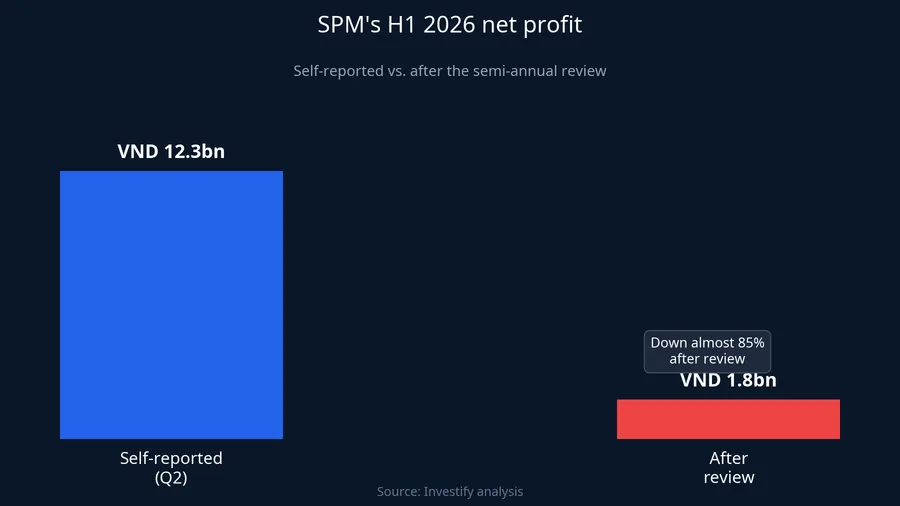
What the report doesn't spell out upfront is what actually changed between the two filings. Revenue didn't change. Cost of goods sold didn't change. The company didn't lose a single contract in that window. What changed was a line item that comes from estimation, not from counting cash: the provision for hard-to-collect receivables.
Per an explanation from SPM CEO Nguyen The Quyen, the sharp profit decline was mainly due to higher administrative expenses, after the company booked additional provisions for doubtful receivables following the auditor's review.Nguoi Quan Sat The short-term receivables provision balance stood at VND45.3 billion by end-June, up VND12.8 billion from the start of the year. The auditor didn't uncover any new transaction. It simply reassessed the collectability of a debt already sitting on the books and required the company to book that risk as an expense. The entire roughly VND10 billion profit gap traces back to that single reassessment.
The VND733 billion debt behind the profit figure
Who was that provision actually booked against? By the end of Q2, SPM's total assets stood at VND916 billion, of which receivables (VND735bn) and inventory (VND53bn) made up 86%.Nguoi Quan Sat
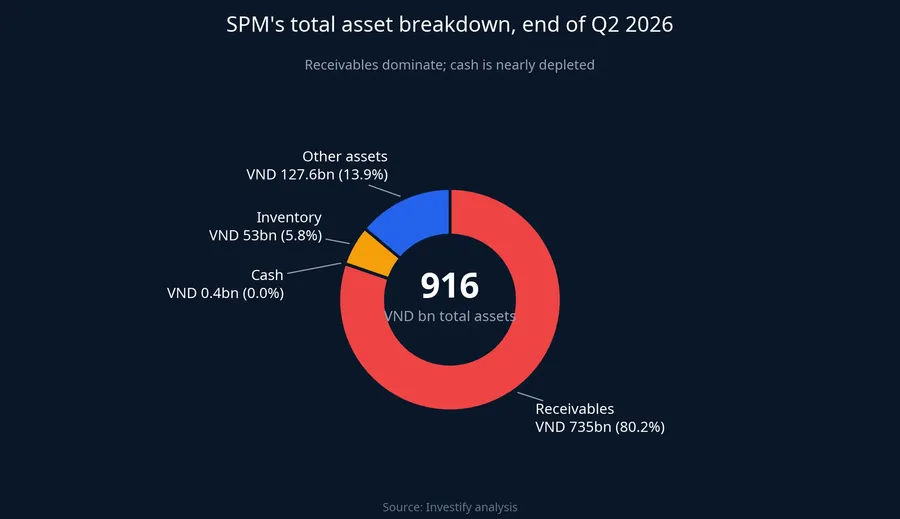
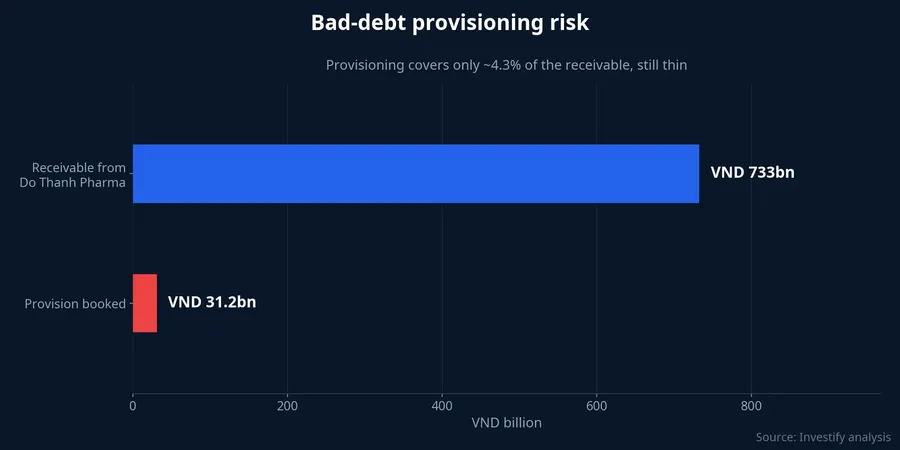
In its notes, the company disclosed that VND733 billion of that receivable balance is owed by a single customer: Do Thanh Pharmaceutical Co., Ltd. and its branch, equivalent to more than 80% of SPM's total assets.Nguoi Quan Sat The provision booked specifically against this receivable is VND31.2 billion, up VND12.4 billion from the start of the year.
This is where it's worth pausing longer. Do Thanh was founded in July 1995 and is currently led by Van Tat Chien as director and legal representative, who also holds 98% of the firm's VND100 billion charter capital.Nguoi Quan Sat Chien previously served as Deputy CEO at SPM itself starting in 2007, and before that worked as a physician at Thong Nhat Hospital from 1996 to 2006. Put the numbers side by side and the issue becomes clear: a company with roughly VND138 billion in charter capital is owed VND733 billion by a single partner — more than five times SPM's own charter capital — and that debtor is a private company run by a former SPM executive, with charter capital of just VND100 billion. This isn't evidence of wrongdoing, but it is a relationship structure any investor should know about before taking the profit figure at face value.
Why VND31.2 billion in provisions isn't the final number
The real risk doesn't sit in the VND31.2 billion already provisioned: it sits in the portion that hasn't been. Against the VND733 billion principal, that provision covers only about 4.3%, meaning nearly 96% of the receivable is still carried on the balance sheet at full value, on the assumption it will be collected.
In Vietnam, provisions for doubtful receivables are set based on how overdue a debt is: the longer it goes unpaid, the higher the required provisioning rate. That means if the Do Thanh receivable continues to go unpaid in coming periods, provisioning expense will rise automatically, with no new adverse event required to trigger it. This VND12.8 billion adjustment shouldn't be read as a closed, one-off event, but as the early stage of a process that could well continue.
To be fair to SPM on one point: gaps between self-reported and reviewed financials show up every year at many listed companies, and they don't always signal weak governance. Quarterly filings are self-prepared and not subject to mandatory audit, so the accounting estimates in them reflect management's own view; semi-annual and annual reports get a third-party look. There are at least two readings for SPM's case: one is that management was simply more optimistic than the auditor about collectability, and the debt could still be repaid in full; the other is that the company's cash flow is now hostage to the payment decisions of a single counterparty. The available data leans toward the second reading: not because of the VND12.8 billion adjustment itself, but because of the asset structure behind it. A company sitting on VND456 billion of profit accumulated over many years while holding under VND400 million in cash is a company that has booked earnings without ever converting most of that profit into cash.
Thin liquidity means the share price reflects little
SPM shares closed the August 19, 2026 session at VND10,500, down 0.47%. But that price is a poor risk gauge, because there's barely any trading behind it.
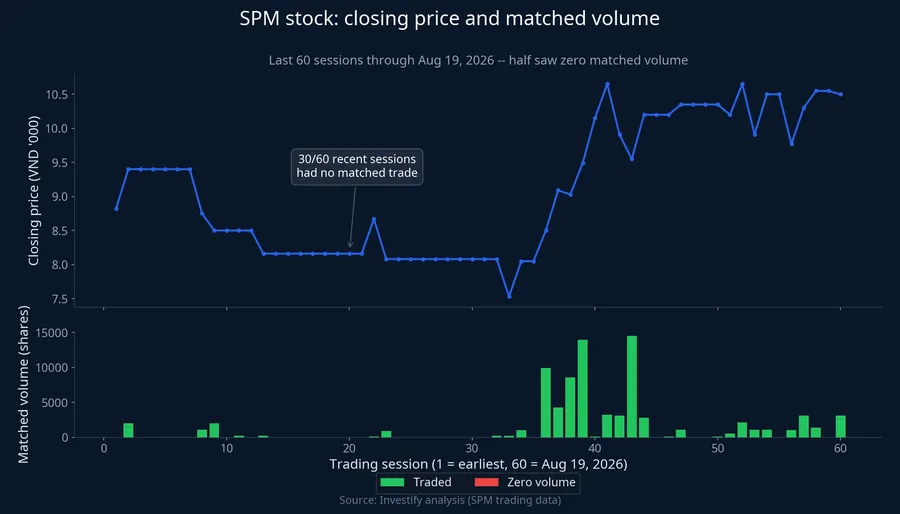
Over the last 60 sessions, SPM saw zero matched volume on 30 of them, exactly half. Total matched volume across all 60 sessions was just 83,100 shares, under 1% of shares outstanding. On some sessions, as few as 100 shares changed hands while the price still swung nearly 7%, as it did on July 22. With liquidity this thin, price moves don't reflect the market digesting information: they reflect a handful of small orders meeting each other. Investors reading the price chart of a stock like this can easily mistake quietness for stability, when in reality there simply aren't enough buyers and sellers for the price to capture the risk sitting on the balance sheet.
What to check before trusting a quarterly profit number
SPM's case is useful because it points to lines worth checking in any set of financial statements, not just this one. Start with receivables as a share of total assets: when receivables dominate a company's assets, most of its value sits outside its own direct control. At SPM, that ratio is over 80% for a single customer alone. Next, compare cash to accumulated profit: if a company reports profit quarter after quarter but its cash balance barely moves, the question to ask is where that profit actually went, rather than assuming it has already turned into cash.
Then there's the identity of the debtor. Financial statement notes typically name the customers that make up a large share of receivables; when that name is tied to someone who currently or previously held an executive role at the company, the objectivity of debt collection deserves extra scrutiny. Finally, there's the habit of waiting for the reviewed report: for companies with large receivable balances or a history of restating figures, a self-reported quarterly profit number should be treated as a first estimate, not a conclusion.
Signals worth watching
The question that matters for SPM isn't how much profit it books in the second half of the year: it's whether Do Thanh's VND733 billion debt gets paid, and how fast. The Q3 report and the audited FY2026 report will answer part of that: if the Do Thanh receivable balance doesn't shrink while the provisioning ratio keeps climbing from today's 4.3%, that's a sign collectability is deteriorating, not simply a case of auditor caution.
Until those two reports land, the number worth remembering from this balance sheet is still VND400 million in cash sitting next to VND456 billion in retained profit. That gap is something a single profit line will never fully explain.