


July 2026 was the toughest month for Vietnam's stock market so far this year. The VN-Index fell from 1,860.01 points at the end of June to 1,735.78 points at the end of July, down 6.68%.VnExpress At the session low on July 22, the index touched 1,668.53 points, 10.29% below the end-of-June level.
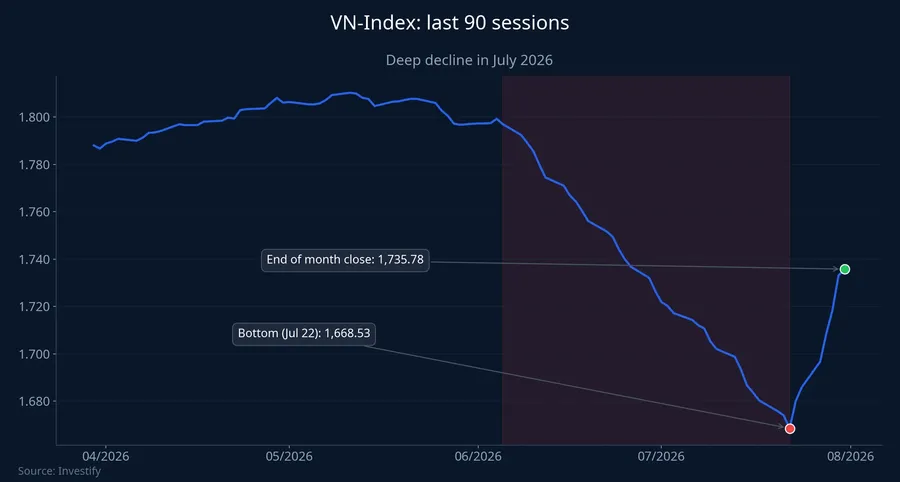
VinaCapital's largest open-end equity fund fell with the market. VESAF lost 8.3% in July.VnExpress But that loss isn't the most notable line in the monthly report. What stands out more is what the fund did with its cash pile, in the very month the market was falling hardest.
The cash buffer thinned by nearly half
VinaCapital described the move as deploying most of its cash reserves during the month. The portfolio numbers show just how specific that was. VESAF's cash weighting fell from 11.39% of NAV at the end of June to 6.55% of NAV at the end of July. In absolute terms, the cash balance dropped from VND 277.44 billion to VND 145.85 billion, meaning roughly VND 131.6 billion flowed into the market, or 47.4% of the fund's opening cash position.
All of that money went into equities. The listed-stock weighting rose from 90.50% to 94.32% of NAV, while the fund held no bonds or term deposits at either point in time.
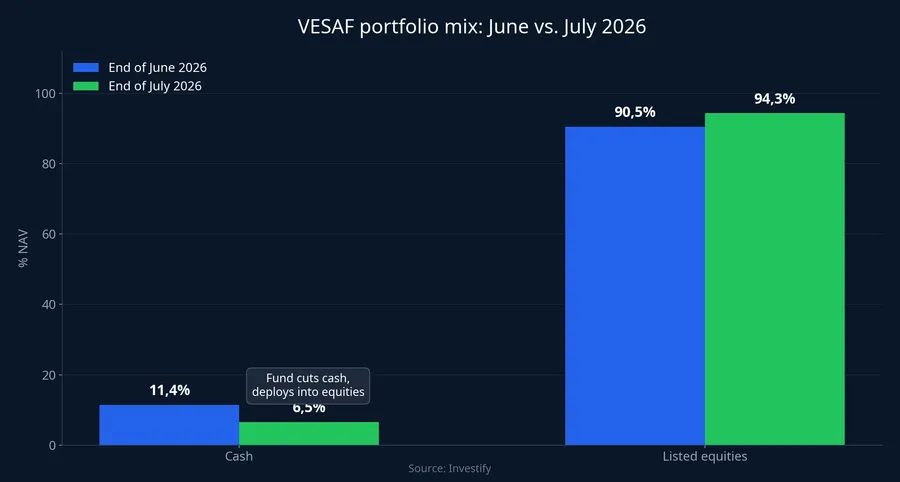
For newer investors, this is worth reading carefully. The phrase "deployed most of its cash" can easily be read as the fund having gone all in. In reality it still held VND 145.85 billion in reserve, but that buffer has thinned noticeably. A portfolio that's almost entirely equities means every market swing now hits NAV harder, in both directions.
Where the money went
The pattern of buying shows the fund wasn't spreading capital evenly. At the sector level, financial services rose from 0 to 4.90% of NAV, retail rose from 5.94% to 10.50% of NAV, and banking rose from 21.80% to 25.55% of NAV. Water and gas appeared as a new position at 2.88% of NAV, while real estate rose from 6.18% to 8.50% of NAV.
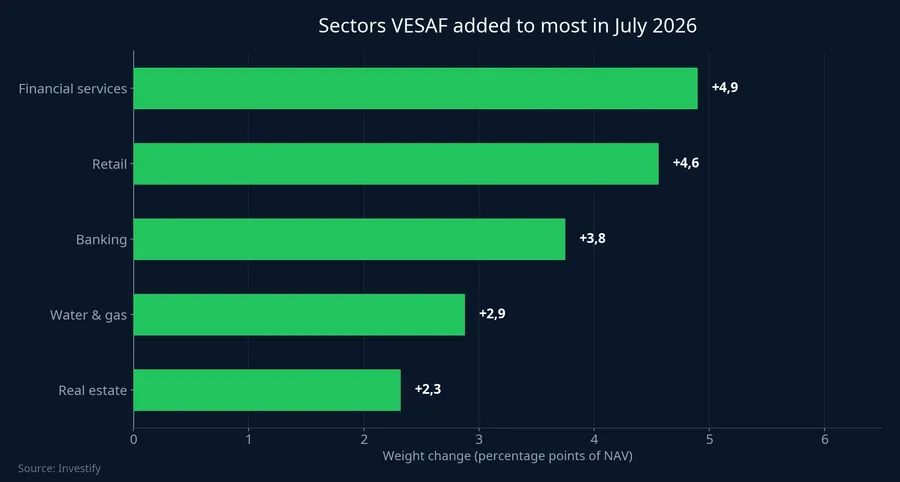
At the stock level, the largest new or increased positions were GAS, up 2.88 percentage points, MWG up 2.85, TCB up 1.87, FPT up 1.76, SSI up 1.67, and ACB up 1.66. SSI, VCI, and VND were all new positions among the brokerages. On the other side, PNJ was cut by 5.58 percentage points, nearly closing the position, alongside PVT down 2.34 and DHC down 1.83.
At the end of July, the fund's top holdings were BVH at 7.21% of NAV, MWG at 6.32%, VCB at 6.16%, HPG at 5.99%, and CTG at 5.90%. Banks remain the largest pillar of the portfolio, even though banking wasn't the sector with the biggest increase for the month.
Who does the "40-50% off peak" claim actually apply to
VinaCapital said the fund bought in as many quality companies had fallen 40-50% from their peaks, calling it an opportunity that rarely appears across the board at once.VnExpress That range checks out for part of the portfolio, but not all of it.
At the July 22 session low, VRE closed at VND 21,750, down 48.1% from its peak of VND 41,914 on October 16, 2025. SSI closed at VND 22,650 the same session, down 39.6% from its peak of VND 37,483 on August 29, 2025. Both stocks were positions the fund added to during the month, and both fell squarely within the 40-50% range VinaCapital cited.
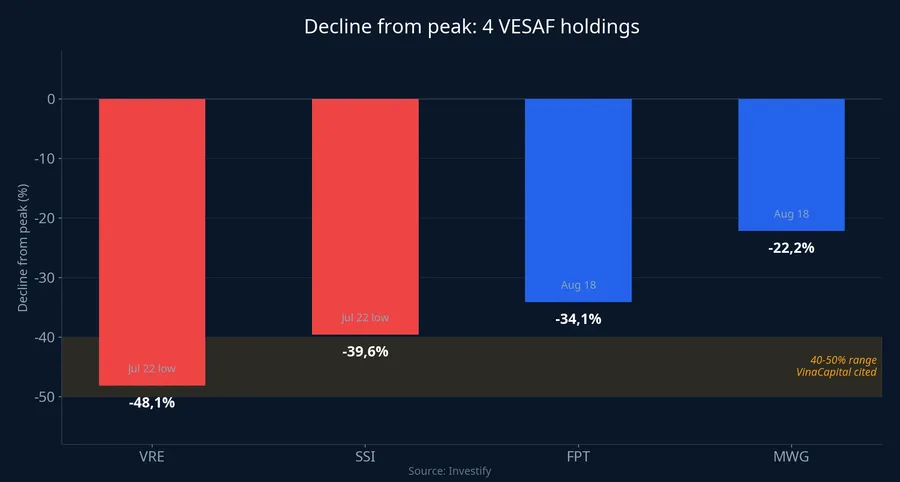
But that range doesn't cover the whole portfolio. MWG closed at VND 72,800 on August 18, down 22.2% from its peak of VND 93,600 on February 26, 2026. FPT closed at VND 69,000 the same day, down 34.1% from its peak of VND 104,658 on January 29, 2026. In other words, "quality names down 40-50%" describes the hardest-hit group — mostly brokerages and retail-adjacent real estate — rather than the broader portfolio.
The case behind the buying: valuation and earnings
The fund laid out three anchors for buying into a falling market.
The first is valuation. According to VinaCapital's figures, the VN-Index's forward 2026 P/E stands at 11.5 times, or about 9.5 times excluding the Vingroup group of stocks.VnExpress
The second is corporate earnings. Net profit attributable to parent-company shareholders among HOSE-listed firms rose 46% year-on-year in the second quarter and roughly 48% in the first half, with gains spreading across 11 of 12 sectors: materials led at 72%, followed by non-essential consumer goods at 55%.
The third is the macro backdrop. The industrial production index rose 11.4% in the first seven months of the year, and the manufacturing PMI climbed from 51.8 to 52.9 points in July, marking a 13th straight month of expansion. FTSE Russell's expected upgrade of Vietnam to emerging-market status in September 2026 is also seen by the fund as a sentiment booster, though that remains a milestone still ahead rather than a result already delivered.
Why the 9% savings comparison needs the right time frame
The most eye-catching line in the report compares stocks with bank deposits. VinaCapital wrote that the fund is only interested in opportunities with the potential to double in 1-3 years, and that even against deposit rates of around 9% a year, equities still look more attractive across every time horizon.
That deposit rate is real. In August 2026, several banks listed 12-month deposit rates around 9% a year, including Bac A Bank, BVBank, OCB, PGBank, PVcomBank, and VCBNeo, mostly for over-the-counter deposits.VnEconomy
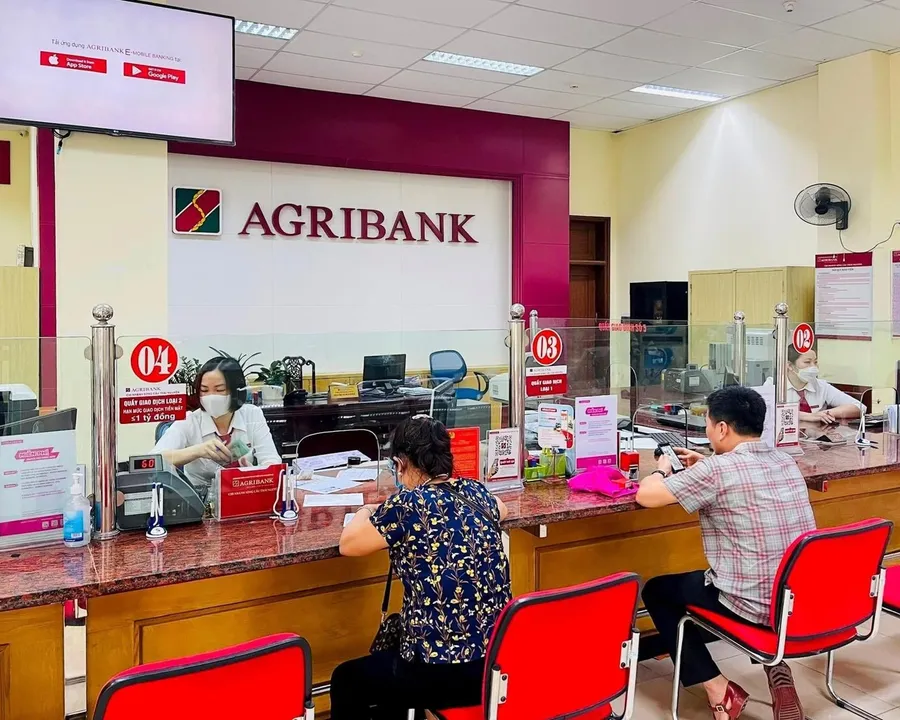
What matters is that the two sides of this comparison aren't the same kind of bet. Earning 9% a year for three years compounds to about 29.5% in cumulative interest, close to guaranteed, and depositors are protected up to VND 125 million per bank under deposit insurance. "Doubling in three years," by contrast, works out to roughly 26% a year compounded. That is an expectation, not a promise, and it applies only to a handful of hand-picked opportunities, not the whole portfolio.
A more realistic frame for individual investors is the time horizon of their own money. For cash needed within 12 months, a fixed 9% deposit remains the sensible default, since stocks offer no guaranteed payout date. For money set aside for three years or more, and for investors who can stomach NAV dropping by double digits in a single month the way it did in July, the fund's valuation thesis becomes genuinely worth weighing.
The results so far, and what the fund still hasn't proven
Since the end of July, the buying decision has paid off in the short run. VESAF's NAV per fund unit rose from VND 30,465.8 at the end of July to VND 31,725.5 on August 18, up 4.13%, while the VN-Index moved almost sideways, from 1,735.78 to 1,732.02 points.
There are at least three possible explanations for that gap, and two and a half weeks of data isn't enough to separate them. The brokerage and real estate names the fund added to tend to bounce back harder than the broader index after being oversold. That is a volatility effect, not necessarily a sign of fundamental improvement. Raising the equity weighting to 94.32% also amplifies any rebound, whatever its cause. Genuinely good stock selection is only the third possible explanation, and it will take several more quarters to confirm.
The full-year picture still isn't in the fund's favor. As of August 18, VESAF's NAV per unit was 5.49% below the end-2025 level of VND 33,569.8, while the VN-Index was down just 2.94% over the same stretch. The fund is still trailing the index year to date. And one of its new positions kept falling: SSI closed at VND 19,500 on August 18, down 17.2% from VND 23,550 at the end of July.
None of this disproves VinaCapital's thesis, since the time frame the fund set for itself is 1-3 years, not a few weeks. It simply means the right yardstick hasn't arrived yet. Grading a buying decision on two and a half weeks of stock prices is using the wrong scale, in either direction — praise or criticism.
Three signals worth watching in the coming months: the fund's cash weighting in its August and September reports, which will show whether it kept buying or started rebuilding its buffer; third-quarter earnings growth among listed companies, since that's the main pillar under the valuation thesis; and the deposit-rate environment, since every additional percentage point in rates pulls down what counts as fair value for stocks.