


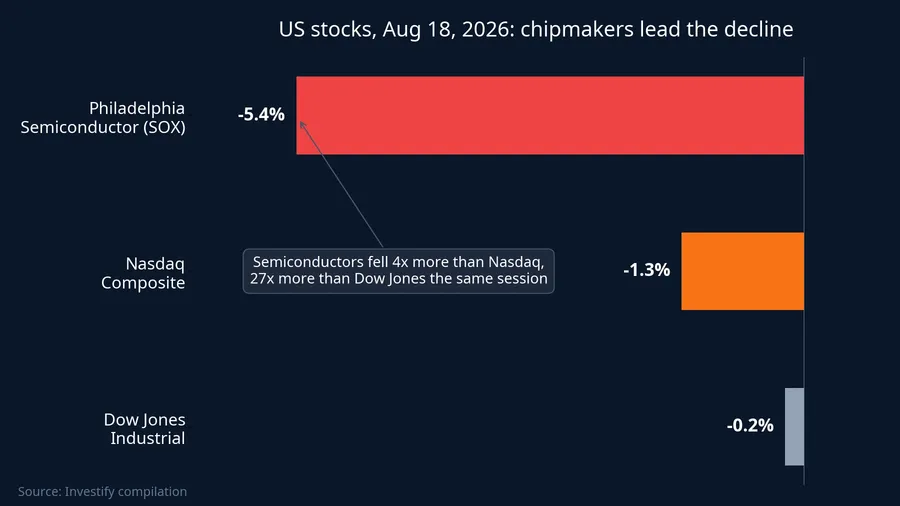
On August 18, the US 30-year Treasury yield broke above 5.33%, the most expensive long-term capital since June 2007.CNBC The same session, the Philadelphia Semiconductor Index dropped 5.4%, wiping out more than $680 billion in market cap if the decline held through the close: Nvidia fell 2.4%, Meta fell 3%, Micron lost 7% after rallying nearly 18% over the prior five sessions, and Sandisk fell 9%.Detroit News
What stands out is how unevenly the damage spread: the Nasdaq fell 1.3%, while the Dow Jones lost just 0.2%. Same rate news, same trading day, yet tech stocks took a hit several times larger than traditional blue chips. That divergence isn't random, and the mechanism behind it is something Vietnamese investors should understand before the pressure reaches the domestic market.
Why rate hikes hit growth stocks harder
A stock's value is, at its core, the sum of a company's future cash flows discounted back to the present. That discount rate combines a risk-free rate, typically benchmarked to government bond yields, plus a risk premium investors demand for holding equity instead of bonds. When government yields rise, the entire chain of future cash flows gets discounted more heavily. The time horizon of those cash flows is what determines how much damage is done.
Say a company promises 100 VND of profit ten years from now. At a 5% discount rate, that's worth 61.4 VND today; push the rate to 6%, and present value drops to 55.8 VND, a loss of roughly 9%. The same 100 VND just two years out barely moves: the same rate increase takes present value from 90.7 to 89.0 VND, a loss of under 2%.
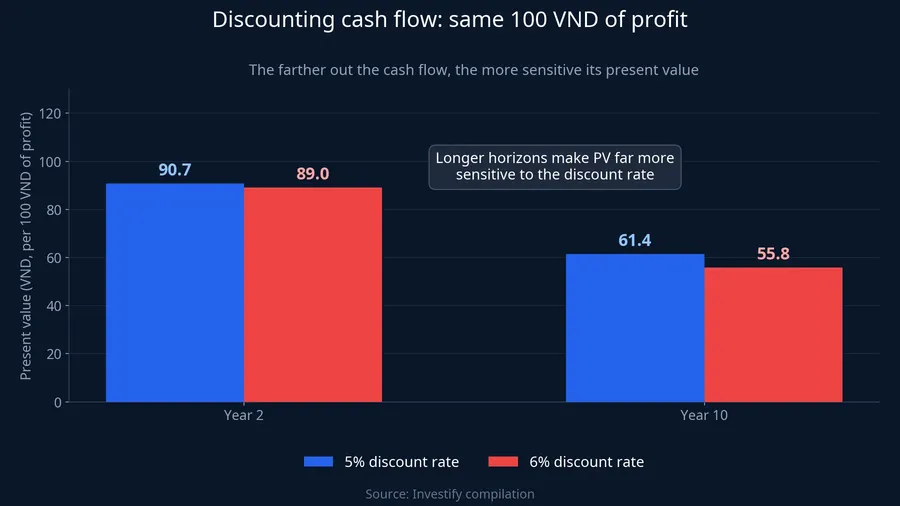
Semiconductors, AI, and the big tech platforms sit squarely in the far-horizon bucket: most of their value comes from profit expectations years out, not dividends or earnings already in hand, and high P/E multiples are simply the market's way of pricing in that faith. As the discount rate ticks up, the priced-in growth is the first thing to shrink, while banks, staples, and energy companies, whose cash flows arrive sooner, feel far less of the pinch. Two more forces compound the effect: growth-tech companies typically need to raise capital continuously to fund expansion, so higher rates directly raise their cost of financing, and with the 30-year Treasury now paying 5.33% at essentially zero default risk, that risk-free cash competes head-on with far-dated equity bets.

Three forces are pushing yields up, and government debt isn't the fastest one
It's worth being careful about pinning the entire yield spike on public debt. The August 18 session had at least three forces pushing at once, and debt is the slowest-moving of the three.
The most direct force on the day was oil. Stalled talks to end the US-Iran conflict, and the collapse of hopes for a ceasefire extension, pushed Brent crude to $91.10 a barrel, on top of a 2.65% gain the prior session. Pricier oil revives inflation worries, and higher inflation forces bond buyers to demand higher yields to offset the erosion in purchasing power.
The second force is debt supply. July's deficit alone came to $432 billion, on top of $1.7 trillion in corporate bonds issued this year, together dumping a large volume of long-dated paper into the fixed-income market.CNBC When buyers have too many options, bond prices fall and yields rise.
The third force is demand. Per CNBC, foreign holdings of US government bonds fell in June, with the UK, Japan, and China all trimming their positions. When the three largest creditors all buy less, the remaining demand has to be bid up to absorb the same issuance. The 10-year yield closed the same day at 4.73%, a slight uptick from the prior session,Trading Economics a sign that pressure is concentrating at the long end of the curve, exactly where long-term fiscal risk gets priced.
The debt spiral approaching the $40 trillion mark
As of August 11, total US public debt stood at $39,941.9 billion per Treasury Department data, just $58 billion shy of the $40 trillion mark and expected to cross it this week, months earlier than the Congressional Budget Office had projected.Just The News That milestone arrived early because of July's budget report: the US government posted a $432.3 billion deficit for the month, a record high for any July, of which net interest payments alone accounted for $104 billion.TTNews
Cumulatively, through the first 10 months of fiscal 2026, the deficit reached $1.799 trillion, already exceeding the full fiscal 2025 deficit of $1.775 trillion with two months still left in the fiscal year. Net interest payments over the same period totaled $931 billion, roughly $93 billion a month.Marketplace
This is where the two storylines converge into a loop: more debt forces the Treasury to issue more bonds, more supply pushes yields up, higher yields inflate the interest bill on every maturity being rolled over, and that bigger bill adds to the deficit, forcing even more issuance. For equity investors, this loop matters because it keeps the risk-free rate elevated for longer, not because the $40 trillion mark itself carries any special accounting significance.
One limitation is worth flagging: the semiconductor sector's 5.4% single-session drop can't be attributed entirely to rates, since Micron had already rallied nearly 18% over the prior five sessions, meaning some of the decline was simply profit-taking. What rates do explain is why far-duration names fell harder than the rest of the market in the same session, not the full magnitude of any individual stock's move.
Vietnam: the transmission channel runs through capital flows, not the exchange rate yet
For the domestic market, the clearest effect right now is foreign capital flows. On August 18, the VN-Index rose 4.56 points to 1,732.02, yet foreign investors still net sold more than VND 700 billion on HOSE, concentrated in VIC, VPB, SSI, and VCB;CafeF more broadly, over VND 3,400 billion in foreign capital has flowed out net over seven straight sessions.Dân Trí
The mechanism is fairly intuitive: when a risk-free dollar asset pays 4.7-5.3% a year, the opportunity cost of holding equities in an emerging market rises correspondingly. International investors don't need Vietnam's market to deteriorate to sell — a better alternative at home is reason enough to trim allocation.
The exchange-rate channel is, by contrast, being kept in check. The USD/VND rate on August 14 stood at 26,063.5, having traded in a tight range for nearly six months and even easing about 0.91% over the past 30 sessions, meaning the dong has ticked slightly stronger. In other words, the pressure from the rate differential is currently showing up in sell orders on the exchange, not in downward pressure on the currency.

Reread your portfolio, don't try to forecast yields
The lesson worth acting on isn't predicting where US yields go next. It's rereading your own portfolio: the more a stock's value depends on growth many years out, the more sensitive its price is to global interest rates. In a cycle where yields stay anchored high, the margin of safety for richly valued names needs to be wider than in a low-rate environment, and concentrating a portfolio around a single growth narrative is the most vulnerable position to hold.
For the portion of assets prioritizing stability, globally elevated rates also mean fixed-income channels are paying more than they did a few years ago — a genuine alternative now, not just a stopgap.
Three signals worth watching over the coming weeks: whether the US 10-year yield breaks above the 4.75% zone toward 5%, or cools instead; whether Brent crude holds above $90 a barrel, since oil is the most direct inflation driver right now; and whether foreign selling pauses as FTSE Russell's index announcement date approaches.
If US yields cool first, the valuation compression in growth names tends to reverse quickly, because what changed was the discount rate, not the underlying business outlook. If all three forces keep pushing yields higher instead, the performance gap between richly valued growth stocks and the rest of the market will likely widen further.