


Japan has posted another quarter of economic growth. Still, stopping at the 0.3% headline would miss the more useful signal for investors: the domestic engines were not moving in step. Domestic demand contracted, while net exports supplied enough offset for total output to rise.Cabinet Office of Japan
Think of GDP as the combined sales of several departments in a store. Sales to domestic customers can weaken while overseas sales are strong enough to lift the total. A positive GDP print therefore says that the economy did not shrink. It does not, by itself, certify broad-based economic health. The evidence in the second quarter supports one clear reading: external demand carried growth while private domestic demand still needs confirmation.
The 0.3% figure is the quarter’s actual gain
The Cabinet Office’s preliminary estimate, released on August 17, puts Japan’s real GDP growth at 0.3% quarter on quarter after seasonal adjustment. It also reports an annualised pace of 1.1%.Cabinet Office of Japan
Those figures answer different questions. The 0.3% is the actual increase in real output during the second quarter. The 1.1% annualised number asks what growth would look like if that quarterly pace continued for four quarters. It is not a year-on-year result already achieved by the Japanese economy.
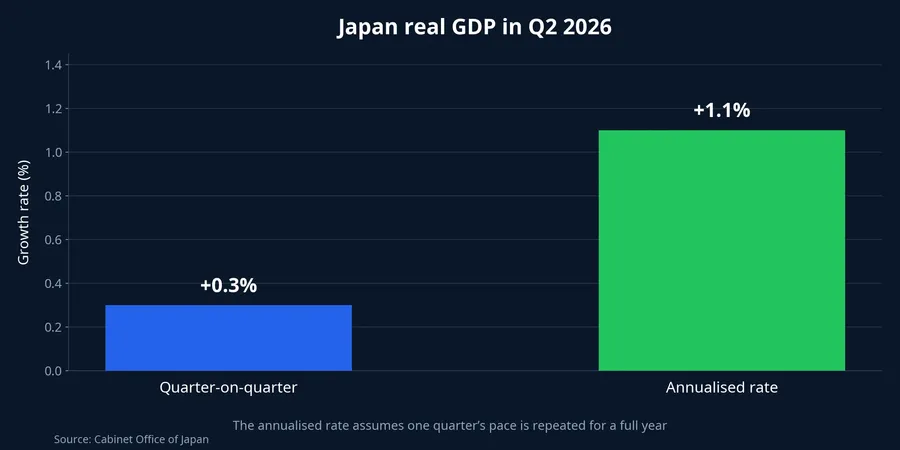
For newer investors, the cleanest habit is to read the quarter-on-quarter number first, then use the annualised rate as a measure of pace. Revised data show real GDP rose 0.5% in the first quarter, equivalent to a 1.9% annualised pace. Japan was still expanding in the second quarter, but the pace slowed from the opening three months of the year.Cabinet Office of Japan
Domestic demand did not underpin the expansion
The composition table is more revealing than the headline. Domestic demand fell 0.2% and subtracted 0.2 percentage points from GDP growth. This aggregate includes consumption, investment and other spending at home. It shows that the engines closest to household budgets and companies’ expansion decisions were not adding to growth during the quarter.Cabinet Office of Japan
Real private consumption was broadly unchanged. Real household spending, specifically, fell 0.1% from the preceding quarter.Cabinet Office of Japan That is not a crisis-sized move, but it matters because household spending feeds through to retailers, services businesses and companies focused on the domestic market. When consumers remain cautious, growth has less breadth beneath it.

Business investment was no stronger. Investment in equipment fell 1.2% in the second quarter after a 1.0% decline in the first, while private residential investment fell another 0.5%.Cabinet Office of Japan In plain terms, companies spent less on machinery and new productive capacity. Two weaker quarters do not establish a permanent trend, but they do not provide a solid domestic base for a demand-led recovery either.
This distinction matters when investors compare countries or sectors. A headline growth rate tells us the direction of total output; the components tell us which businesses may be feeling that growth. A company selling overseas can benefit from resilient foreign orders even as a retailer, housing supplier or machinery maker faces a more cautious customer at home. It is a framework for reading the data, not a forecast for any individual stock.

Private inventories added 0.3 percentage points to GDP. That item needs careful interpretation. Businesses may be deliberately building stocks ahead of orders, or they may be holding goods because sales were slower than expected.Cabinet Office of Japan GDP data alone cannot distinguish between those explanations. Upcoming retail sales, orders and industrial production figures should make the answer clearer.
Net exports provided the offset
GDP adds exports and subtracts imports. In the second quarter, Japan’s real exports rose 0.5% while real imports fell 1.5%. The result was a 0.5-percentage-point contribution from net exports, more than enough to offset the domestic-demand drag and leave real GDP up 0.3%.Cabinet Office of Japan
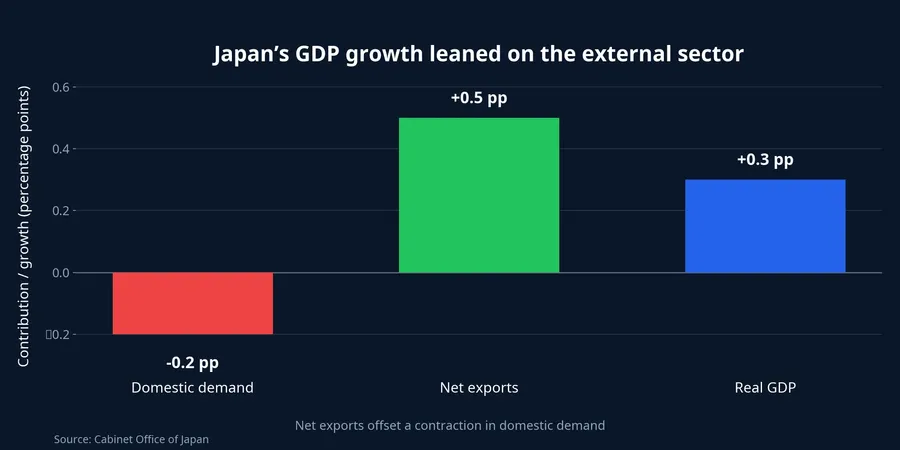
That offset should not be read in only one direction. Rising exports are encouraging because they indicate stronger foreign demand for Japanese goods and services. But falling imports also enlarge net exports. If imports are down because households and firms are buying fewer consumer goods, inputs or machines, the same trade outcome also contains evidence of soft domestic demand.
This is why the phrase “export-led growth” needs context. It can describe genuine strength in foreign sales, but it can also be amplified by a weak import bill. The national accounts release confirms both an export increase and an import decline; it does not allocate a single cause to the trade contribution. Investors should resist turning the timing of these figures into a simple causal story before the more detailed demand and trade data arrive.
Prices add another layer. Nominal GDP rose 1.2% quarter on quarter, or 4.8% at an annualised rate, materially faster than real GDP. The domestic-demand deflator also increased 1.2%.Cabinet Office of Japan Revenue measured in yen can grow faster than the real volume of goods and services produced. That distinction is useful well beyond macro data: investors should separate price-driven growth from volume growth in company results too.
One report, several market interpretations
For the Bank of Japan, the report is not a one-way signal. Falling domestic demand and weak equipment spending argue for caution over tightening too quickly. Yet GDP is still expanding and the domestic-demand price measure remains firm. This report alone therefore does not establish that the Bank of Japan will change the direction of policy.
The yen, bonds and equities can consequently read the same data differently. The yen is often sensitive to the interest-rate gap between Japan and the United States, so weak domestic demand may make markets more cautious about expectations for rapid Japanese rate increases. Bonds also have to price inflation, the growth outlook and government borrowing. Export-oriented equities may focus on overseas orders and the exchange rate, while domestic-consumption businesses need evidence that real incomes and household spending are recovering.

It would be a leap to infer from a positive GDP release that the Nikkei 225 must rise or that the Bank of Japan is about to act. Those outcomes may move alongside the data, but they are also shaped by inflation, wages, US policy and risk appetite. The report narrows the more useful question: which part of growth is durable enough to change policy expectations?
The plus sign is a starting point, not a conclusion
The right conclusion is neither that Japan is in recession nor that the economy is expanding evenly. The strongest evidence says real GDP grew in the second quarter, but growth leaned on net exports while domestic demand contracted. That is the difference between a growth rate and the quality of growth.
For a portfolio reader outside Japan, the practical value is not a trading instruction from one release. It is a reminder to separate the macro headline from the channels that can affect assets: foreign demand, the yen, interest-rate expectations and domestic earnings do not necessarily point in the same direction. Treating them as one signal is often where a seemingly simple GDP number becomes misleading.
The next releases should be read in that sequence: whether real consumption turns up, whether equipment investment stops falling, and whether trade’s contribution comes more from stronger exports or from a further import contraction. A recovery in the domestic components would give growth a wider foundation. Without it, the external sector remains a valuable support, but not yet proof of a broad-based recovery.