


Vietnam's National Assembly assigned VND 1.08 quadrillion to the 2026 public-investment plan. That establishes the scale of available resources, but it does not tell investors which listed company will earn revenue, when it will do so, or when it will collect cash.Ministry of Finance
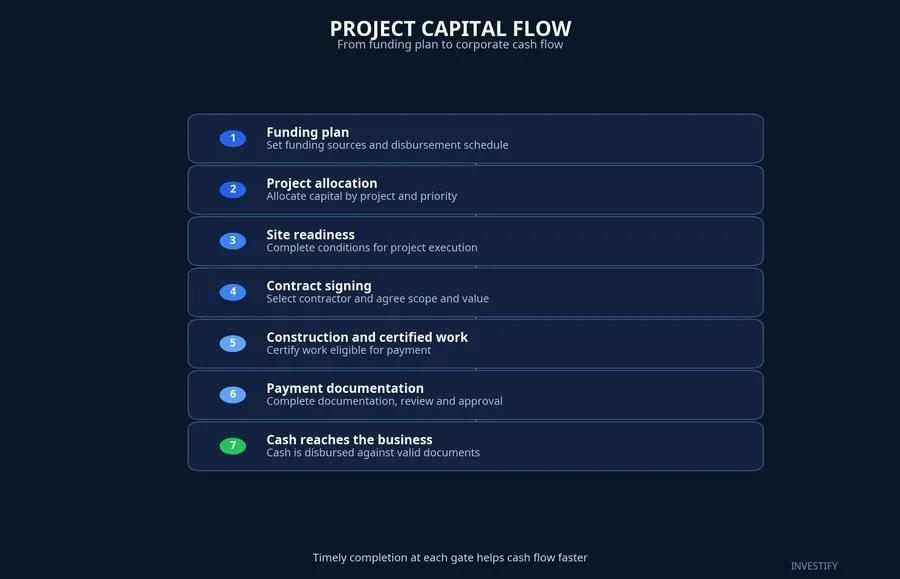
Think of public capital as a shipment with seven checkpoints. A funding plan is its dispatch order. The money reaches a business only after it is allocated to a project, the site is ready, a contractor has won work, construction is certified, and payment documents are completed. The central point is simple: for construction, materials and infrastructure stocks, project-level evidence is far more reliable than a broad “public-investment beneficiary” label.
Gate one: funding must be attached to a project
A national plan is not a company's contract. Once the total budget is approved, capital must still be assigned and allocated in detail to tasks, projects and project owners. Law No. 58/2024/QH15 on Public Investment, effective from January 1, 2025, provides the legal framework for that process; it was amended by Law No. 90/2025/QH15.Government GazetteGovernment Gazette
So the first question after a public-investment headline is not “How large is the national budget?” It is “Which named project has been allocated funding this year?” A priority sector or locality does not automatically give a particular business any work. Even a project already listed in a plan does not reveal who will win the contract or what share of the work it will receive.
For newer investors, three documents are a useful starting point: the annual funding-allocation decision, the project list and the amount assigned to each project. They help separate a project that has detailed funding from one that remains only a policy intention or headline investment total. In the latter case, the path to company revenue is still long.
Gate two: the worksite has to be ready
Funding does not mean machinery can enter the site immediately. A project also needs investment documentation, design, land clearance and suitable materials. The Ministry of Finance has identified recurring obstacles including shortages of construction materials, input costs above budget estimates and difficulties in land clearance involving land origins, compensation pricing and settlement plans.Ministry of Finance
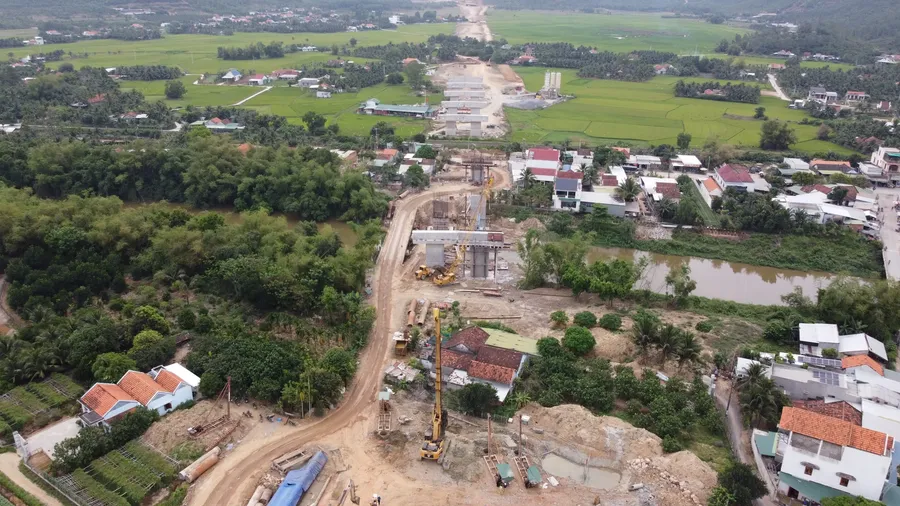
Put simply, a contractor cannot fully deploy without handed-over land. A material shortage or costs above the estimate can slow execution and require contract adjustments. That is why delayed disbursement is not merely money waiting at the payment authority. The bottleneck can arise well before a construction quantity exists.
For contractors, more useful signals than a ground-breaking ceremony are the proportion of cleared land, progress on each package and work actually completed. For a materials supplier, look for confirmed orders, delivery volumes and recorded sales. A road that needs stone, steel or cement does not prove that a specific supplier is selling into that project.
Gates three and four: contract, then completed work
Once a project is ready, the project owner selects contractors and signs contracts. The contract defines scope, value, timetable, advance-payment terms and settlement terms. It is the first point where a macro narrative connects to a named business, but it is still not revenue.
Unperformed contract value shows work that the company has secured. It does not determine the pace at which that work becomes revenue. If land handover is late, or input costs rise faster than price-adjustment terms allow, a large contract can also create a larger working-capital requirement.
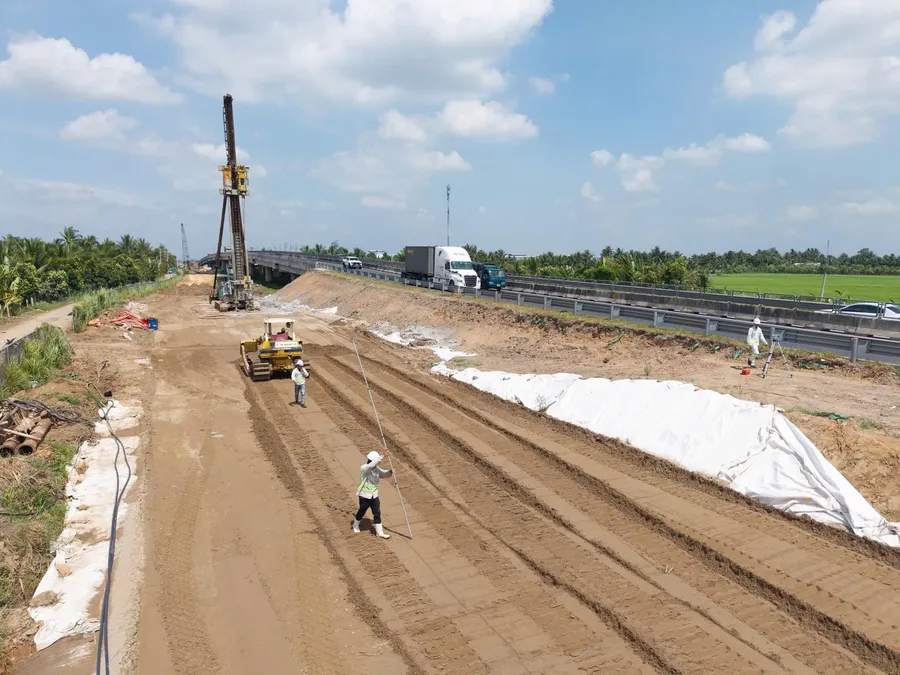
Only when the worksite operates does a company create completed work. The work must be measured, certified and accepted under the contract before it enters payment documentation. Read announcements of contract value alongside progress, completed scope and the revenue-recognition policy in the financial-statement notes.
The same template should not be applied to every business model. A contractor generally records revenue from work performed. A materials company needs deliveries and invoices. An infrastructure operator may not earn operating revenue until the asset is complete. One project can therefore place these three types of company at very different points on the capital path.
Gates five and six: acceptance, documents, payment
Decree No. 254/2025/ND-CP governs payment and final settlement for public-investment projects. Under the decree, the payment authority disburses capital based on the completeness and information in legal, advance-payment and payment documents.Xây dựng Chính sách
That procedural detail matters because it shapes the quality of cash flow. After acceptance, the project owner must prepare a payment request. Guidance citing Article 8 of Decree No. 254/2025/ND-CP lists the assigned funding plan, project-approval decision and contract among the initial legal documents.Can Tho State Treasury
An advance is not revenue either. Article 9 allows an advance for contracted work after the contract takes effect and, where required, the guarantee conditions are met.Xây dựng Chính sách It may help a contractor mobilise a site, yet profitability still depends on contract terms, actual progress and actual costs.
The final gate: does revenue become cash?
At this point, investors should leave the project story and open the financial statements. Rising revenue is encouraging, but it is incomplete if receivables grow faster while operating cash flow remains negative. The business may have recorded an accounting result but still be waiting to turn it into cash.

Conversely, accepted work progressing alongside controlled receivables and improving operating cash flow creates a stronger chain of evidence. Construction is project-driven and can be seasonal, so every indicator need not look perfect in a single reporting period. What matters is that the indicators tell the same story instead of reported revenue moving one way and cash collection another.
A framework for reading public-investment stocks
When a company is linked to public investment, trace the seven gates: a specifically funded project, readiness to execute, a contract or order for the company, certified completed work, payment-ready documentation and cash actually arriving. Outside investors will not always have complete data for every gate. But the more clearly a company discloses each one, the easier it is to test whether expectation is becoming a result.
The thesis is not that public investment creates no opportunity. The scale of planned capital can support demand for construction, materials and infrastructure operations. Yet the opportunity becomes a company-specific result only when the execution chain remains intact. The next quarterly report, tender disclosures, acceptance progress, receivables and operating cash flow are the signals that show which gate the money has reached.
This approach also guards against a common analytical shortcut: treating a sector narrative as a company result. A macro plan can be relevant without being sufficient evidence for a valuation conclusion. The useful distinction is between information that describes a possible market and information that shows a specific company is already participating in it.