


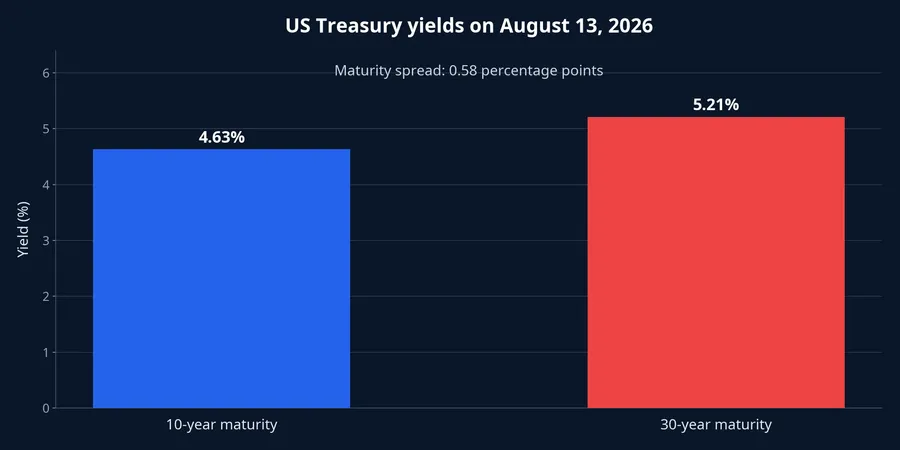
The S&P 500 closed at 7,798.99 on August 13 and moved above 7,800 early in the following session. Over the same window, the US 10-year Treasury yield stood at 4.63% and the 30-year yield at 5.21%.AP US Treasury
Those numbers are not contradictory. They show a market willing to live with a high discount rate because it still believes in the earnings stream ahead. The useful frame is not “high yields must sink stocks.” It is a comparison between earnings growth and the rate investors use to value those earnings.
The central thesis is straightforward: earnings are cushioning US equity valuations, but the balance becomes fragile when yields rise while earnings expectations are being cut. For Vietnamese investors following global markets, that condition matters far more than trying to predict the next index milestone.
Why high yields normally pressure equities
At its simplest, a share is a claim on profits a company may generate in the future. To compare profits expected years from now with money today, investors discount them back to present value. Long-term Treasury yields are a major reference point in that calculation: the higher the yield, the lower the present value of the same future cash flow.
That is why stocks whose value rests heavily on more distant earnings are usually more sensitive when yields rise. The 10-year yield is often treated as an equity valuation counterweight. Yet it is only the denominator in the calculation. Expected earnings are the numerator, and that is why equities can still advance in a high-yield environment.

The 4.63% 10-year yield and 5.21% 30-year yield on August 13 show that long-term capital remains expensive. The 0.58 percentage-point maturity spread also signals a higher return demanded for locking money up for longer.US Treasury That does not tell us where the S&P 500 will trade tomorrow, but it raises the bar for companies valued chiefly on future growth.
Earnings are offsetting the discount rate
The market’s current support comes from the second-quarter reporting season. As of August 11, roughly 88% of S&P 500 companies had reported; 86% beat earnings expectations and 76% topped revenue estimates.Kiplinger That is a breadth signal, rather than a story driven by only a few mega-cap names.
The key is not that the market rewards every company equally. A high beat rate can mean expectations going into the season were conservative, or that operating results were stronger than expected. Either way, analysts have a reason to hold or lift earnings forecasts rather than simply pay a higher P/E multiple for unchanged profits.

This is an important distinction in the quality of a rally. A price increase driven only by multiple expansion means investors are paying more for the same unit of earnings. A rise accompanied by improving earnings forecasts is more durable, because the forward P/E can cool even as share prices increase. Not every earnings beat will persist, but the breadth of the data makes a single-company explanation less persuasive.
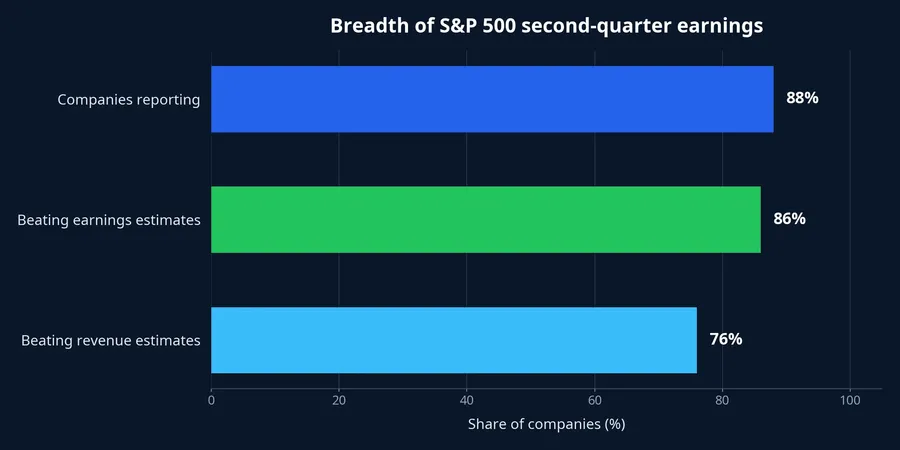
Still, an 86% beat rate is not a guarantee for the rest of the year. The S&P 500 is market-cap weighted, so the largest companies retain exceptional influence. A strong quarter can also come from revenue, margin expansion, cost controls, or one-off gains. The next reporting cycle will reveal which of these drivers can repeat.
An index high is not an answer on valuation
The move above 7,800 early on August 14 is an attention-grabbing milestone.AP But an index level alone cannot tell an investor whether equities are expensive or cheap. An index at a record can keep rising if expected earnings grow faster than prices. Conversely, a falling index is not automatically becoming attractive if earnings forecasts are falling faster.
It is also important not to turn coincident events into causation. The S&P 500 rose alongside positive earnings reports and elevated yields, but the evidence here does not allocate the exact contribution of earnings, index-related flows, or monetary-policy expectations. What the evidence supports more strongly is that business results are helping the market absorb a higher cost of capital, not that one factor alone created the new high.
The three variables that belong in one frame
To follow this balance, put yields, earnings estimates, and demand in the same frame. Yields are the discount-rate pressure. Earnings estimates are the offset. Demand, visible through revenue and sales outlooks, indicates whether those earnings have an operating foundation.
The most constructive state is stable yields, continued revenue beats, and no cuts to estimates for coming quarters. In that setting, high prices have a basis because the market is not buying a story alone; it is revising expectations for future cash flow. A rally can still correct, but a P/E adjustment with earnings intact is different from a trend reversal.
The more difficult state emerges when long-term yields establish a higher range while earnings estimates are reduced. Both sides of valuation then work against equities: the denominator rises as discount rates increase, while the numerator falls as expected profits weaken. That combination deserves more attention than a one-day yield move or an individual earnings miss.
The third state is easy to misread: falling yields. If yields ease because inflation is moderating while revenue and earnings retain momentum, equities receive a double benefit. If yields fall because growth is weakening, however, a lower discount rate may not offset cuts to expected profits. The same decline in yields can be good news or a defensive signal, depending on its cause.
What could thin the cushion
The real risk is not a high yield in isolation. It is the market’s need to keep proving that earnings are strong enough to justify that discount rate. If the share of companies beating revenue estimates narrows in the next quarters, investors will need to test whether margins can still improve. If earnings estimates are cut, the same share-price level becomes more expensive even if the index does not rise further.
Federal Reserve expectations should likewise be treated as a variable, not a promise. After the CPI report, futures markets at one point implied a 64% probability that the Fed would keep rates in the 3.50% to 3.75% range at its September meeting.Kiplinger That was a market price at a particular moment; new inflation, employment, or spending data can change it. For equities, the more relevant question is how long-term yields and earnings estimates respond after those releases, not the probability alone.
A conclusion with clear conditions
The evidence still leans toward US equities being able to withstand high yields because the reporting season is supplying a broad earnings cushion. The risks do not overturn that thesis unless two signals appear together: a sustained rise in long-term yields and cuts to earnings estimates for coming quarters. In that event, valuation would lose protection on both the numerator and denominator.
Rather than reacting to every S&P 500 record, a newer investor can monitor the 10-year yield, revisions to earnings forecasts, and the share of companies beating revenue estimates. They cannot produce certainty, but they do help distinguish a market supported by business results from one sustained mainly by confidence.