

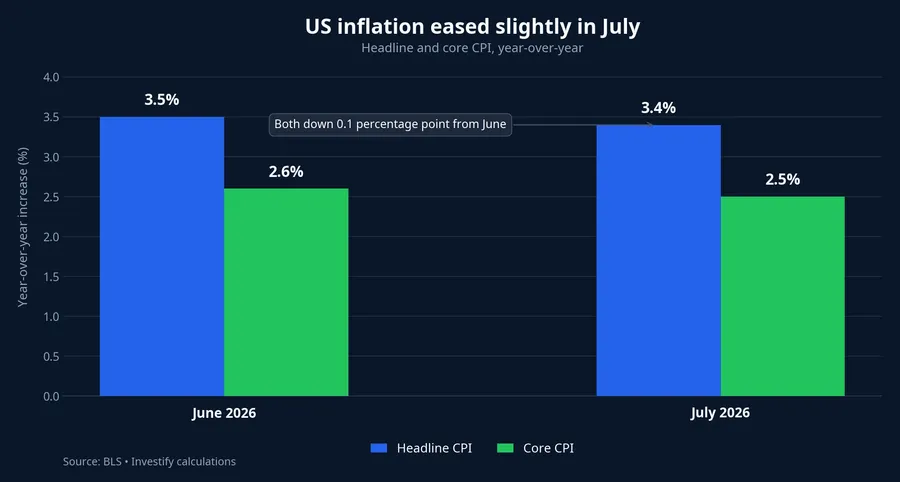
July’s US CPI report accomplished something important: it reduced the immediate case for further tightening, but it did not establish a case for rate cuts. Headline CPI rose 0.1% month on month and 3.4% year on year. Core CPI rose 0.2% for the month and 2.5% from a year earlier. Both readings were lower than in June, yet both remained above the Federal Reserve’s 2% inflation objective.
That distinction matters, especially for newer investors. An improving data release is not a policy decision; it is one input into that decision. The bigger picture still has three paths: holding rates is the base case, renewed hikes become a risk if an energy shock spreads, and cuts require clearer weakness in both underlying inflation and the labour market.
What the July CPI report actually says
Headline CPI covers the full consumer basket, including food and energy. It can move quickly when petrol or oil prices change. In July, energy prices fell 1.5% and petrol prices declined 2.9%. That helped pull down headline inflation, but it does not by itself show that economy-wide price pressure has been resolved.
Core CPI excludes food and energy and is therefore often used to assess the stickier part of inflation. It rose 2.5% year on year, down from 2.6% in June. Shelter costs still increased 0.1% during the month, while services excluding energy rose 0.2%. The numbers point to easing pressure, not the disappearance of the more persistent costs facing households.
For a Vietnamese retail investor, this is a useful distinction. Lower oil prices can improve headline CPI rapidly, while rents, services and wages tend to adjust more slowly. If core inflation keeps cooling across several reports, the Fed has more reason to believe inflation is returning to target. If headline CPI softens while core inflation heats up, the policy message is very different.
Holding rates remains the base case
The most plausible path for now is for the Fed to hold rates and wait for more evidence. July inflation was better than June’s, but 3.4% is not a declaration of victory on price stability. Meanwhile, the July employment report showed nonfarm payrolls down 23,000 and the unemployment rate broadly unchanged at 4.1%. The labour market is softening, but it has not yet shown the broad deterioration that would force immediate policy support.
Kevin Warsh, Chair of the Board of Governors of the Federal Reserve System, also played down the significance of a single inflation release. That fits the logic of monetary policy: a central bank should not overreact to one month of data, particularly when energy-driven moves can reverse quickly. What the Fed needs is a sequence of confirmation, not one favourable headline.
The Treasury market responded accordingly. On August 12, the two-year Treasury yield edged down from 4.22% to 4.20%, while the ten-year yield declined from 4.70% to 4.68%.US Treasury A two-basis-point move at both maturities is a modest adjustment in expectations, not evidence that markets have priced in a new easing cycle.
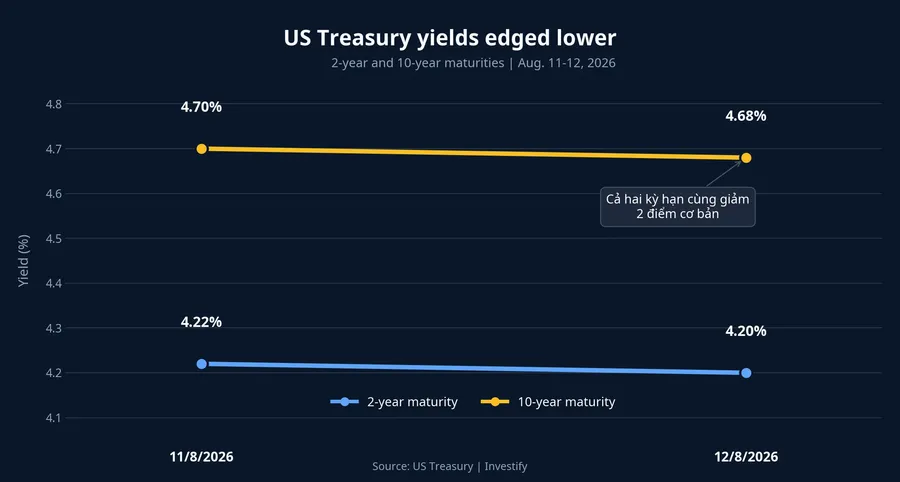
For Vietnamese investors, the two-year yield is especially useful because it is sensitive to expectations for Fed policy. Lower yields can support prices of existing bonds, as their fixed coupons become relatively more attractive. Still, a small one-day decline cannot establish a trend in global capital flows or the exchange rate. It simply shows that markets were somewhat less concerned after the CPI release.
Oil could reshape the August data
July CPI does not fully capture the oil rally that emerged in August. Brent closed at USD 88.39 a barrel on August 12, approximately 7.2% above USD 82.49 on August 6. This needs to be read alongside core CPI, not as an unrelated story. Higher oil can feed into transport, airfares, manufacturing and food costs; the extent of that pass-through is what matters for the Fed.

The US Energy Information Administration projects average Brent prices of about USD 85 a barrel in the third quarter, USD 11 above its prior forecast. Its outlook assumes severe shipping restrictions through the Strait of Hormuz during August and estimates that 5.5 million barrels a day of oil production was shut in during July.EIA This is a supply-risk scenario, not confirmation that CPI will certainly reaccelerate.
The case for renewed hikes becomes stronger only if two things happen together. First, energy shifts from July’s decline to a clear positive contribution to August CPI. Second, core CPI rises faster than July’s 0.2% monthly pace. If oil lifts the headline number for one month while services and core goods do not reaccelerate, the Fed can still wait rather than respond to a temporary shock.
It is also too early to attribute every move in yields or currencies to oil. Investors may be repositioning after CPI; growth expectations may be changing; and interest-rate differentials with other economies may be driving the dollar. The available evidence does not permit a precise allocation of these effects.
What would open the door to rate cuts
Rate cuts require the most demanding conditions. The Fed would need core CPI to remain subdued over several reports, rather than merely one 0.2% month. At the same time, labour-market softness would have to become clearer and more persistent: payroll declines continuing, unemployment rising materially, or income and hiring indicators slowing together.
The reason is straightforward. The Fed balances price stability against employment. When inflation remains above target, one weak jobs report is not enough to shift the priority toward stimulus. When underlying inflation has eased durably and employment is weakening, growth risks become more important. That is the data combination that could justify easing.
Investors should not turn these conditions into a confident forecast. Upcoming releases can still move in several directions, especially while oil is rising and services inflation remains sticky. Rather than trying to predict the next decision, a more useful approach is to watch which path the incoming data is strengthening or weakening.
Read three indicators together
Short-dated Treasury yields show how market expectations for Fed policy are changing. DXY indicates whether the US dollar is strengthening at the same time. On August 12, DXY rose only 0.08% to 99.86. If yields rise without a corresponding rise in DXY, markets may be more concerned about longer-term inflation than convinced that the Fed will tighten.
Brent is an early signal for the energy component of August CPI, but oil is not an automatic policy switch. The more meaningful combination would be elevated Brent, rising yields, a stronger dollar and hotter core CPI. Until those pieces appear together, drawing a firm conclusion too early is usually costlier than waiting for another report.
The thesis is clear: July CPI gives the Fed more room to hold rates, not a foundation for cuts. Oil and employment risks can change that picture, but only when confirmed by core CPI and subsequent releases. The key signals for the next few weeks are Brent, August core CPI, US employment and the joint response of the two-year yield and DXY.