


Non-interest income at listed Vietnamese banks reached VND 22.5 trillion in the second quarter of 2026, up 54.3% year on year and 27.9% quarter on quarter. That is meaningful support at a time when lending income is under pressure from funding costs. Yet the headline is only a starting point: a payment fee earned every day and a recovery from an old bad-debt file can both be recorded as non-interest income, but they do not deserve the same weight in an estimate of future earnings.Thời báo Tài chính VN
Think of the distinction as monthly rent versus selling an old possession. Both put cash in an account today, but only one has a clear basis for recurring next month. The same principle matters for bank equities: a sensible valuation depends more on earnings that can recur than on the percentage increase reported in one quarter.
Lending pressure makes non-interest income more visible
Across 27 listed banks, outstanding loans at the end of the first half of 2026 were 8.9% higher than at the end of 2025. Interest income rose 33.6% year on year, but interest expense climbed faster, at 49.0%. Net interest income consequently rose only 17.6%.Thời báo Tài chính VN
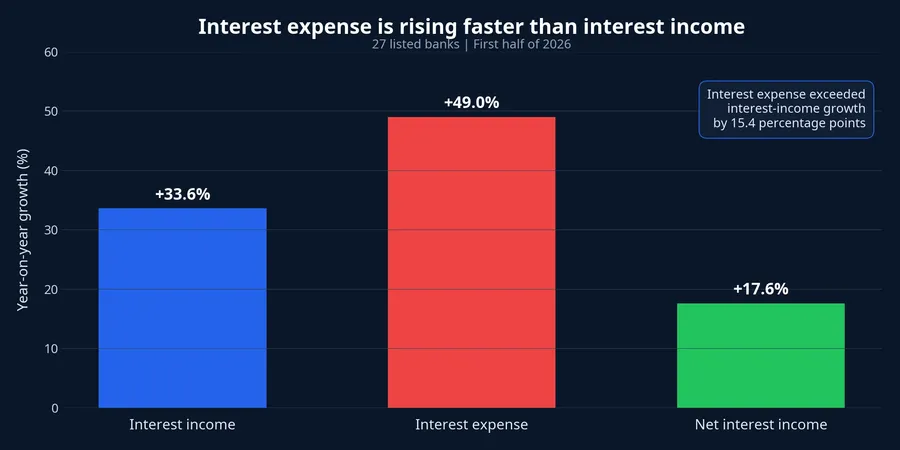
This gap does not mean lending has stopped being the core business. It shows that loan growth does not automatically translate into comparable growth in core earnings when the cost of funding rises. Fees, foreign-exchange trading, securities trading and other income then become a material cushion for total operating income.
The mistake is to treat every non-interest item as a cushion of equal durability. A bank that earns more from customers using cards, payments and cash-management services is telling a different story from one whose profit rose after it resolved a collateral case. The income statement puts those items close together; an investor needs to pull them apart.
Service fees are often more predictable
Payment fees, card fees, letters of credit, guarantees, collection and payment services, and cash management usually arise from customers' ongoing activity. If customer numbers, transaction values and service use remain stable, the bank has a basis for earning fees again. This is why service income is generally the more predictable form of non-interest income.
Still, the word “fee” is not a guarantee of durability. A major contract, a campaign to distribute financial products or a single corporate client can concentrate revenue in one reporting period. Rather than stopping at the growth rate of net service income, readers should look in the notes for the type of service and the customers that drove the change.
Sacombank illustrates why that extra check matters. Its fee income in the second quarter of 2026 rose more than fourfold from the prior quarter and 248% year on year. The reported explanation points to letters of credit, collection and payment services, and cash management in ecosystem lending. Its total operating income still rose 12.3% year on year even though loan balances did not increase materially.Thời báo Tài chính VN
That suggests an ability to sell more services to existing customers. It does not yet establish that the entire increase will recur at the same pace. The next quarterly report and its disclosure of transaction concentration should clarify whether the bank has built a higher fee base or simply recorded an exceptional period.
Foreign exchange and securities need a multi-quarter view
Foreign-exchange trading can generate income across many quarters when a bank has import-export clients, international-payment demand and market-making capability. Its result nevertheless changes with transaction volume, exchange-rate spreads and position management. A strong quarter is therefore useful information, not a reason to extend the result mechanically across a full year.

Securities gains should also be read through their source. Income from a liquidity-management portfolio has different properties from a gain realised by selling assets into favourable prices. Both may recur, but each depends on interest rates, asset prices and trading decisions. They are usually more volatile than fees generated by a stable volume of payments.
A practical test is to compare the current foreign-exchange or securities result with several earlier quarters, then set it beside portfolio size and customer activity. If profit rises sharply while the underlying platform does not change in parallel, the explanation of asset sales, revaluations or portfolio changes is more informative than the headline growth rate.
Debt recoveries are real cash, not recurring revenue
Cash recovered from a loan already treated as risky is real cash and can improve a bank's results for the period. The question is not whether the money exists. It is that, once a particular file has been resolved, that same file cannot generate the recovery again.
The same logic applies to gains from collateral sales and isolated transactions. A bank may resolve other cases in the future, but the timing and scale are harder to forecast than fee income tied directly to active customers. In a base-earnings estimate, these items should be normalised over several periods or excluded until disclosures make their recurrence clearer.
ABBank shows why a large share warrants a closer look at composition. Its non-interest income doubled year on year and accounted for approximately 65% of total operating income. The sources included both service development and proceeds from bad-debt resolution.Thời báo Tài chính VN A large share is not inherently negative. It simply makes the split between income tied to current customers and income tied to legacy assets more consequential.
Move from the headline line to the notes

A straightforward approach begins with four lines: net service income, foreign-exchange trading, securities trading and other operating income. For each line that rises materially, compare it with both the year-earlier period and the immediately preceding quarter. A steady trend over several periods carries a different forecasting signal from a jump that occurs once.
Then open the note for the specific line that moved. For service fees, look for fee type and concentration by client or contract. For foreign exchange and securities, examine portfolio size, realised gains and revaluation results. For other income, search for recovered written-off loans, collateral sales, dividends or unusual transactions.
Associated costs matter too. High fee revenue does not necessarily mean high net service income, because the latter reflects what remains after service costs. Similarly, a provision reversal can raise profit through a separate mechanism; it should not be mixed with non-interest income when comparing banks.
Growth is a starting point, not a conclusion
The central conclusion is clear: higher non-interest income is genuine support for bank earnings, but only the part that has demonstrated repeatability deserves to be treated as base earnings. Fees tied to customer transactions are generally more predictable. Foreign exchange and securities sit in the middle because they can recur but depend on markets. Debt recoveries and asset sales require the greatest caution.
The 54.3% increase in the second quarter of 2026 therefore confirms that non-lending income is helping offset funding-cost pressure.Thời báo Tài chính VN It does not, by itself, confirm that every bank has created a more durable earnings stream. Upcoming reports, especially their explanation of the fastest-growing lines, are the signals that can test that conclusion.