

Vietnam's seafood export turnover in the first seven months of 2026 was estimated at approximately USD 6.7 billion, up about 10.5% year on year. That is an encouraging sign that orders and demand in overseas markets are improving.FILI For a frozen-food exporter, however, that figure only describes goods sold. The harder question is the cost of getting goods to the buyer, the time required, and when the cash returns.
Put simply, revenue is the amount on the invoice; profit is what remains after raw materials, processing, packaging and delivery have been paid for. A contract can still deliver revenue on plan when freight rates rise or vessel schedules are disrupted. Yet the amount left for shareholders can shrink, while more of the company's capital stays tied up in inventory and cargo in transit.
The central point is that higher export turnover becomes high-quality growth only when margins remain stable and sales cash comes back quickly enough. New investors should therefore not stop at the revenue line when reading seafood companies. Selling costs, gross margin, inventory, receivables and operating cash flow deserve equal attention.
How higher freight costs reach the financial statements
Frozen seafood travels in refrigerated containers and must remain at the required temperature throughout the journey. Depending on the delivery terms in a contract, an exporter may bear ocean freight, surcharges, insurance, container detention, demurrage and costs caused by schedule changes. These expenses do not necessarily appear in the same place on the income statement. They may be included in cost of goods sold or selling expenses, according to the nature of the contract and the company's accounting treatment.
Nguyễn Hoài Nam, Secretary General of the Vietnam Association of Seafood Exporters and Producers (VASEP), said ocean freight had risen sharply since mid-June, with some routes up as much as 30%. He cited additional costs of USD 2,000 to USD 3,000 per container for the US East Coast route and USD 800 to USD 1,200 per container for Europe.FILI
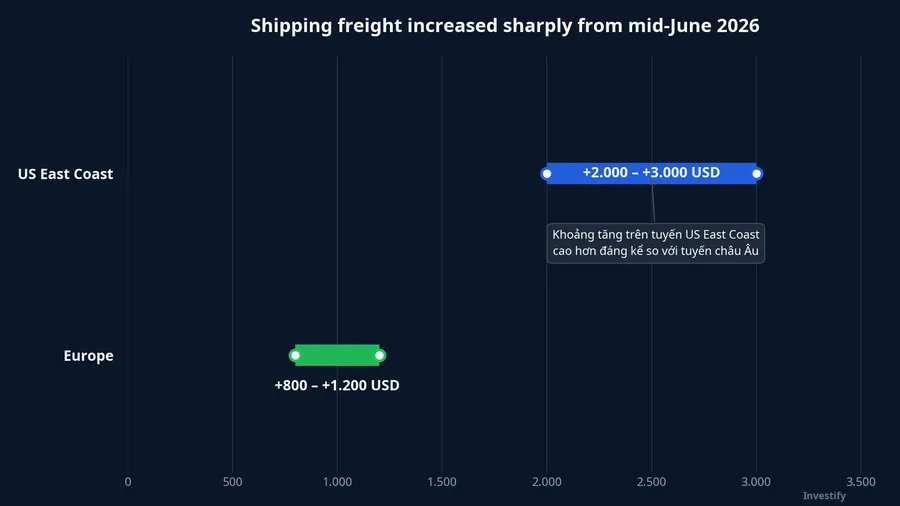
Those are cost increases, not total freight rates. Nor do they immediately tell us how much any particular company will lose in profit. The deciding factor is pass-through: a company with more processed products, a stronger brand or price-adjustment clauses may have more room to protect margins. A supplier of less differentiated products that locked in prices early may need to absorb part of the increase instead.
The same freight shock will not therefore produce the same result at every company. Raw-material prices, product mix, exchange rates, import duties and technical trade barriers also affect margins. If gross margin falls, it is too early to blame shipping alone. Expense notes and management commentary are the better places to distinguish freight pressure from other drivers.
A delayed shipment can lock up cash for longer
The less visible risk is time. When vessel space is scarce, schedules change or journeys become longer, finished goods may spend extra time in cold storage, at port or at sea. Revenue recognition depends on when control of the goods passes under each contract. As a result, the same delay may increase period-end inventory at one company but extend receivables at another.
That is where the cash conversion cycle is useful. It measures the period between paying for materials and collecting cash from customers. A longer cycle means the company must finance raw materials, processing, cold storage, insurance and cargo in transit for longer. If short-term borrowing fills that gap, interest expense can become a second layer of pressure after freight costs.
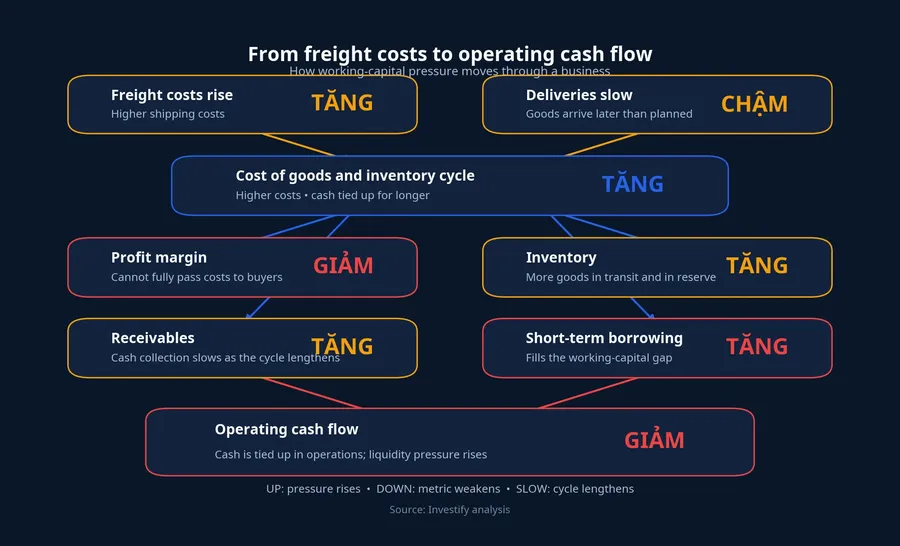
A healthy pattern is revenue growth alongside stable gross margin, no unusual extension in inventory or receivable days, and operating cash flow that does not fall far behind net profit. The opposite deserves closer reading: revenue rising while inventory, receivables and short-term debt all grow quickly can indicate growth that consumes more capital. These indicators still need to be read against each company's procurement seasonality, as seafood processors often buy raw materials before their export period.
Dependence on shipping lines narrows the options
Nguyễn Hoài Nam said the seafood industry is highly dependent on foreign shipping lines and proposed developing domestic container and refrigerated-container fleets.FILI That does not mean carriers set every freight rate at will. Vessel supply, cargo demand, fuel, insurance and maritime security also matter. But fewer alternatives make it harder for exporters to respond quickly when schedules or surcharges change.
The cold chain makes this stricter than it is for dry cargo. Switching routes can lengthen transit times; switching carriers may not secure space at the needed moment; and air freight is generally unsuitable for large shipments with a modest value per kilogram. Companies can split orders among several lines, negotiate freight-adjustment clauses or build in more schedule buffer. Each choice comes with a trade-off, since a larger buffer can also keep capital tied up for longer.
High freight rates do not lift every port or shipping stock
It is tempting to assume that higher ocean freight benefits every port and shipping company. That shortcut is too broad because businesses earn money at different points in the chain. Ports mainly earn from handling, storage and port services. Their results depend heavily on throughput, tariff schedules, capacity and route mix, rather than directly capturing all of the freight on an international voyage.
Domestic transporters and freight consolidators benefit only if higher volumes and service prices are enough to cover fuel, chartering and finance costs. Operators on international routes have more direct exposure to ocean freight, but their results also depend on owned versus chartered vessels, contract length and how much capacity was committed earlier. The available evidence is not enough to treat a broad move in freight rates as the sole cause of any individual stock's performance.

Rather than reasoning from the sector label, investors can begin with the actual source of revenue. For a port, examine throughput, capacity and ancillary services. For a carrier, examine routes, charter exposure, contract terms, fuel and finance costs. The same freight movement can produce entirely different outcomes for two businesses with different operating models.
A compact framework for the next quarterly report
When an exporter reports higher revenue, set that number beside gross margin and selling expenses. Then check how inventory, trade receivables, short-term borrowing and operating cash flow are moving. If management discusses freight, the key question is whether customers absorb the cost, contracts adjust it, or the company must bear it itself.
Export turnover of approximately USD 6.7 billion in seven months confirms that overseas orders are improving.FILI For shareholders, though, the more important question is whether that growth remains in the margin and turns into cash. The next quarterly reports should provide a clearer answer through gross margin, working-capital and cash-flow data, rather than through revenue alone.